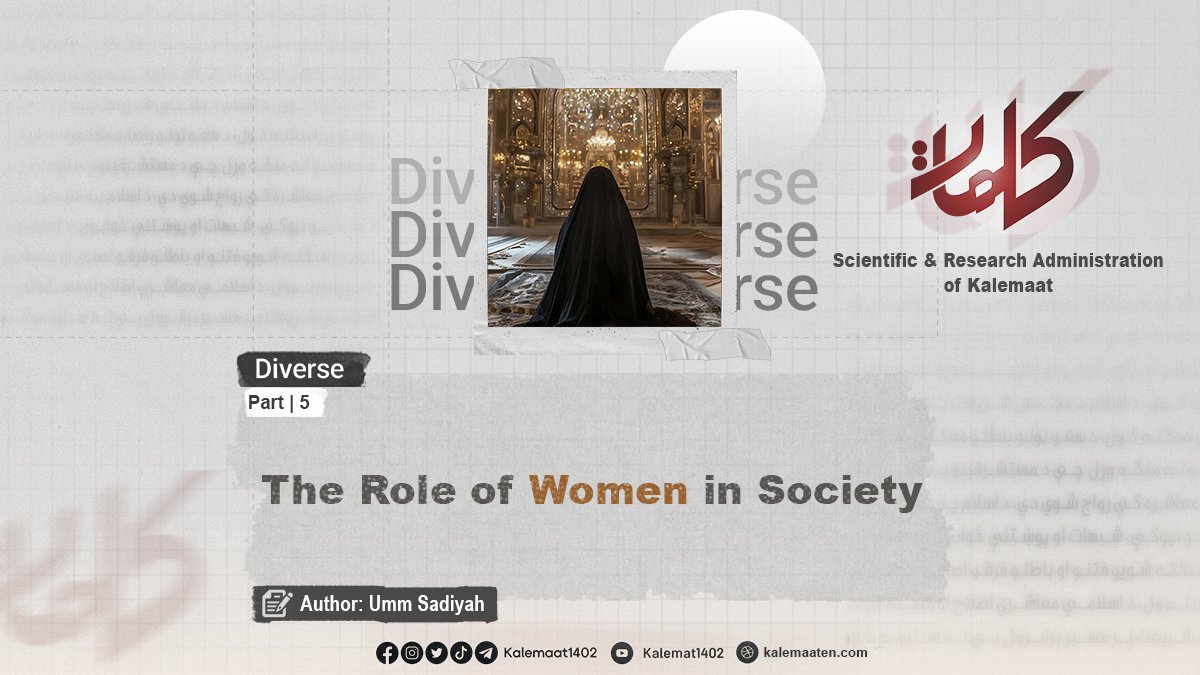
Safeguarding public chastity is a responsibility shared by both men and women: men through personal and social protective zeal (Honor), and women through modesty and dignity (Haya). A Muslim woman, by behaving appropriately and respectfully, paves the way for chastity to spread in society. The essence of hijab lies in self-control and dignity. If one limits it to merely external covering, without cultivating piety in behavior, then hijab becomes a lifeless shell, ineffective and devoid of its intended spiritual impact.
Islam, as the final and most complete divine religion revealed by the All-Knowing Allah for all of humanity, regards clothing as a divine gift and has commanded women’s covering with moderation and harmony. It steers clear of distortions, extremes, and excesses regarding women’s dress, and sets boundaries that align with human instincts. Islamic hijab avoids harmful negligence and unnecessary harshness. Contrary to Western portrayals, hijab does not mean confining women to the home or veiling them from society—it means that in interactions with non-mahram men, a woman covers her hair and body and refrains from flaunting or attracting attention.
Given the powerful nature of sexual instinct, Islamic rulings aim to moderate, guide, and fulfill this instinct in a legitimate way.
The term hijab means both “to cover” and “barrier” or “Curtain,” though it is more commonly used in the latter sense. It conveys the idea of covering because a curtain serves as a barrier. However, not every type of covering is technically hijab—only that which conceals from behind a barrier qualifies as such.
The use of the word hijab for women’s covering is relatively recent. In the past, particularly in Islamic jurisprudence, the term satr (covering) was used. It would have been better if this term had remained in use, as hijab commonly implies a physical screen. This has led many to believe that Islam seeks to keep women confined and hidden behind veils at all times, which is a misunderstanding.
When a Muslim woman herself observes hijab, she becomes a role model for women in other societies. A daughter mimics her mother’s every move. So, if a mother seriously adheres to hijab and conducts herself according to Islamic principles, she will raise a well-bred daughter, a complete lady, who will bring joy to her in this world and honor her in the Hereafter.
It is valuable to write and speak about hijab so that those unaware of its truth can understand its ruling, wisdom, and significance.
The Ruling of Hijab in the Qur’an and Its Philosophy
To examine the origins of hijab, we must turn to human nature. Hijab was ingrained in the very essence of human creation. By nature, a person wishes to protect themselves from external harm. Though Islam has defined boundaries for hijab, the practice of covering predates Islam and is found in earlier religious traditions. From the beginning, humans have covered themselves and felt shame when undressed. This is evident in the story of Adam and Eve’s disobedience in Paradise and their attempt to cover themselves after eating from the forbidden tree: (فَدَلَّهُمَا بِغُرُورٍ فَلَمَّا ذَاقَا الشَّجَرَةَ بَدَتْ لَهُمَا سَوْءَتُهُمَا وَطَفِقَا يَخْصِفَانِ عَلَيْهِمَا مِن وَرَقِ الْجَنَّةِ وَنَادَاهُمَا رَبُّهُمَا أَلَمْ أَنْهَكُمَا عَن تِلْكُمَا الشَّجَرَةِ وَأَقُل لَكُمَا إِنَّ الشَّيْطَانَ لَكُمَا عَدُوٌّ مُّبِينٌ) Translation: “Then he (Satan) lured them with deception. And when they tasted of the tree, their shame became apparent to them, and they began to cover themselves with leaves of Paradise. Their Lord called out to them, ‘Did I not forbid you from that tree and tell you that Satan is a sworn enemy to you?’” (Surah Al-A‘raf: 22)
It was Satan’s whispers that led them to uncover themselves. Hence, the culture of nudity stems from Satan, leading to divine displeasure and deprivation of God’s mercy. Humanity began with covering, as shown in their state in Paradise: (إِنَّ لَكَ أَلَّا تَجُوعَ فِيهَا وَلَا تَعْرَى * وَأَنَّكَ لَا تَظْمَؤُا فِيهَا وَلَا تَضْحَى) Translation: “Indeed, you will neither go hungry therein nor be unclothed. And you will not suffer from thirst or the sun’s heat.” (Surah Taha: 118–119)
The necessity of a woman’s modesty before men is a core Islamic principle also emphasized in the Qur’an. Hijab existed before Islam, among Jews, Hindus, Iranians, and others. Islam merely outlined its boundaries. Thus, according to the Qur’an and Hadith, hijab is an obligatory act (Farz). Allah says: (يَـٰٓأَيُّهَا ٱلنَّبِيُّ قُل لِّأَزْوَٰجِكَ وَبَنَاتِكَ وَنِسَآءِ ٱلْمُؤْمِنِينَ يُدْنِينَ عَلَيْهِنَّ مِن جَلَـٰبِيبِهِنَّۚ ذَٰلِكَ أَدْنَىٰٓ أَن يُعْرَفْنَ فَلَا يُؤْذَيْنَۗ وَكَانَ ٱللَّهُ غَفُورًا رَّحِيمًا) Translation: “O Prophet! Tell your wives and your daughters and the women of the believers to draw their cloaks over themselves. That is better so that they may be recognized and not harassed. And Allah is All-Forgiving, Most Merciful.” (Surah Al-Ahzab: 59)
Hence, wearing hijab is a sign of faith, as the verse specifically addresses believing women. This highlights the value Allah places upon them, intending to shield them from harm. The Qur’an views the woman as a trustee of divine honor, granted status, dignity, and respect by Allah Himself. And any society governed by the Qur’an will reflect this divine order.
But today, many people have forgotten the sovereignty of Allah and His Book, falling prey to Satan’s deception. Have they truly pondered the words of the verse above? Was it meant only for the Prophet’s wives and daughters? Who are “the women of the believers” (نساء المؤمنين)?
Ayesha, the mother of the Believers, said: “May Allah have mercy on the women of the Ansar. When the verse [33:59] was revealed, they tore pieces of their garments and covered their heads with them and prayed behind the Prophet (peace be upon him) as though crows were perched on their heads.”
So who are the believers? They are those who worship the One God with sincerity. Hijab is a divine ornament bestowed by Allah upon the wives, daughters, and women of the believers. Anyone who reflects deeply will realize that this verse applies to all Muslim women, not just the Prophet’s household or his companions.
So, dear sister, awaken your heart and respond to the call of Allah and His Messenger. Let your mind turn fully toward implementing it. Aren’t you and I both servants of Allah and followers of His Messenger? Have you not heard that the Prophet, until his final breath, said: “My Ummah, my Ummah”?
If we truly believe this statement, we’ll understand how precious we were to him—that even in his final moments, he worried for us. But how do we, his Muslim sisters, respond to this love? How do we show our gratitude for his sacrifices? How can we claim to worship Allah while rejecting the very command He gives us to wear hijab, saying instead that it is backward or imprisonment?
How can we claim to be loyal servants while dismissing His words as outdated? What kind of progress is this, where the commands of Allah are rejected and hijab is replaced with immodesty?


 By
By