Close Menu
    Facebook X (Twitter) Telegram WhatsApp
    • Language
      • دری
      • پښتو
      • العربیة
    • Home
    • Analysis
    • Islam
      • Prophet of Islam (PBUH)
      • Holy Quran
      • Muslim
      • Belief
      • Faith
      • Worships
      • Fiqh
      • Jihad
      • Islamic Perspectives
      • Islamic Economics
      • Islamic Management
      • Islamic Culture
      • Sufism
      • Crimes
      • Prohibitions
      • Sayings of the Scholars
      • Muhajir Tafsir
      • Hadith
    • Religions
      • Judaism
      • Christianity
      • Buddhism
      • Hinduism
      • Zoroastrianism
      • Satanism
      • Confucianism
      • Sikhism
    • Theories
      • Atheism
      • Secularism
      • liberalism
      • Socialism
      • Communism
      • Democracy
      • Federalism
      • Fascism
      • Capitalism
      • Marxism
      • Feminism
      • Nationalism
      • Colonialism
      • Frankfurt School
      • Freemasonry
      • Humanism
    • Fitan
      • Mu’tazila
      • Murji’ah
      • Jahmiyyah
      • The Fitna of the Khawarij
      • The Fitna of the Rawafid
      • The Fitna of Orientalism
      • Ghamdism
      • The Fitna of the Qadianis
      • Qadariyyah
      • Karramiyyah
    • Ummah
      • Sahabah (Companions of the Prophet ﷺ)
        • Hazrat Abu bakr Siddiq (RA)
        • Hazrat Umar al-Faruq (RA)
        • Hazrat Uthman ibn Affan (RA)
        • Hazrat Ali (RA)
        • Hazrat Khalid ibn al-Walid (RA)
        • Hazrat Fayruz al-Daylami (RA)
        • Hazrat Abdullah ibn al-Zubayr (RA)
      • Ummahat al-Mu’minin
      • Islamic scholars
        • Allamah Sayyid Abul Hasan Ali Nadwi (RH)
        • Imam al-Aʿzam Abu Hanifa (RH)
        • Imam al-Bukhari (RH)
        • Imam al-Tirmidhi (RH)
        • Imam al-Ghazali (RH)
        • Shah Waliullah al-Dehlawi (RH)
        • Sayyid Jamal al-Din Afghani
        • Mawlana Jalal al-Din Muhammad Balkhi Rumi (RH)
      • Muslim Rulers
        • Sultan Salahuddin Ayyubi (RH)
        • Umar ibn Abd al-Aziz (RH)
        • Sultan Yusuf ibn Tashfin (RH)
      • Muslim Scientists
    • Civilizations
      • Islamic Civilization
      • Eastern and Western Civilizations
      • Traces of History
    • Diverse
      • Ramadan Message
      • Reports
      • Light and Darkness
    • library
    Facebook X (Twitter) Telegram WhatsApp Instagram Pinterest YouTube
    kalemaat Englishkalemaat English
    You are at:Home»Religions»Sikhism: Its Origin and Fundamental Beliefs (Part One)
    Religions

    Sikhism: Its Origin and Fundamental Beliefs (Part One)

    By 03/05/2025Updated:04/05/2025No Comments4 Mins Read
    Share Facebook Twitter Telegram WhatsApp
    Share
    Facebook Twitter Telegram Email WhatsApp
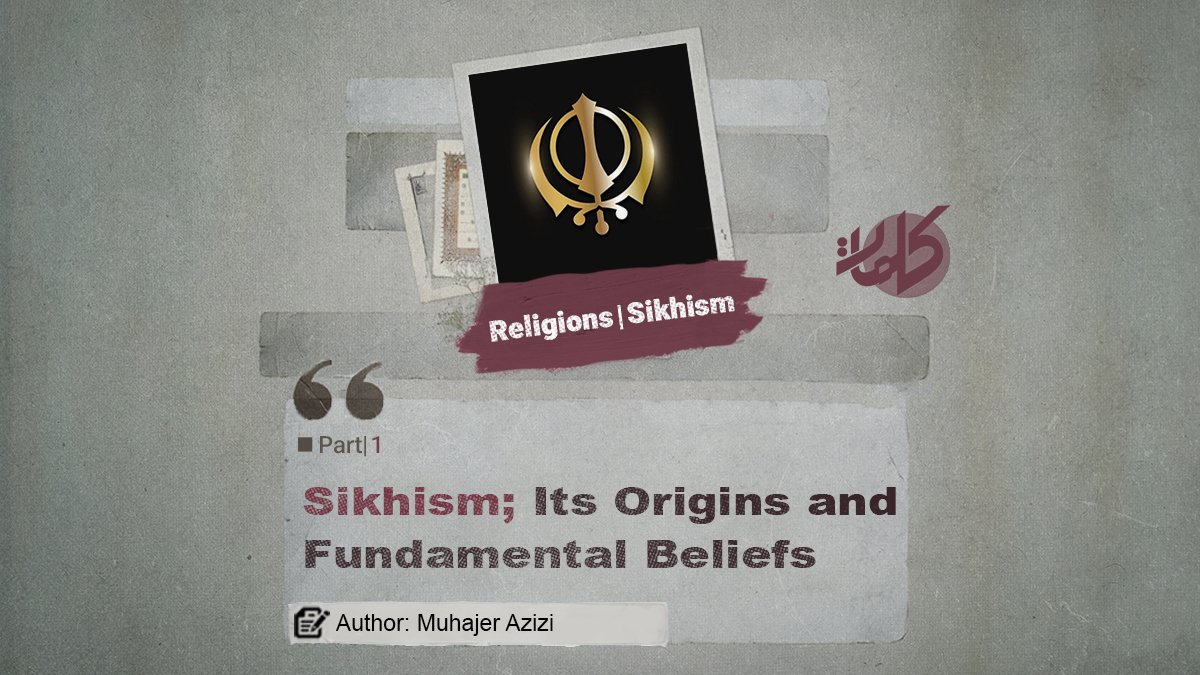
    Author: Mohajer Azizi
    Sikhism: Its Origin and Fundamental Beliefs (Part One)
    Abstract
    Sikhism is one of the world’s emerging religions, founded in the 15th century by Guru Nanak in the Indian subcontinent. This faith was influenced by the teachings of both Islam and Hinduism; however, its followers emphasize the independence and uniqueness of its doctrines. Guru Nanak laid the foundations of this faith with a message of unity, monotheism, and a rejection of religious and class discrimination.
    The prominent features of Sikhism include a focus on individual and social ethics, avoidance of practices such as cutting hair, using drugs, and lying, and striving to create a society based on honesty and justice. This religion combines mystical elements of Islam with concepts such as karma and reincarnation from Hinduism but has developed its own distinct structure and teachings.
    The etymology of the word “Sikh” indicates that it means “student” or “disciple,” referring to the followers of Guru Nanak’s teachings and those of his successors. Sikhism, as a new way to guide humanity, has found a unique place among contemporary religions. Despite being influenced by other faiths, it has maintained its independent identity.
    Keywords: Sikhism, Guru Nanak, emerging religions, comparative theology, mysticism in India.
    Introduction
    Sikhism emerged around five centuries ago in the social, cultural, and religious context of the Indian subcontinent. Founded by Guru Nanak in the 15th century, it gradually developed into an independent system of beliefs, ethics, and social organization. Sikhism has been shaped in various ways by the previous religions prevalent in the region, especially Islam and Hinduism, as many of its teachings, rituals, and structures reflect elements of these two faiths. However, followers of Sikhism emphasize the complete independence of their religion and believe that its principles and teachings were divinely inspired in the heart of Guru Nanak, rather than being derived from earlier faiths.
    From the perspective of non-Sikhs, Sikhism is often viewed as a combination of Hinduism and Islam or, as some suggest, a branch of Hinduism. However, this perspective is rejected by Sikhs, who consider their religion a new way of guiding and liberating humanity, one that has carved out a distinct role among contemporary religions with its unique moral, mystical, and spiritual teachings.
    One of the remarkable features of Sikhism is its strong emphasis on individual and social ethics. The religion strictly prohibits practices such as cutting hair, using drugs, lying, backbiting, and blindly following religious customs. These rules reflect a rigorous, yet human-centered moral system designed to purify the soul and build a society founded on honesty, purity, and justice.
    This article aims to examine Sikhism from a historical, doctrinal, social, and cultural perspective, utilizing library and available sources to present a comprehensive picture of this relatively new religion.
    Etymology of the Word “Sikh”
    The word “Sikh” means “student” or “disciple,” deriving from the Punjabi word “sikhna.” This term appears in the holy scripture of Sikhism, the Guru Granth Sahib, in forms such as “Sikh” and “Sikhya,” meaning “teachings of the Guru,” and as “Guru Sikhe” and “Satgur Sikhe,” meaning “follower of the Guru.”
    For example:
    – ستگور ساچی سیکه سنائی
    Translation: “The only true Guru expresses the true teachings.”
    – سیکهیا دیکهیا بهوجن بهاوو
    Translation: “Love of God is my teaching, preaching, and sustenance.”
    – ستگور سیکه کی کری پرتپال
    Translation: “The true Guru honors his followers.”
    In this context, “Sikh” refers to those who follow the teachings of Guru Nanak and his descendants, making these teachings and principles the model for their path. Thus, the followers and disciples of the seekers and leaders of this faith are referred to as “Sikhs.”

    Continues…

    Next Part

    Islam Polytheism Religions Sikhism

    Related Posts

    Kindness to Parents

    18/10/2026

    Serving One’s Parents

    15/10/2026

    Prohibited Oaths

    14/10/2026
    Leave A Reply Cancel Reply

    Follow us on the social media pages
    • Facebook
    • Twitter
    • Instagram
    • Telegram
    • WhatsApp
    Don’t miss

    Kindness to Parents

    The Divine Education Model in the Family of the Prophets (Part 142)

    The Smallness of a Sin

    Remembering Death

    About Us:

    The Academic and Research Organization of Kalemaat is an independent Islamic Da'wah organization affiliated with Ahl al-Sunnah wa al-Jama'ah. It is dedicated to promoting the authentic values of Islam, advancing the higher objectives of the Sharia, countering Western cultural influence, upholding the Word of Allah, and contributing to the intellectual and spiritual awakening of the Muslim Ummah.

    The Organization is supported by Muslim philanthropists and businessmen, and it welcomes the cooperation and support of Muslims worldwide in advancing its mission.

    Famous publications

    Kindness to Parents

    18/10/2026

    The Divine Education Model in the Family of the Prophets (Part 142)

    17/10/2026
    Follow us on social medias
    • Facebook
    • Twitter
    • YouTube
    • Telegram
    • Instagram
    • WhatsApp
    All right reserved by (kalemaat)
    • Home
    • Analysis of the day
    • The greats of the Ummah
    • library

    Type above and press Enter to search. Press Esc to cancel.