Author: Dr. Noor Mohammad Mohibi
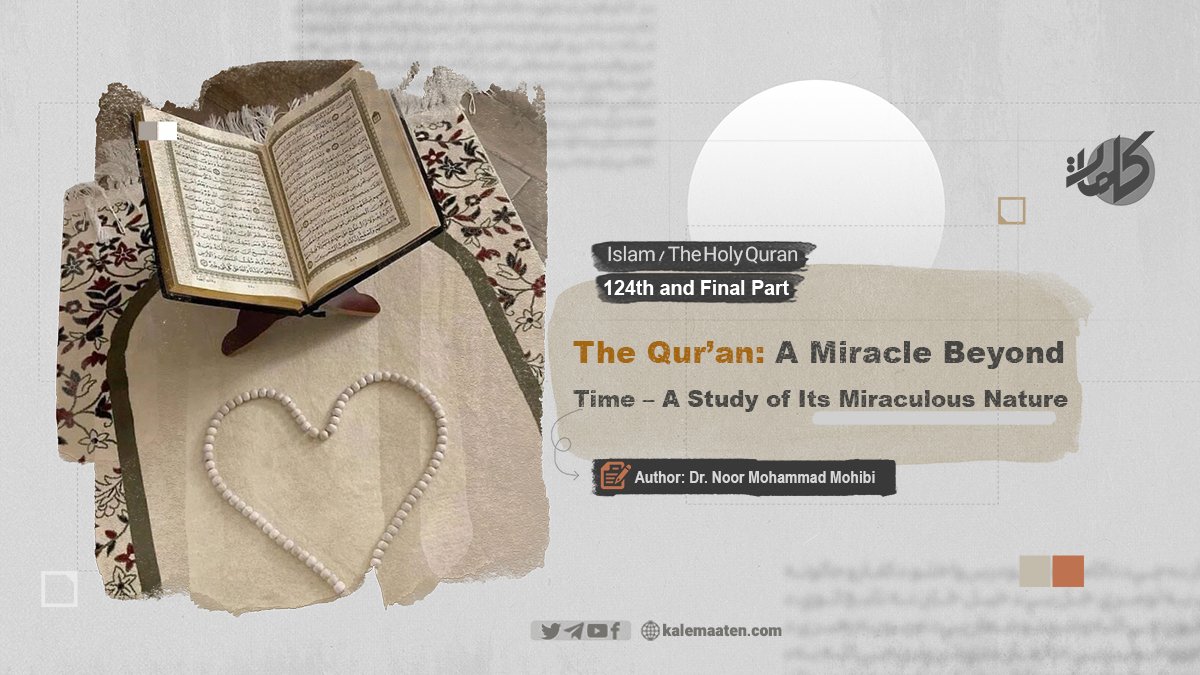
The Quran: A Miracle Beyond Time—A Study of Its Miraculous Nature (the 124th and final part)
Conclusion and Final Remarks
In this work, I‘jaz (the miraculous nature of divine revelation) was examined as a bridge between revelation and reason and between faith and experience through a systematic and multidimensional approach. The discussion began with a precise definition of “miracle” and an explanation of its pillars and conditions. It then proceeded to distinguish clearly between miracle (mu‘jizah), saintly miracle (karamah), and magic (sihr), thereby establishing a conceptual framework through which the Qur’anic miracles of the Prophets (peace be upon them) gained greater coherence and meaning. The various classifications of miracles—based on subject matter, audience perception, duration of effect, and field of specialization—demonstrated that I‘jaz is not merely a limited supernatural phenomenon, but rather a divinely guided system that manifests itself according to the intellectual and historical needs of humanity.
The study then turned to the miracles of the Prophet of Islam (PBUH), especially the Noble Qur’an, which opened a new horizon of understanding. The Qur’an is a living and everlasting miracle that has challenged humanity throughout history and continues to remain unanswered. The analysis of the concept of Tahaddi (challenge), its stages, and the reactions of pre-Islamic Arab society, supported by historical testimony, established that the inability to produce anything comparable to the Qur’an was not due to external circumstances but rather stemmed from its superhuman nature. An examination of the perspectives of various Islamic schools further showed that although scholars differed regarding the specific aspect of the Qur’an’s miraculousness, there remains broad agreement concerning the reality of its miraculous nature itself.
A substantial portion of the book was devoted to the linguistic, rhetorical, and stylistic miracle of the Qur’an. Here, careful reflection upon the selection of words, the astonishing harmony between wording and meaning, the avoidance of purposeless repetition, and the multilayered semantic structures revealed aspects of miraculousness that transcend human linguistic capability. Case studies—including the analysis of terms related to death and the precise usage of the word “tawaffa”—demonstrated that every word in the Qur’an occupies an irreplaceable position. Furthermore, the study of Qur’anic eloquence, rhetoric, and style clarified that the Qur’an fits neither the structure of poetry nor conventional prose; rather, it established a unique and independent style unparalleled in human expression.
In the section on legislative miraculousness, the Qur’an was presented as a comprehensive system for regulating both individual and social life—a system fully harmonious with human nature and continuously effective throughout time. Comparisons with contemporary human legal systems highlighted the dynamism, balance, and comprehensiveness of Qur’anic legislation.
In the section on scientific miraculousness, while observing proper scientific methodology and caution in interpretation, various manifestations of harmony between the Qur’an and established scientific discoveries were explored. These included references to the creation of the universe, astronomical systems, the complex structure of the human body, embryology, biological systems, and the wonders of nature, water, plants, and animals.
These studies demonstrated that the Qur’an is not a textbook of experimental sciences; rather, it contains precise and guiding indications whose dimensions become increasingly apparent with scientific advancement. At the same time, it was emphasized that scientific miraculousness remains valid only when one avoids hasty interpretations or imposing temporary scientific theories upon the Qur’anic text.
The examination of the intricate systems of the human body—from the brain and heart to the immune and hormonal systems—alongside natural systems such as the seas, the earth’s atmosphere, and galaxies, presented a comprehensive picture of balance and wisdom within creation. Likewise, the study of plants, animals, and their nutritional and medicinal properties highlighted the profound connection between divine guidance and human well-being.
Ultimately, this book demonstrated that the miraculous nature of the Qur’an consists of interconnected dimensions: linguistic, legislative, scientific, and guidance-oriented. None of these dimensions alone encompass the entire reality of I‘jaz; rather, together they present a more complete image of this divine phenomenon.
Final Conclusion
The miraculous nature of the Qur’an is not merely for proving prophethood in the past but also for guiding humanity in the present and future. Through its repeated calls to reflection, reasoning, and observation, the Qur’an invites humanity to an intellectual journey in which knowledge and faith are not in conflict but in mutual completion. As human knowledge expands, new horizons for understanding the miraculous nature of the Qur’an continue to unfold—without this heavenly Book ever being confined to any particular theory.
Therefore, the central message of this work is that the miraculous nature of the Qur’an is a perpetual invitation to knowledge, faith, and responsibility: knowledge that leads to deeper faith and faith that drives human beings toward righteous action and the cultivation of the earth. In this way, the Qur’an is not only a book of guidance but also a charter for balanced human life—a life in which intellect, heart, and action exist in complete harmony.
In light of all that has been discussed, it becomes clear that the miraculous nature of the Qur’an is a living, dynamic, and inexhaustible reality. Every generation benefits from this boundless ocean according to its intellectual and spiritual capacity, yet no generation can ever fully encompass it. This characteristic itself stands as another testimony to the divine origin of the Qur’an.
It is hoped that this work may serve, however modestly, as a step toward deepening the understanding of the miraculous nature of the Qur’an and strengthening the relationship between knowledge and faith, while encouraging readers to reflect more deeply upon the divine verses and apply their guidance practically in life. For ultimately, the purpose of recognizing the miraculous nature of the Qur’an is not mere awareness but transformation in thought, behavior, and the course of human life.
References
- Abu Dawud, Sulayman ibn al-Ash‘ath. Sunan Abi Dawud. Edited by Shu‘ayb al-Arna’ut. Beirut: Dar al-Risalah al-‘Alamiyyah, 1430 AH / 2009 CE.
- Ibrahim, Muhammad Isma‘il. Al-I‘jaz al-Tashri‘i fi al-Qur’an. Translated by ‘Abd al-Latif.
- Ibn al-Jawzi, ‘Abd al-Rahman ibn ‘Ali. Zad al-Masir fi ‘Ilm al-Tafsir. Edited by ‘Abd al-Razzaq al-Mahdi. Beirut: Dar al-Kitab al-‘Arabi, 1st ed., 1422 AH.
- Ibn Hajar al-‘Asqalani, Ahmad ibn ‘Ali. Fath al-Bari bi Sharh Sahih al-Bukhari. Egypt: al-Maktabah al-Salafiyyah, 1380–1390 AH.
- Ibn Sina, al-Husayn ibn ‘Abd Allah. Al-Qanun fi al-Tibb. Commentary by Muhammad Amin al-Dinnawi.
- Ibn Qayyim al-Jawziyyah, Muhammad ibn Abi Bakr. Zad al-Ma‘ad fi Hady Khayr al-‘Ibad. Riyadh/Beirut: Dar ‘Ata’at al-‘Ilm & Dar Ibn Hazm, 3rd ed., 1440 AH / 2019 CE.
- Ibn Majah, Muhammad ibn Yazid al-Qazwini. Sunan Ibn Majah. Edited by Muhammad Fu’ad ‘Abd al-Baqi. Cairo: Dar Ihya’ al-Kutub al-‘Arabiyyah.
- Al-Bukhari, Muhammad ibn Isma‘il. Sahih al-Bukhari. Edited by Mustafa Dib al-Bugha. Damascus: Dar Ibn Kathir & Dar al-Yamamah, 5th ed., 1993 CE.
- Al-Bayhaqi, Ahmad ibn al-Husayn. Al-Sunan al-Kubra. Edited by ‘Abd Allah ibn ‘Abd al-Muhsin al-Turki. Cairo: Markaz Hajr, 1st ed., 1432 AH / 2011 CE.
- Al-Bayhaqi, Ahmad ibn al-Husayn. Dala’il al-Nubuwwah wa Ma‘rifat Ahwal Sahib al-Shari‘ah. Edited by ‘Abd al-Mu‘ti Qal‘aji. Beirut: Dar al-Kutub al-‘Ilmiyyah & Dar al-Rayyan, 1st ed., 1408 AH / 1988 CE.
- Al-Tirmidhi, Muhammad ibn ‘Isa. Al-Sunan. Edited by Ahmad Muhammad Shakir and others. Egypt: Matba‘at Mustafa al-Babi al-Halabi, 2nd ed., 1395 AH / 1975 CE.
- Al-Taftazani, Sa‘d al-Din Mas‘ud ibn ‘Umar. Sharh al-Maqasid fi ‘Ilm al-Kalam. Pakistan: Dar al-Ma‘arif al-Nu‘maniyyah, 1401 AH / 1981 CE.
- Al-Jurjani, ‘Abd al-Qahir ibn ‘Abd al-Rahman. Dala’il al-I‘jaz fi ‘Ilm al-Ma‘ani. Edited by ‘Abd al-Hamid Hindawi. Beirut: Dar al-Kutub al-‘Ilmiyyah, 1st ed., 1422 AH / 2001 CE.
- Al-Madinah International University. Scientific Miracles in the Noble Qur’an. Master’s Program.
- Al-Madinah International University. Linguistic Miracles in the Noble Qur’an. Bachelor’s Program.
- Al-Hakim al-Naysaburi, Muhammad ibn ‘Abd Allah. Al-Mustadrak ‘ala al-Sahihayn. Edited by the Sunnah Service Office Team. Syria: Dar al-Minhaj al-Qawim, 1st ed., 1439 AH / 2018 CE.
- Al-Khattabi, Hamd ibn Muhammad. Bayan I‘jaz al-Qur’an. Included in: Three Treatises on the Miraculous Nature of the Qur’an. Egypt: Dar al-Ma‘arif, 3rd ed., 1976 CE.
- Al-Daraqutni, ‘Ali ibn ‘Umar. Sunan al-Daraqutni. Edited by Shu‘ayb al-Arna’ut and others. Beirut: Mu’assasat al-Risalah, 1st ed., 1424 AH / 2004 CE.
- Al-Darimi, ‘Abd Allah ibn ‘Abd al-Rahman. Sunan al-Darimi. Edited by Husayn Salim Asad. Saudi Arabia: Dar al-Mughni, 1st ed., 1412 AH / 2000 CE.
- Al-Razi, Fakhr al-Din Muhammad ibn ‘Umar. Mafatih al-Ghayb (Al-Tafsir al-Kabir). Beirut: Dar Ihya’ al-Turath al-‘Arabi, 3rd ed., 1420 AH.



