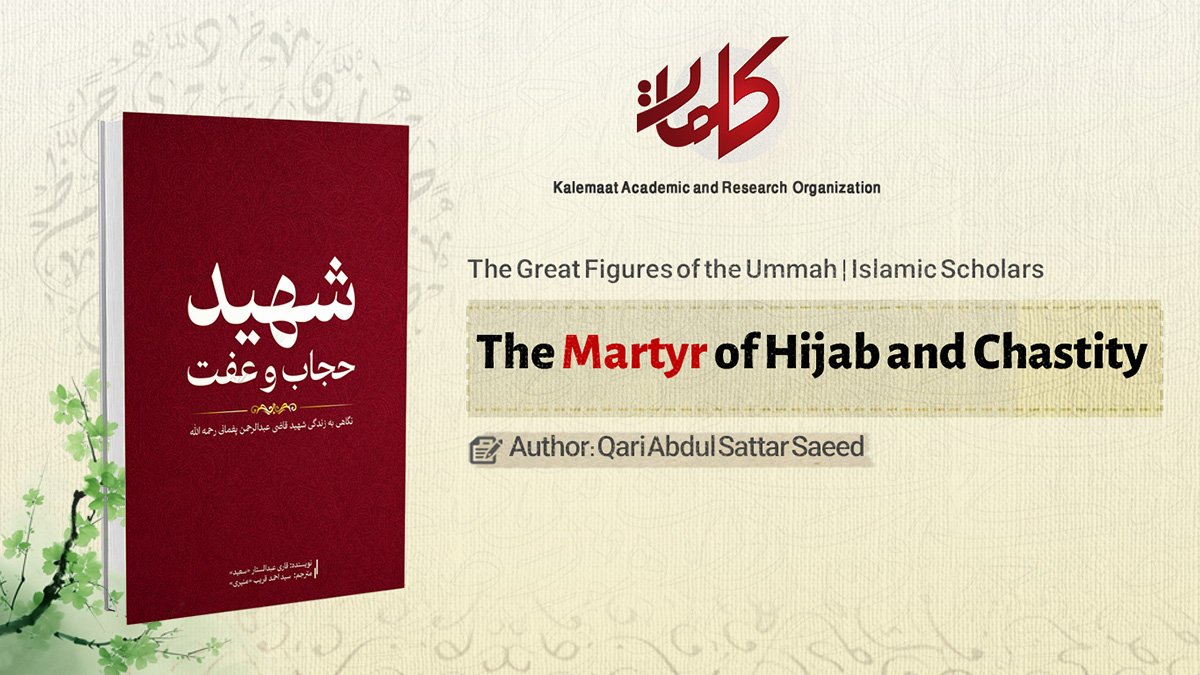
A Glimpse into the Life of the Martyred Qazi Abdul Rahman Paghmani
Connection with Sufism and the Spiritual Path
Qazi Abdul Rahman was not merely a jurist and scholar of religious sciences; he also held a recognized position in the field of Sufism and spiritual discipline. He had pledged allegiance (bay‘ah) to Hazrat Ghulam Qayyum Mujaddidi, the spiritual leader of the Naqshbandi-Mujaddidi Khanqah of Shor Bazaar in Kabul. At the instruction of his spiritual guide, during the years when he was engaged in scholarly and administrative duties in Kabul, he resided at the Shor Bazaar Khanqah. The sons of Hazrat Ghulam Qayyum Mujaddidi were also among his students. After the death of Hazrat Ghulam Qayyum Mujaddidi, Qazi Abdul Rahman renewed his pledge of allegiance with his eldest son, Hazrat Shams al-Mashaikh Fazl Muhammad Mujaddidi, and, following his death, with Hazrat Nur al-Mashaikh Fazl Umar Mujaddidi. In fact, both of these figures had been among Qazi Sahib’s students in the field of religious sciences. Nevertheless, this demonstrated Qazi Abdul Rahman’s scholarly humility and reformist spirit, as he also sought spiritual benefit from his own students.
Hazrat Muhammad Sadiq Mujaddidi states in this regard that Qazi Abdul Rahman maintained such close and cordial relations with the Mujaddidi family that very few among the followers and close associates of the family enjoyed a level of trust and confidence comparable to his. In return, Qazi Sahib showed the utmost sincerity, affection, and respect towards the Mujaddidi family and treated their children with compassion and kindness. Clear examples of this close relationship became particularly evident later during the journey to Paktia and in his interaction with the son of Hazrat Shams al-Mashaikh, Masoom Mujaddidi.
Participation in Jihad
In the early years of Amanullah Khan’s reign, when jihad against British colonialism was declared, the leadership of the popular jihad forces in the Southern Region (Paktia) was entrusted to Hazrat Shams al-Mashaikh Fazl Muhammad Mujaddidi and Hazrat Nur al-Mashaikh Fazl Umar Mujaddidi. Qazi Abdul Rahman, who had resigned from his judicial position after the beginning of Amanullah Khan’s reign, accompanied these distinguished figures on this jihad expedition. He joined the ranks of the Mujahideen and actively participated in their activities.
Responsibilities under the Government of Amanullah Khan
As mentioned earlier, Qazi Abdul Rahman resigned from his judicial position at the beginning of Amanullah Khan’s rule. He consistently held critical views regarding Amanullah Khan’s policies and believed that his ideas and programs showed no genuine intention for reform. According to him, Amanullah Khan had no inclination to implement and promote Islamic Sharia; therefore, he was unwilling to cooperate officially with his government. Nevertheless, continued government pressure eventually compelled him to accept responsibility for the Kabul Court of Appeals. On another occasion, he also headed a delegation appointed to examine and inspect the courts in the western region of the country. In carrying out these judicial duties, he demonstrated the utmost integrity and precision; however, he did not conceal his ideological differences with Amanullah Khan. Qazi Abdul Rahman openly stated that Amanullah Khan was seeking to undermine the foundations of the sacred Islamic Sharia, while remaining unaware of the fact that the protection of Allah’s religion rests with the Almighty Himself.
In 1342 AH, when his spiritual guide, Hazrat Shams al-Mashaikh Fazl Muhammad Mujaddidi, set out for the Two Holy Sanctuaries to perform the Hajj pilgrimage, Qazi Abdul Rahman also obtained permission to travel from Amanullah Khan and departed for Hajj for the second time. He joined his spiritual guide in the Two Holy Sanctuaries and performed the Hajj rituals alongside him.
The Secular Measures of Amanullah Khan and the Uprising of Mullah Abdullah
After coming to power, Amanullah Khan embarked on a series of measures and programs that were unprecedented in many respects in the history of Afghanistan’s politics and system of governance. These developments took place at a time when the Westernization of Muslim societies, under the banner of “modernization and progress,” had begun in several major countries of the Islamic world, including Turkey, Egypt, and Iran. Amanullah Khan, too, did not wish to lag behind this movement. In fact, the foundations for this intellectual transformation had been laid several years before he came to power.
In 1323 AH, Mahmoud Tarzi returned from Syria, bringing with him new ideas and perspectives to Afghanistan. Some of these ideas were beneficial, such as striving to achieve complete political independence from Britain; recognizing the need to formulate laws for the state; promoting modern sciences; encouraging people to work diligently and maintain order in various aspects of life; raising public awareness of world affairs through the press; bringing Afghanistan into line with contemporary developments; and pursuing other useful objectives. Alongside these, however, some of his ideas, particularly those concerning intellectual, cultural, and moral matters, were inspired by modern Western civilization and were incompatible with the religious beliefs and national identity of Afghan society. In some cases, they even stood in direct conflict and contradiction with them.
During the final years of Amir Habibullah Khan’s reign, Mahmoud Tarzi had become not only an influential intellectual figure in society but had also gained considerable influence at the royal court. His influence extended to the point that he married two of his daughters to two of Amir Habibullah Khan’s sons. Among them, Prince Amanullah Khan was more deeply influenced by Mahmoud Tarzi’s ideas than the others. After ascending to power, he placed the implementation of the ideas and programs of his intellectual mentor and father-in-law on the government’s agenda and proceeded to put them into practice.
Since every social transformation and every intellectual and cultural change first finds expression through laws, Amanullah Khan appointed a group of Turkish jurists to draft the regulations and laws required for various sectors of the country’s administration, drawing upon the legislation of European countries, including Switzerland, France, and several others. Accordingly, a collection of regulations and laws covering various fields was translated or drafted, and the government pursued their implementation with seriousness and determination.
Since these laws were, to a considerable extent, translations or adaptations of European legislation, and the religious and national values of Muslim Afghan society had not been fully taken into account in their formulation, it was not long before widespread opposition and protests emerged against them. Among these protests, the most significant and influential was the opposition led by Mullah Abdullah, popularly known as “Mullah Lang,” in Paktia. As a result of the indifference and negligence of local officials, this protest quickly developed into a popular uprising.
In addition to provisions in the regulations that contradicted Sharia, the unreasonable policies of Amiruddin Khan, the Governor-General of the Southern Province (Paktia), and his insulting conduct towards religious sanctities were among the principal factors that contributed to the escalation of this crisis. For example, Ghulam Muhammad Ghobar, the prominent Afghan historian, writes that Amiruddin Khan openly declared, “The law abrogates Sharia.” Whenever people objected to certain provisions of the regulations on the grounds that they contradicted the principles of Sharia, the governor would respond, “The new laws are superior to the Qur’an” (Allah forbid!) [1]. He further maintained that from then on, people were required to follow only these laws. Muhyiddin Anis, who was himself an eyewitness to those events, writes on page 11 of his valuable book, Bahran wa Nijat (Crisis and Salvation), that the governor’s conduct went even further. Whenever anyone spoke of the sacred Sharia or the Holy Qur’an, he would angrily shout at them, “Your Qur’an has become outdated. There is no longer any need for Sharia; from now on, speak only of the law.”
In the same manner, Mullah Abdullah, the imam of the mosque in Atmani village near Gardez in Paktia, who is also referred to in historical sources as Mullah Lang, organized protest gatherings to oppose the conduct and policies of the governor of Paktia. Gradually, a large number of religious scholars and tribal elders from the surrounding areas joined the movement. Initially, through peaceful gatherings, they called upon the government to reconsider and amend its policies and regulations.
In an effort to appease Mullah Abdullah and put an end to the protests, the government of Amanullah Khan dispatched delegations of religious scholars from Kabul to Paktia. Since Mullah Abdullah was a follower of the Mujaddidi elders of Shor Bazaar, Amanullah Khan sent a delegation consisting of Hazrat Shams al-Mashaikh Fazl Muhammad Mujaddidi and Hazrat Nur al-Mashaikh Fazl Umar Mujaddidi, with Qazi Abdul Rahman Paghmani and Muhammad Nur Sahibzada Musehi also among its members, to Paktia to hold discussions with him. These scholars themselves were also critical of certain provisions of the regulations, which they considered contrary to the injunctions of Sharia. Consequently, rather than persuading Mullah Abdullah to abandon his position, their direct discussions and debates with him led them to acknowledge the validity of many of his objections. This, in turn, made Mullah Abdullah even more steadfast and confident in his position.
Instead of retreating from the implementation of his laws and regulations, Amanullah Khan dispatched armed forces to Paktia Province. This action led to the outbreak of extensive battles that continued for nearly nine months. During these clashes, government forces repeatedly suffered heavy casualties and losses. Eventually, Amanullah Khan was compelled to convene a Loya Jirga in Paghman. As a result, he annulled or amended sixteen provisions of his regulations that had faced opposition from religious scholars.
Amanullah Khan initially accused Mullah Abdullah and his movement of collaborating with the British government, seeking through this accusation to discredit them. He then used military forces and troops mobilized from across Afghanistan to suppress the uprising. He achieved a military victory in this conflict; however, in his efforts to realize his desired modernist ideas and liberal values, he encountered failure and defeat.
Qazi Abdul Rahman, who himself had serious criticisms of the regulations and several of Amanullah Khan’s measures, witnessed all these events firsthand. He realized that although Amanullah Khan regarded himself as a revolutionary king and insisted on enforcing his laws, even through the use of force, the imam of a simple mud-brick mosque in Atmani village of Paktia had ultimately succeeded in compelling him to retreat through popular protest and pressure.
To be Continued…
[1] Ghulam Muhammad Ghobar, Afghanistan dar Ahd-e A’la Hazrat Amanullah Khan, p. 234.