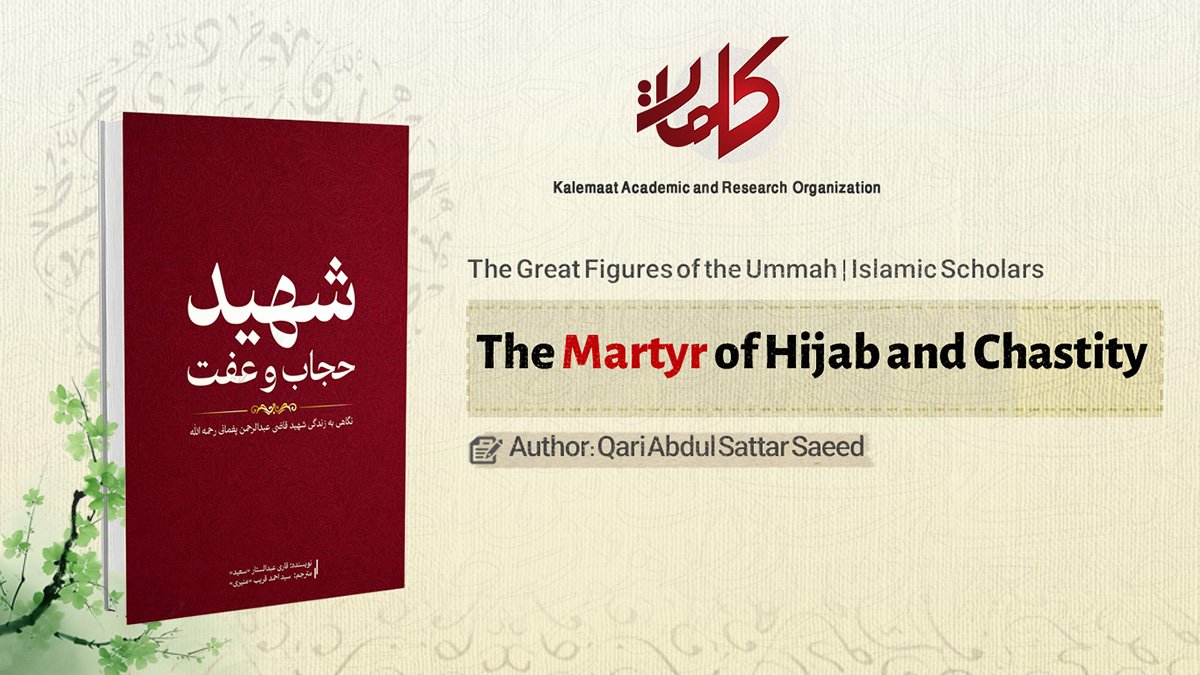
A Glimpse into the Life of the Martyred Qazi Abdul Rahman Paghmani
All praise is due to Allah Subhanahu wa Ta ‘ala, and may peace and blessings be upon His Messenger. To begin with:
A few years ago, amid my teaching responsibilities, I was assigned to teach the subject of “Modern History of Afghanistan.” Since I had no prior specialized background in the field of history, accepting this responsibility prompted me to study and research the modern history of Afghanistan.
During my studies, in addition to becoming familiar with various historical subjects, I came to realize that Afghanistan had been a battleground of intellectual and cultural conflicts during the past century (1300–1400 AH, Solar Hijri). Whereas internal conflicts in earlier periods of Afghan history had largely revolved around the struggle for power and the seizure of the royal throne and crown, during the past hundred years, most political conflicts have been rooted in intellectual and ideological differences.
A study of Afghanistan’s history over the past hundred years reveals that three attempts have been made during this period to bring about intellectual, cultural, and social transformations in the country. In other words, in addition to foreign military invasions, our country has been exposed to the influence of Western ideas on three occasions. At each of these junctures, mujahideen and committed resistance fighters who upheld religious authenticity and Islamic values stood firm against these intellectual assaults, prevented the spread of foreign ideas, and safeguarded the religious, doctrinal, intellectual, and cultural identity of Afghan society.
The beginning of these intellectual assaults dates back to the reign of Amir Amanullah Khan. During his ten years in power, he twice attempted, under the banner of reform, to promote a range of laws, customs, and values derived from Western liberal civilization and culture in Afghanistan. The first phase of these reforms began in 1923 (1302 SH). In response, in addition to scattered protests in various provinces of the country, a widespread uprising led by Mullah Abdullah, popularly known as “Mullah Lang,” emerged in the southern region of Paktia. This uprising kept the military forces of Amanullah Khan’s government engaged for nearly nine months. Although the uprising eventually ended with the execution and martyrdom of its leader, it compelled Amanullah Khan to remove from the laws sixteen provisions that conflicted with the rulings of Islamic Sharia.
The second phase of Amanullah’s reforms began when Amanullah Khan returned from his lengthy European tour in the summer of 1928 (1307 SH). Having been deeply influenced by Western societies and pro-Western movements, he hastily began implementing social reforms. Although widespread protests against these policies subsequently erupted in various parts of the country and ultimately led to the fall of Amanullah Khan’s government, the first and most resounding voice of opposition to this course of action came from the chief justice of the Amanullah government, the martyred Mawlana Abdul Rahman Paghmani.
Qazi Abdul Rahman, who held the highest judicial position under Amanullah Khan, enjoyed considerable social standing, public respect, and government privileges. However, when he witnessed the government’s violation of religious injunctions, he openly opposed it. Despite all the pressure brought to bear upon him, he refused to comply with the king’s demand that he endorse actions contrary to Sharia. In the cause of safeguarding religion, defending Sharia, and preserving Islamic values, he sacrificed everything he possessed. Even after losing his two young sons, he stood firm and dignified before the bullets of government agents.
The remarkable steadfastness, sacrifice, and selflessness of the martyred Qazi Abdul Rahman have not received the recognition they deserve in historical accounts. Like many other truth-seeking resistance fighters of this land, he too suffered from biased judgments and, at times, from the intellectual jealousy of certain historians. Efforts have been made either to consign his character and legacy to oblivion or to portray them in a distorted manner.
Believing that this guardian of religious sanctity and the intellectual heritage of the Afghan people deserves to receive his due recognition and that the present generation should become acquainted with his character and legacy, I had long been considering writing an independent work about his life and struggles. Last year, on the occasion of the centenary of the martyrdom of Mullah Abdullah (Akhundzada), I wrote an article about his character and resistance. The article was warmly received by a wide readership. From that time onward, I also intended to compile a similar work on the martyred Qazi Abdul Rahman Paghmani. However, when I began writing, the breadth of the sources and the abundance of material gradually caused the manuscript to grow beyond the scope of an article, reaching the length of a book or treatise. It is worth mentioning that all the material and information presented in this work have been collected from reliable and documented historical sources, and the necessary references have also been provided in the footnotes wherever required.
Finally, I would like to express my sincere gratitude to Ustad Sayed Ahmad Qarib, a grandson of the martyred Qazi Abdul Rahman Paghmani, who kindly provided me with a rare copy of the treatise Mukhtasar al-Bayan and several other sources for use in and completion of this research. I would also like to extend my heartfelt appreciation to Mawlawi Ehsanullah Badr, Head of Publications at the Administrative Office, who assisted me in completing some of the information presented in this work.
I ask Allah (SWT) to make this effort a provision for the Hereafter for me and my parents.
In the Name of Allah, the Most Gracious, the Most Merciful
All praise is due to Allah (SWT), and peace and blessings be upon Prophet Muhammad (SAW).
The purpose of translating this book, The Martyr of Hijab and Chastity: A Glimpse into the Life of Martyred Qazi Sayyid Abdul Rahman (RH), by Qari Abdul Sattar Saeed, is to introduce the life, scholarly contributions, and religious services of this distinguished Afghan scholar to English-speaking readers.
Martyred Qazi Sayyid Abdul Rahman (RA) devoted his life to Islamic knowledge, teaching, judicial service, and spiritual development. His life and legacy offer valuable lessons for students of Islamic sciences and all those interested in Afghanistan’s scholarly and religious heritage.
In this translation, I have endeavored to preserve the meaning and message of the original text while presenting it in clear and fluent English. I pray that Allah (SWT) accepts this humble effort and makes it beneficial for readers.
(وَقُل رَّبِّ زِدْنِي عِلْمًا) Translation: “And say: My Lord, increase me in knowledge.”
(Surah Taha, 20:114)
Khalil Baha
Endorsement
الحمد لله رب العالمین، حمداً یوافی نعمه ویکافئ مزیده، والصلاة والسلام على سیدنا محمد، خاتم النبیین وإمام المرسلین، وعلى آله الأطهار وصحابته الأخیار، ومن اقتفى آثارهم بإحسان إلى یوم الدین.
All praise is due to Allah, the Lord of all worlds, with praise that is befitting of His blessings and sufficient to match His abundant favors. May peace and blessings be upon our master Muhammad, the Seal of the Prophets and the Leader of the Messengers, and upon his pure family, his noble Companions, and all those who follow their path with excellence until the Day of Judgment.
Civilizations endure not merely through the grandeur of their buildings, the vastness of their territories, or the rise and fall of their governments, but through their historical memory, intellectual heritage, and spiritual treasures. Historical memory, in turn, cannot remain firmly established without the pens of trustworthy researchers who place truth above expediency and scholarly integrity above emotion. Therefore, documenting and analyzing the lives and contributions of figures who have played a role in shaping the intellectual, religious, and social consciousness of a society is not merely the compilation of individual biographies; rather, it is an act of preserving a nation’s identity and safeguarding its historical continuity.
Among Afghanistan’s scholarly and religious figures, there are individuals whose roles have extended beyond the boundaries of official responsibilities and whose contributions to intellectual thought, education, judiciary, religious propagation, and reform have left lasting impacts. The Martyred Qazi Sayyid Abdul Rahman (RH) was one such figure. He was a personality who combined knowledge with commitment, judiciary with justice, religious devotion with responsibility, and scholarly excellence with social service. During one of the most sensitive periods in the history of this land, he left behind an influential legacy. Therefore, studying his life and heritage is not merely revisiting the record of an individual; it is also an examination of a part of the history of religious thought and social life in modern Afghanistan.
The present work, compiled by the distinguished researcher, respected Qari Abdul Sattar Saeed, represents a valuable effort toward reviving this part of the country’s historical memory. What makes this research worthy of attention is not merely the collection of information, but also the author’s commitment to scholarly integrity, examination of historical accounts, logical organization of discussions, and effort to present a documented and balanced picture of the personality and era of the martyr Qazi Abdul Rahman. The author has endeavored to go beyond merely narrating events and, in light of evidence and historical indications, to present their historical, scholarly, and social contexts as well. This approach has given the work scholarly credibility and lasting value.
Undoubtedly, historical research is an open-ended and continuous endeavor, and no work can be regarded as the final word on a subject, since the passage of time, the discovery of new documents, emerging accounts, and different research perspectives create opportunities for revision and further development. Nevertheless, there is no doubt that this book represents a significant step toward documenting and preserving a part of Afghanistan’s scholarly and historical heritage. It can serve as a useful and valuable reference for researchers of modern Afghan history, Islamic studies, law, historical sociology, and those interested in learning about the country’s scholarly figures.
Another merit of this work is that the author has avoided falling into the traps of emotion, exaggeration, and hasty judgment. Instead, he has sought to present the subject of his research within the historical context of his own time. This approach is one of the essential requirements of scholarly research and a sign of maturity in historical studies. History comes closer to the truth when its narratives are founded upon documented evidence and its analysis remains within the bounds of fairness and moderation.
Today, when our society needs, more than ever, to rediscover its scholarly, cultural, and moral heritage, the publication of such works should be regarded as a valuable step toward strengthening historical awareness and preserving the country’s spiritual treasures. It is hoped that, in addition to introducing one of the prominent figures in modern Afghan history, this work will also encourage young researchers to undertake systematic studies of the lives of other scholars, judges, reformers, and thinkers of this land. Indeed, nations that properly recognize their great figures are better equipped to shape their future with awareness and understanding.
I, while appreciating the scholarly efforts of the esteemed author, regard the publication of this book as a valuable service to research culture, modern historiography, and Afghanistan’s scholarly heritage. I hope that this work will attain its rightful place among reliable sources concerning the modern history of the country and pave the way for further extensive research in this field.
I beseech Allah, (SWT), to grant the esteemed researcher ever-increasing success in research, authorship, and service to Islamic and national culture, and to bestow forgiveness, divine pleasure, and elevated ranks upon the martyred Qazi Sayyid Abdul Rahman (RH).
رَبَّنَا تَقَبَّلْ مِنَّا إِنَّكَ أَنْتَ السَّمِيعُ الْعَلِيمُ Translation: Our Lord, accept this from us. Indeed, You are the All-Hearing, the All-Knowing.
Assistant Professor Dr. Sayyid Rawzatullah Majid
Lecturer, Department of Persian-Dari Language and Literature
Faculty of Language and Literature
Kabul University