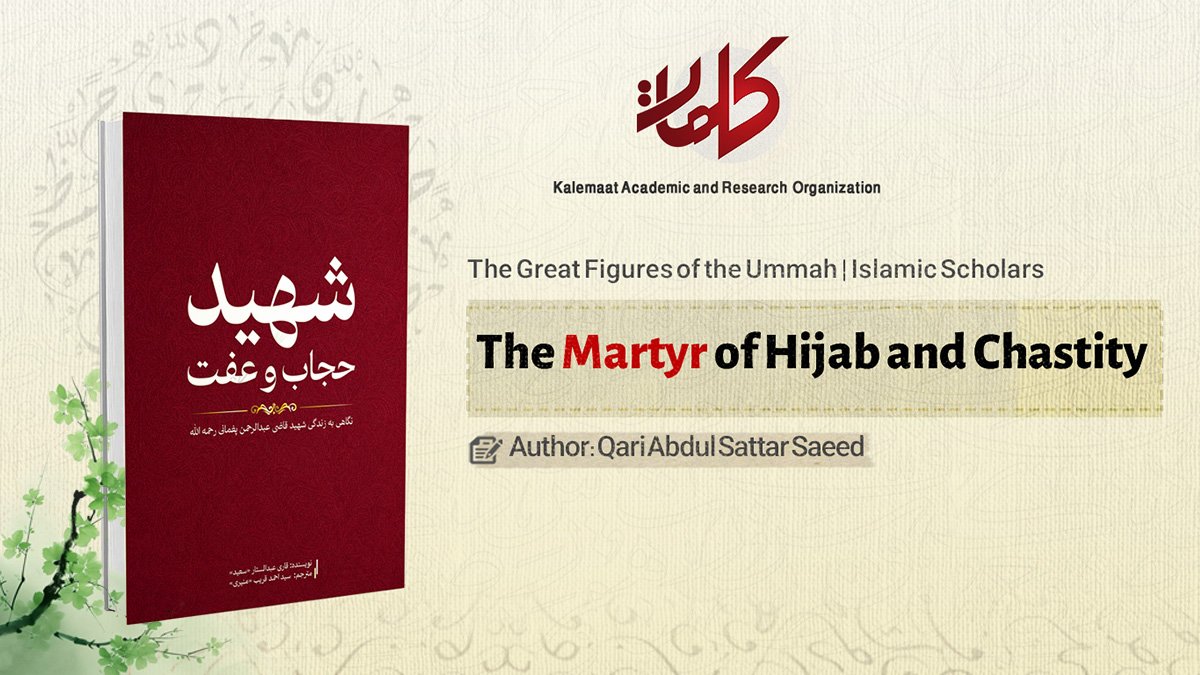
A Glimpse into the Life of the Martyred Qazi Abdul Rahman Paghmani
Who Was the Martyred Qazi Abdul Rahman Paghmani?
The martyred Qazi Sayyid Abdul Rahman was the son of Sayyid Muhammad Munir, son of Sayyid Muhammad Bashir, and belonged to the Husayni Sayyid lineage. He was born in 1284 AH in an area known as Seh Gonbad, located in Paghman District of Kabul Province.
According to accounts provided by members of Qazi Abdul Rahman’s family, as well as information recorded in the reliable treatise Mukhtasar al-Bayan fi Tarikh Shahid al-Ilm wa al-Iman (A Concise Account of the History of the Martyr of Knowledge and Faith), his original birthplace was the village of Seh Gonbad in Paghman District. He was born in this village, spent his childhood and adolescence there, and continued to reside in Seh Gonbad until the time of his martyrdom. [1]
Little information is available about his childhood, stages of education, and acquisition of religious knowledge. Given that Afghanistan did not have organized religious schools in the modern sense at that time, and students of Islamic knowledge generally studied under scholars in mosques and local study circles, it may be assumed that Qazi Abdul Rahman also acquired his religious education through scholarly gatherings and study circles in Kabul and its surrounding areas.
In general, what is widely known and established is that, from an early age, he possessed exceptional intelligence and outstanding intellectual abilities. Within a relatively short period, he mastered the commonly taught sciences of that era, including Arabic morphology (Sarf), Arabic grammar (Nahw), rhetoric (Balaghah), Islamic creed (Aqa’id), principles of Islamic jurisprudence (Usul al-Fiqh), logic, mathematics, and geography. He subsequently attained a high level of knowledge in the advanced Islamic sciences, including Qur’anic exegesis (Tafsir), Hadith sciences, and Islamic jurisprudence (Fiqh).
Little information is available about his teachers. However, available accounts suggest that he received most of his scholarly education from the distinguished scholar and renowned mujahid, Mawlana Abdul Razzaq Andar. In addition, he benefited from the scholarly guidance of prominent members of the Mujaddidi family in Shor Bazaar, Kabul, as well as several other eminent scholars of his time.
The Beginning of His Judicial Career
After completing his studies in the Islamic sciences, the martyred Qazi Abdul Rahman devoted himself to teaching until the age of thirty. Then, in 1315 AH, he was appointed for the first time as a judge of the Primary Court of Panjshir, north of Kabul. He served as a judge in Panjshir for four years with the utmost integrity and honesty. His profound religious devotion and piety led the people of Panjshir to regard him not merely as a judge but also as a pious religious leader and spiritual guide.
At that time, in many remote regions of Afghanistan, local khans and influential figures wielded considerable power and influence, often oppressing the weaker and less privileged segments of society. Qazi Abdul Rahman prevented their transgressions and injustices. He never allowed the social influence, wealth, or possessions of powerful individuals to affect his judgments, nor did any of their attempts to bribe him or win his favor prove successful. Consequently, some local khans and influential figures opposed him and awaited an opportunity to have him removed from the Sharia Court of Panjshir or transferred to another location.
In 1319 AH, following the death of Amir Abdul Rahman Khan and the accession of Amir Habibullah Khan to the throne, the opponents of Qazi Abdul Rahman considered this change in the country’s leadership an appropriate opportunity to pursue their objectives and lodged complaints against him in Kabul. In this regard, one of the influential figures of Panjshir, named Langar Khan, submitted a complaint against him to the authorities in Kabul, alleging that Qazi Abdul Rahman did not observe justice and fairness in issuing judgments, accepted bribes, and had accumulated considerable wealth.
Following this complaint, the government summoned Qazi Abdul Rahman from Panjshir to Kabul and placed him under detention until the truth of the allegations could be established. At the same time, a delegation was dispatched to Panjshir to investigate the allegations of bribery and the wealth attributed to him and, should the accusations be proven, to prepare the grounds for his trial.
However, after several months of investigation, it became clear that these allegations had no factual basis whatsoever. Not only was no evidence of substantial wealth or property found, but it was also discovered that Qazi Abdul Rahman owed the people approximately ten thousand Kabuli rupees. When the people of Panjshir learned of his imprisonment, they took steps to pay off his debts and requested the government to appoint him once again as a judge in their region.
Thus, after six months of imprisonment, Qazi Abdul Rahman was cleared of all charges and released from prison. Following his release, he did not return to judicial service and instead resumed teaching the Islamic sciences. From that time onward, alongside his other scholarly and social responsibilities, teaching remained one of his principal fields of activity until the end of his life.
Activities in Research and Authorship
Amir Habibullah Khan sought to establish a committee composed of distinguished, capable, and trusted scholars. This committee was assigned the following responsibilities:
Collecting and compiling jurisprudential issues related to legal claims and disputes on the basis of authoritative Islamic jurisprudential sources and organizing them into a systematic collection. The outcome of these efforts was later published in several volumes under the title (Siraj al-Ahkam fi Mu’amalat al-Islam).
Assessing the scholarly qualifications of individuals nominated or appointed to hold judicial and religious positions, including judges, muftis, court clerks, mosque imams, and preachers.
Conducting the final review of judgments issued by courts across Afghanistan to ensure the accuracy and soundness of judicial decisions and prevent any errors in the issuance of rulings.
Examining and addressing complaints submitted by individuals who objected to judgments issued by the Sharia Court of Kabul.
This distinguished council of scholars, initially known as the “Ulama-ye Mu’allifin” (Committee of Scholar-Authors), began its activities at Shahī Madrasa, located in the Choob-Farooshi neighborhood of Kabul. This madrasa had been established during the reign of Amir Abdul Rahman Khan. Later, the group became an independent institution and continued its work under the name “Mizan al-Tahqiqat al-Shar‘iyyah.” The institution’s first head was Sayyid Mir Ali Khan Agha Sahib, the preacher of Dar al-Saltanah. He was succeeded by Sardar Muhammad Usman Khan, who headed the institution for a period. Thereafter, this responsibility was entrusted for many years to the distinguished scholar, Mawlana Abdul Razzaq Khan Andar. The Martyred Qazi Abdul Rahman was among the earliest members of this scholarly council. In addition to him, several other renowned scholars of that period were also members of the institution, including Mawlawi Abdul Rauf Kandahari, Sayyid Ghulam Muhammad Agha Charbaghi, Mawlawi Ahmad Jan Akhundzada, Mawlawi Muhammad Sarwar Khan Wasif, Mulla Lala Gul Arghandiwal, and Mawlana Gul Akhundzada. Since Qazi Abdul Rahman was one of the distinguished students of the institution’s head, Mawlana Abdul Razzaq Andar, and was later appointed as the deputy head (Na’ib) of the institution, a considerable portion of its responsibilities was entrusted to him by its head.
According to Hazrat Muhammad Sadiq Mujaddidi, Qazi Abdul Rahman played a greater role than any other member of this council in collecting materials, preparing drafts, reviewing them, and finalizing the text of the book (Siraj al-Ahkam). Nevertheless, since the overall responsibility for Mizan al-Tahqiqat al-Shar‘iyyah rested with Mawlana Abdul Razzaq Andar, his name was recorded as the author of this work.
In 1324 AH, Qazi Abdul Rahman traveled to the Two Holy Sanctuaries (Al-Haramayn al-SharIfayn) to perform the Hajj pilgrimage. At that time, the journey for Hajj was generally undertaken on foot and involved considerable hardship. During this journey, he contracted a serious illness whose effects troubled him for several years. Nevertheless, this illness never diminished his determination and resolve to teach, conduct research, and provide other religious services, nor did it disrupt his scholarly and educational activities.
During this period, the martyred Qazi Abdul Rahman continued teaching alongside his research and authorship. Many students of religious sciences of that era, particularly those studying at Shahi Madrasa in Kabul, benefited from his scholarly knowledge. His scholarly standing was so widely recognized that even the prominent members of the Mujaddidi family of Shor Bazaar acknowledged his learning and merit. Three sons of Hazrat Khwaja Ghulam Qayyum Mujaddidi—namely, Hazrat Shams al-Mashaikh Fazl Muhammad Mujaddidi, Hazrat Nur al-Mashaikh Fazl Umar Mujaddidi, and Hazrat Muhammad Sadiq Mujaddidi—were among Qazi Abdul Rahman’s students.
Hazrat Muhammad Sadiq Mujaddidi relates that in 1329 AH, when Hazrat Ghulam Qayyum Mujaddidi was preparing to travel to Sirhind to visit the tomb of his revered ancestor, Imam Rabbani Shaykh Ahmad Sirhindi, he summoned Qazi Abdul Rahman and asked him to move his residence to the Mujaddidi Khanqah in Shor Bazaar and settle there. He also entrusted his young son, Muhammad Sadiq Mujaddidi, to Qazi Abdul Rahman and placed particular emphasis on his education and upbringing. From that time until 1347 AH—nearly nineteen years—the Mujaddidi Khanqah in Shor Bazaar served as Qazi Abdul Rahman’s nighttime residence. This was because his principal residence was in the village of Seh Gonbad, Paghman District, and travelling daily between Paghman and Kabul was not feasible for him. [2]
[1] Some writers have mistakenly attributed Qazi Abdul Rahman to the village of Bektut, located in Paghman District, and referred to him as Bektuti. However, investigations indicate that his actual birthplace and place of residence was the village of Seh Gonbad, which is entirely separate from Bektut, with two villages lying between them. It appears that the greater fame of Bektut led some writers to associate him with that village.
[2] The information concerning the personal life, education, judicial career, and teaching activities of martyred Qazi Abdul Rahman presented in this section has been adapted and compiled from various sections of Mukhtasar al-Bayan, a treatise written about his life.