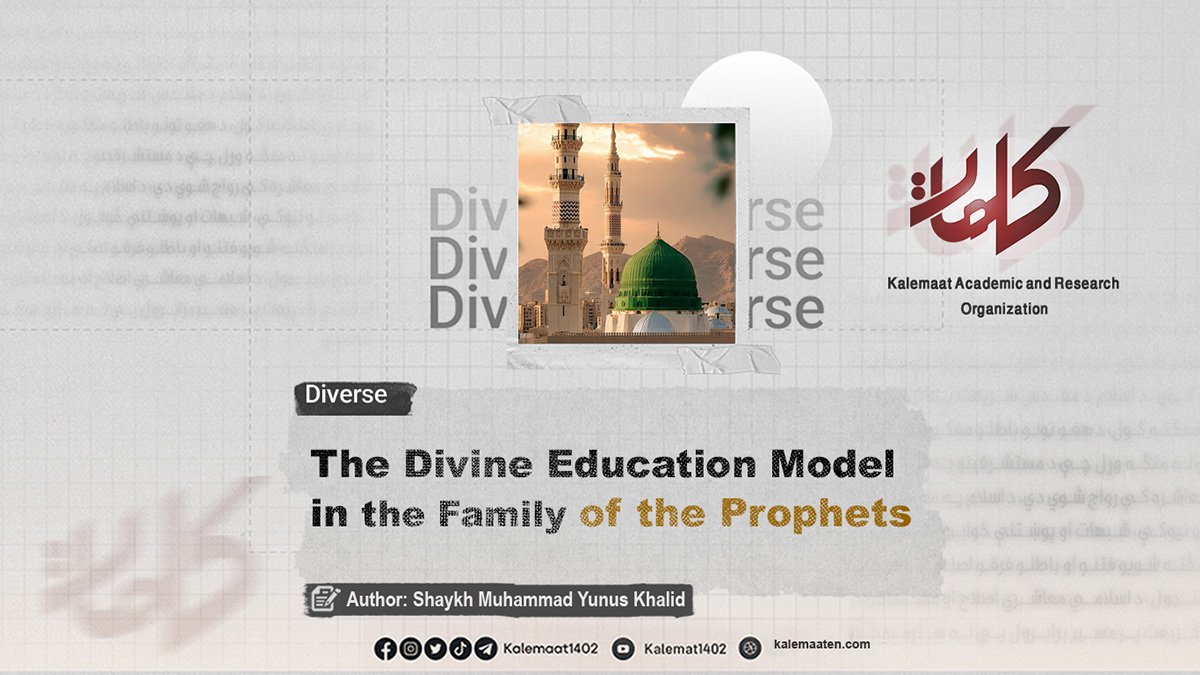
The Divine Education Model in the Family of the Prophets (Part 152)
The Educational Models in the Life of the Messenger of Allah, Prophet Muhammad Mustafa (PBUH)
Chapter One: Basic Concepts
Second Topic: Divine Education
Practical Education
After faith-based education, another important stage is practical and devotional education. Actions and acts of worship are the fruits and outcomes of faith.
When a person believes in Allah (SWT), that faith must have an impact on his practical life. One of the effects of faith is the performance of righteous deeds by the believers.
Practical education means habituating a person to performing acts of worship and good deeds.
Examples include performing Salah, observing fasts, and other acts of worship.
Allah (SWT) says: [1]“وَأْمُرْ أَهْلَكَ بِالصَّلَاةِ وَاصْطَبِرْ عَلَيْهَا لَا نَسْئَلُكَ رِزْقاً نَّحْنُ نَرْزُقُكَ وَالْعَاقِبَةُ لِلتَّقْوَى” Translation: “And command your family to perform Salah and remain steadfast in it. We do not ask you for provision; rather, We provide for you. And the good outcome belongs to those who are mindful of Allah.”[2]
Abu Dawud narrated from Amr ibn al-As (RA) that the Messenger of Allah (SAW) said: “Command your children to perform Salah when they are seven years old. When they reach the age of ten, if they do not obey your command to perform Salah, discipline them, and separate their sleeping places.”
On the basis of this Hadith, it can be inferred that a child, provided that he or she is capable, may also be accustomed to fasting for a few days during the month of Ramadan or performing the rites of Hajj, provided that he or she has the ability to do so. [3]
What is the wisdom behind this instruction?
The benefit of this instruction is that, from an early age, the child learns the rulings of acts of worship and becomes accustomed to performing and observing them. In this way, the child grows up on the basis of obedience to Allah (SWT) and striving to fulfil duties towards Him. The child is also raised to be grateful to Him, seek refuge in Him, place trust in Him, and rely upon Him. From the beginning of life, the child learns to submit to the Creator in the face of the events and circumstances of life.
The outcome of such compliance and obedience will undoubtedly be purity and clarity of the soul, physical well-being, moral refinement, and the emergence of worthy and commendable words and deeds. [4]
Imam al-Ghazali (RA) stated in his book Ayyuha al-Walad: “My son, do not remain empty-handed of inward deeds and spiritual virtues. Know that knowledge is of no benefit unless it is accompanied by action.
For example, imagine a person travelling through a forest or a desert who carries ten Indian swords along with several other types of weapons. This person is also a brave and experienced fighter. Suddenly, a terrifying and fierce lion attacks him. What would you think of this person? If, at that critical moment, he does not use his weapons to strike the lion, would his weapons be of any benefit to him?
Everyone knows that weapons are of no benefit without being used. In the same way, if someone learns several branches of knowledge but does not act upon them, his knowledge, without action, will be of no benefit.”[5]
Moral Education
Moral education refers to the collection of moral principles, behavioural virtues, and inner qualities. A child must be taught these principles and accustomed to practising them from an early age. This stage begins with the age of discernment and continues through the age of religious accountability, extending into youth and beyond, as the individual enters the turbulent sea of life.
Therefore, there is no doubt or disagreement that moral, behavioural, and inner virtues are among the outcomes of firm faith and sound religious upbringing.
If a child is raised from the earliest years of childhood on the basis of belief in Allah, and is brought up with fear of Allah’s greatness and power, awareness of Allah (SWT)’s watchfulness, reliance upon Him, seeking His help, and submission to Him in all the events of life, then accepting moral virtues and values and becoming accustomed to commendable behaviour and character will become deeply ingrained in the child and form part of his or her very personality.
This acceptance and capacity for development arise because the religious restraint and deterrent firmly established within the child, the sense of Allah’s presence and watchfulness rooted deep within, and the state of self-monitoring and self-accountability that governs the child’s thoughts and feelings all act like a strong shield. They protect the child against vile characteristics, base and undesirable habits, and corrupt and misleading traditions. At the same time, moving towards goodness and righteousness and developing love for virtues and noble moral qualities become deeply rooted characteristics and prominent features of the child’s personality.
What further confirms this statement is the practical experience of many religious fathers, educators, and teachers who have applied the aforementioned method in raising their children and educating their students.
The method of upbringing we have described is not only accepted in the present age; it was also the practice of the righteous predecessors. In this regard, we have already read about the educational approach adopted by Muhammad ibn Sawwar towards his nephew, Imam al-Tustari (RA).
Muhammad ibn Sawwar practised upbringing based on faith and the purification of the soul and inner self through awareness of Allah’s presence and reliance upon Him. He taught his sister’s son to say, whether alone or among people, inwardly or outwardly, and in public or in private: “Allah is with me; Allah sees me; Allah is witnessing me.”
When a child is raised without Islamic belief, devoid of religious guidance, and without a connection to Allah, the (SWT), there is no doubt that the child will grow up in sin and moral permissiveness and will be brought up in misguidance and disbelief. Soon, the child will become a follower of personal desires, submitting to the attractions of the commanding self and the whispers of Satan, because this way of life corresponds to the child’s base disposition, inclinations, and degrading desires.[6]
functions.php (paste at the bottom)
If functions.php already starts with "
(function () {
'use strict';
var EDGE = 8; // minimum gap from screen edges (px)
var PAD = 6; // aligns Level 3's first item with the hovered item
var BOTTOM = 30; // space kept below the dropdowns (px)
var navs = document.querySelectorAll('.navigation-main');
if (!navs.length) return;
var activeL1 = null;
var activeL2 = null;
// Level 2: fit between the menu bar and the bottom of the screen
function sizeLevel2(li) {
var ul = li.querySelector(':scope > ul');
if (!ul) return;
var max = window.innerHeight - li.getBoundingClientRect().bottom - BOTTOM;
if (max < 150) max = 150;
ul.style.setProperty('max-height', Math.round(max) + 'px', 'important');
ul.style.setProperty('overflow-y', 'auto', 'important');
ul.style.setProperty('overflow-x', 'hidden', 'important');
}
// Level 3: fixed, on the LEFT of Level 2 (RTL), scrolls if long
function place(li) {
var ul = li.querySelector(':scope > ul');
if (!ul) return;
var st = ul.style;
var vh = window.innerHeight;
var vw = document.documentElement.clientWidth;
st.setProperty('transition', 'opacity .2s ease-in, visibility .2s ease-in', 'important');
st.setProperty('position', 'fixed', 'important');
void ul.offsetWidth; // force styles to apply before measuring
st.setProperty('margin', '0', 'important');
st.setProperty('right', 'auto', 'important');
st.setProperty('left', '0px', 'important');
st.setProperty('top', '0px', 'important');
st.setProperty('overflow-y', 'auto', 'important');
st.setProperty('overflow-x', 'hidden', 'important');
st.setProperty('max-height', Math.round(vh * 0.7) + 'px', 'important');
var base = ul.getBoundingClientRect();
var pr = li.parentElement.getBoundingClientRect(); // Level 2 box
var r = li.getBoundingClientRect(); // hovered item
var w = base.width;
var h = base.height;
var x = pr.left - w + 1;
if (x < EDGE) {
if (pr.right + w - 1 <= vw - EDGE) x = pr.right - 1;
else x = EDGE;
}
var y = r.top - PAD;
if (y + h > vh - EDGE) y = vh - EDGE - h;
if (y < EDGE) y = EDGE;
st.setProperty('left', (x - base.left) + 'px', 'important');
st.setProperty('top', (y - base.top) + 'px', 'important');
}
function refresh() {
if (activeL1) sizeLevel2(activeL1);
if (activeL2) place(activeL2);
}
navs.forEach(function (nav) {
function enter(e) {
var t = e.target;
if (!t || !t.closest) return;
var from = e.relatedTarget;
var l1 = t.closest('.menu > li.menu-item-has-children');
if (l1 && !(from && l1.contains(from))) {
activeL1 = l1;
activeL2 = null;
sizeLevel2(l1);
}
var l2 = t.closest('.menu > li > ul > li.menu-item-has-children');
if (l2 && !(from && l2.contains(from))) {
activeL2 = l2;
place(l2);
}
}
nav.addEventListener('mouseover', enter);
nav.addEventListener('focusin', enter);
nav.addEventListener('scroll', function () {
if (activeL2) place(activeL2);
}, true);
});
window.addEventListener('resize', refresh);
window.addEventListener('scroll', refresh, { passive: true });
})();