Close Menu
    Facebook X (Twitter) Telegram WhatsApp
    • Language
      • دری
      • پښتو
      • العربیة
    • Home
    • Analysis
    • Islam
      • Prophet of Islam (PBUH)
      • Holy Quran
      • Muslim
      • Belief
      • Faith
      • Worships
      • Fiqh
      • Jihad
      • Islamic Perspectives
      • Islamic Economics
      • Islamic Management
      • Islamic Culture
      • Sufism
      • Crimes
      • Prohibitions
      • Sayings of the Scholars
      • Muhajir Tafsir
      • Hadith
    • Religions
      • Judaism
      • Christianity
      • Buddhism
      • Hinduism
      • Zoroastrianism
      • Satanism
      • Confucianism
      • Sikhism
    • Theories
      • Atheism
      • Secularism
      • liberalism
      • Socialism
      • Communism
      • Democracy
      • Federalism
      • Fascism
      • Capitalism
      • Marxism
      • Feminism
      • Nationalism
      • Colonialism
      • Frankfurt School
      • Freemasonry
      • Humanism
    • Fitan
      • Mu’tazila
      • Murji’ah
      • Jahmiyyah
      • The Fitna of the Khawarij
      • The Fitna of the Rawafid
      • The Fitna of Orientalism
      • Ghamdism
      • The Fitna of the Qadianis
      • Qadariyyah
      • Karramiyyah
    • Ummah
      • Sahabah (Companions of the Prophet ﷺ)
        • Hazrat Abu bakr Siddiq (RA)
        • Hazrat Umar al-Faruq (RA)
        • Hazrat Uthman ibn Affan (RA)
        • Hazrat Ali (RA)
        • Hazrat Khalid ibn al-Walid (RA)
        • Hazrat Fayruz al-Daylami (RA)
        • Hazrat Abdullah ibn al-Zubayr (RA)
      • Ummahat al-Mu’minin
      • Islamic scholars
        • Allamah Sayyid Abul Hasan Ali Nadwi (RH)
        • Imam al-Aʿzam Abu Hanifa (RH)
        • Imam al-Bukhari (RH)
        • Imam al-Tirmidhi (RH)
        • Imam al-Ghazali (RH)
        • Shah Waliullah al-Dehlawi (RH)
        • Sayyid Jamal al-Din Afghani
        • Mawlana Jalal al-Din Muhammad Balkhi Rumi (RH)
      • Muslim Rulers
        • Sultan Salahuddin Ayyubi (RH)
        • Umar ibn Abd al-Aziz (RH)
        • Sultan Yusuf ibn Tashfin (RH)
      • Muslim Scientists
    • Civilizations
      • Islamic Civilization
      • Eastern and Western Civilizations
      • Traces of History
    • Diverse
      • Ramadan Message
      • Reports
      • Light and Darkness
    • library
    Facebook X (Twitter) Telegram WhatsApp Instagram Pinterest YouTube
    kalemaat Englishkalemaat English
    You are at:Home»Diverse»The Significance and Esteemed Position of Youth in Society (Part Five)
    Diverse

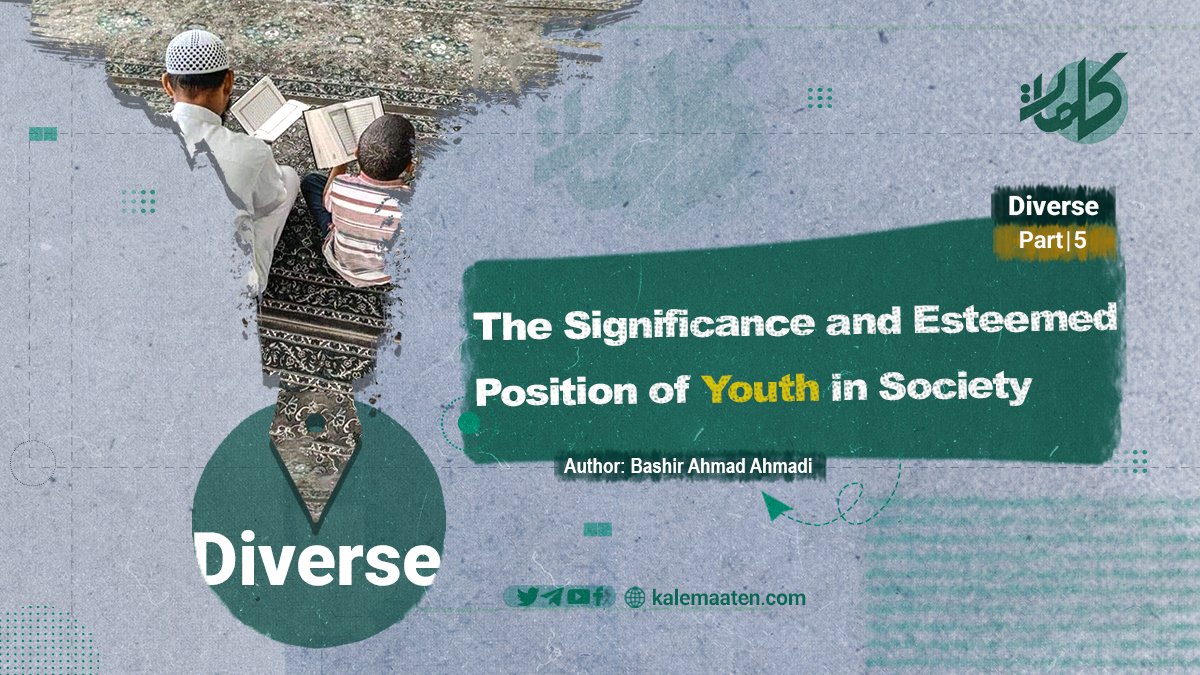
    The Significance and Esteemed Position of Youth in Society (Part Five)

    By 18/02/2025Updated:18/05/2025No Comments3 Mins Read
    Share Facebook Twitter Telegram WhatsApp
    Share
    Facebook Twitter Telegram Email WhatsApp

    Author: Bashir Ahmadi Ahmadi
    The Significance and Esteemed Position of Youth in Society (Part Five)
    Islam’s Perspective on Youth in an Islamic Society
    Adolescence and youth are the springtime of life—a period characterized by flourishing, the beginning of physical and emotional fluctuations, and the journey toward maturity. During this time, a person’s character gradually forms, and many intellectual and cultural questions arise in a young person’s mind. The days of youth are filled with beauty, vitality, emotions, diverse pleasures, recreation, and personal expression. On the other hand, seeking Allah (SWT), discovering faith, and religious devotion are vital aspects of this stage.
    By understanding these characteristics and the immense energy present in youth, we can bring peace and reassurance to the restless souls of young people. By correctly conveying religious and spiritual values, we guide them toward salvation and perfection. In this article, with the help of Allah Almighty, we aim to use Quranic verses, religious teachings, and the practical example of the Prophet Muhammad (PBUH) to inspire young people to embrace their social and Islamic responsibilities.
    Parents and educators play a crucial role in shaping the personalities of adolescents, and they must fulfill their educational role in fostering an Islamic identity in them. The character of adolescents and young people form within the home and family environment, influenced significantly by the perspectives and upbringing of the parents.
    Allah Almighty says in Surah Fatir (35:37) regarding heedless and idle youth: أَوَلَمْ نُعَمِّرْكُم مَّا يَتَذَكَّرُ فِيهِ مَن تَذَكَّرَ Translation: “Did We not give you a lifespan long enough for those who wished to take heed?”
    This verse serves as a reproach and admonition for heedless young people who, upon reaching adulthood, fail to utilize their youth. Since young people have pure hearts and are more receptive to the truth than others, the Prophet Muhammad (PBUH) began his call to Islam with youth, many of whom were among the first to accept and follow him. The Prophet (PBUH) held great respect and esteem for young individuals.
    On many occasions, despite the presence of elderly and senior companions, he assigned key responsibilities to young individuals while supporting their efforts. Whenever a young person possessed the necessary competence and merit, the Prophet (PBUH) would entrust him with significant positions. Among those to whom he delegated important matters was Ali ibn Abi Talib (MABH)—a figure whose contributions deserve a book of their own. Another trusted youth of the Prophet (PBUH) was Jafar ibn Abi Talib (MAPH), who, at the age of 24, led the group of Muslims who migrated to Abyssinia. His wisdom and eloquence convinced Negus, the king of Abyssinia, to grant refuge to the Muslims. Later, at the age of 27, he was appointed as the commander of the Muslim army in the Battle of Mu’tah, where he attained martyrdom.
    The Prophet Muhammad (PBUH) said: “اَکْرِمُوا اَوْلادَکُمْ وَ اَحْسِنُوا آدابَهُمْ یُغْفَرْ لَکُمْ.” Translation: “Honor your children and refine their manners so that you may be forgiven.”
    This narration highlights the value and status of children and adolescents in the divine system and underscores the role of parents in shaping their social and personal behavior. The ideal personality is balanced, elevated, and aligned with all aspects of a young person’s existence.
    To effectively nurture and develop their children’s character, parents must uphold justice among them. Even in the smallest aspects of upbringing—such as kissing their children, interacting with them, and providing for their daily needs—there should be a delicate balance to ensure that their personality growth is not harmed.
    Continues…

    Previous Part/ Next Part

    Related Posts

    The Divine Education Model in the Family of the Prophets (Part 144)

    19/10/2026

    The Divine Education Model in the Family of the Prophets (Part 143)

    18/10/2026

    The Divine Education Model in the Family of the Prophets (Part 142)

    17/10/2026
    Leave A Reply Cancel Reply

    Follow us on the social media pages
    • Facebook
    • Twitter
    • Instagram
    • Telegram
    • WhatsApp
    Don’t miss

    The Divine Education Model in the Family of the Prophets (Part 144)

    Who Is a Sufi?

    The Responsibility of Faith

    The Divine Education Model in the Family of the Prophets (Part 143)

    About Us:

    The Academic and Research Organization of Kalemaat is an independent Islamic Da'wah organization affiliated with Ahl al-Sunnah wa al-Jama'ah. It is dedicated to promoting the authentic values of Islam, advancing the higher objectives of the Sharia, countering Western cultural influence, upholding the Word of Allah, and contributing to the intellectual and spiritual awakening of the Muslim Ummah.

    The Organization is supported by Muslim philanthropists and businessmen, and it welcomes the cooperation and support of Muslims worldwide in advancing its mission.

    Famous publications

    The Divine Education Model in the Family of the Prophets (Part 144)

    19/10/2026

    Who Is a Sufi?

    19/10/2026
    Follow us on social medias
    • Facebook
    • Twitter
    • YouTube
    • Telegram
    • Instagram
    • WhatsApp
    All right reserved by (kalemaat)
    • Home
    • Analysis of the day
    • The greats of the Ummah
    • library

    Type above and press Enter to search. Press Esc to cancel.
