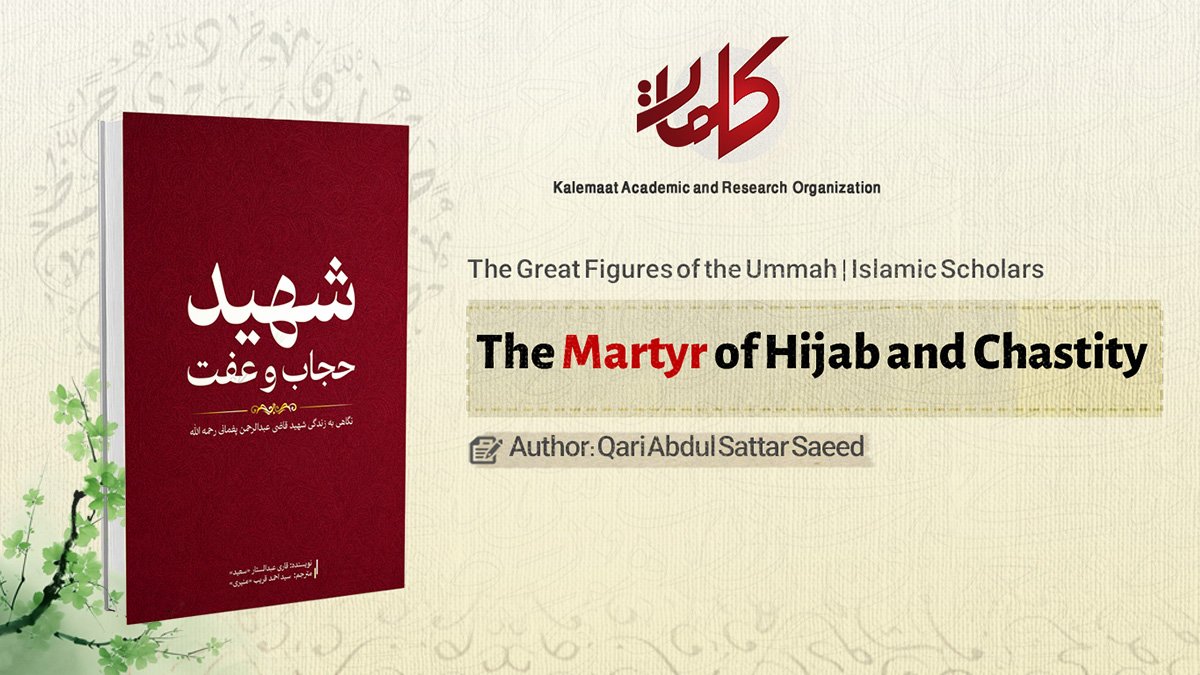
A Glimpse into the Life of the Martyred Qazi Abdul Rahman Paghmani
The Confrontation Between the King and the Qazi
There is no doubt that Qazi Abdul Rahman disapproved of Amanullah Khan’s conduct, particularly after his journey to Europe and the measures he intended to introduce in the religious sphere. However, according to the principles of Hanafi jurisprudence (Fiqh), rebelling against or confronting a ruler is subject to very strict conditions. Therefore, like many other scholars, he sought to avoid direct confrontation with the king.
Nevertheless, according to the accounts of researchers such as Muhammad Husain Khan, Munshi Ali Ahmad, and Senzil Nawid, it was Amanullah Khan who asked Qazi Abdul Rahman to endorse the decree concerning the removal of the hijab on the basis of religious sources and issue an official fatwa declaring that hijab had no basis in Islam and was not obligatory. This unreasonable request by Amanullah Khan became the central issue of disagreement between the king and the Qadi al-Qudat, ultimately compelling Qazi Abdul Rahman to stand firm against the government’s demand.
In August 1928, while the palaces and gardens of Kabul and Paghman were immersed in celebrations of independence, and artists, actors, and performers had been invited from India to make the festivities even more magnificent, a hidden conflict was also unfolding within the government between the king and the Qadi al-Qudat. Amanullah Khan had made a demand that, in Qazi Abdul Rahman’s view, was impossible to fulfil. On one side stood the king, who would sometimes emphasise his determination by saying: “Remember that I am the grandson of Amir Abdur Rahman.” [1]
On the other side stood Mawlana Abdul Rahman Paghmani, who, throughout his sixty-three years of life, had never allowed his conduct to be stained by any deviation from the rulings of Sharia.
Various accounts of this disagreement have been transmitted in written and oral sources.
Muhammad Husain Khan writes that Qazi Abdul Rahman was among the few officials of the Amanullah administration renowned for their integrity and that he never accepted bribes. He even supported some of the government’s beneficial programs. However, when Amanullah Khan compelled him to issue a fatwa in support of unveiling, he considered the request contrary to his religious duty. According to the author, the Qazi left Kabul, but the government arrested him and shot him. [2] Senzil Nawid also writes, quoting Munshi Ali Ahmad, that Amanullah Khan put pressure on Qazi Abdul Rahman to issue an official fatwa in support of removing the hijab. The Qazi requested five days to provide his response. During this period, he consulted the elders of the Mujaddidi family of Shor Bazaar and subsequently left Kabul. [3]
In addition, there are other oral accounts of this event for which no written source has been found. For instance, Mawlawi Dastgir, a prominent scholar of Paghman, has related an account he heard from Mulla Malang, one of Qazi Abdul Rahman’s students. According to this account, Amanullah Khan asked the Qazi to issue a fatwa to legitimise and support the removal of the hijab. Qazi Abdul Rahman rejected the king’s request during that very gathering and, to substantiate his position, presented the king with Qur’anic verses concerning hijab and women’s covering. According to this account, Amanullah Khan regarded the Qazi’s opposition as a form of disobedience, became extremely angry, and kicked him. As a result, the Holy Qur’an that the Qazi was holding fell to the ground. [4] Abdul Rab al-Rasul Sayyaf, a resident of Paghman and former jihadi leader, also referred to this incident in one of his speeches and identified Darul Aman Palace as the place where it occurred. However, no account of such a physical confrontation has been found in the written sources examined so far.
The memoirs of Hazrat Muhammad Sadiq Mujaddidi also refer to the disagreement and conversation between Amanullah Khan and Qazi Abdul Rahman. Quoting the Qazi, he writes: “One day, Amanullah Khan summoned me to the Koti Surkh, located in Bala Bagh, Paghman, and said: ‘I wish to ask you about women showing their faces in public. However, before doing so, I consider it necessary to tell you that I personally do not regard covering the face and veiling women as necessary or obligatory.’ “I replied: I will state only what is in accordance with Sharia and the Hanafi school of thought.
“Then Amanullah Khan asked: ‘In your opinion, is covering the face and veiling women a matter of custom and tradition, or is it a religious ruling?’ “I replied: Hijab and veiling are among the rulings of Sharia, because women’s uncovered faces can become a source of many temptations. Qazi Abdul Rahman then presented Amanullah Khan with a collection of Hadiths, jurisprudential opinions, and fatwas agreed upon by the later Hanafi jurists, all of which emphasised the necessity of hijab and covering women’s faces.
“After that, Amanullah Khan said: ‘Then recite to me a verse of the Qur’an in which the ruling on hijab is mentioned.’
“Qazi Abdul Rahman says: ‘Since I was not a Hafiz of the Qur’an, I asked them to bring the Holy Qur’an. Unfortunately, there was no copy of the Qur’an in the royal office. Amanullah Khan then pointed to one of the servants, who was deaf and mute, and instructed him to bring a copy of the Qur’an from somewhere else. When the Qur’an was brought, I opened it to Surah An-Nur, recited the verses concerning hijab, and showed them to the king. I then explained that detailed discussions of this subject and its related rulings could be found in the books of Tafsir, Hadith, and Hanafi jurisprudence.’
“He further adds: “‘I also told Amanullah Khan that pursuing such matters was not in the country’s interest, because abolishing women’s hijab could expose the country to another crisis and turmoil. I do not understand why His Majesty concerns himself with issues that have no connection whatsoever with the country’s progress or the nation’s independence.’
“Despite these explanations, Amanullah Khan did not appear to be convinced. He told the Qazi: “‘Bring all your books tomorrow at four o’clock in the afternoon so that we may discuss this matter and reach a final decision.’
“Thus, the meeting came to an end. Qazi Abdul Rahman says that the Minister of Education had also been invited to this meeting because the matter of determining the clothing of the students at Maktab-e Masturat was related to hijab. Amanullah Khan had decided that from then on, ‘Maktab-e Masturat’ would be renamed ‘Maktab-e Makshufat’ (the School of Unveiled Women).
“Muhammad Sadiq Mujaddidi writes that, since it was summer and his residence was in Qala-e Mir, in the Bektut area of Paghman, Qazi Abdul Rahman came to his house after the meeting. Deeply saddened and distressed, he recounted his conversation with Amanullah Khan. The king’s recent measures, which, according to the Qazi, increasingly disregarded the rulings of Sharia Day by day, had deeply troubled him.
“I said to him: ‘I share your view. We must stop Amanullah Khan from continuing these policies by whatever means and at whatever cost possible. We have discussed this matter many times before. What is your opinion now? Should we take action, or should we continue to exercise patience?’
“Qazi Abdul Rahman replied: ‘It is no longer permissible to live under the rule of this man. Action must be taken so that the king can be prevented from continuing these wrongful practices and the nation can be spared anxiety and upheaval. In that case, we too will be able to spend the remainder of our lives with a clear conscience.’
“The following day, Qazi Abdul Rahman took copies of Tafsir Husayni and Umdat al-Qari, the commentary on Sahih al-Bukhari, and went to the same place at the appointed time to engage in scholarly discussion with Amanullah Khan and his companions on the subject. He informed the king that he had arrived. However, Amanullah Khan, who had already become aware of the Qazi’s position during their first meeting, postponed the gathering until the following day and subsequently forgot about it altogether. As a result, the scholarly debate on the issue of hijab never took place.”[5]