

Close Menu
    Facebook X (Twitter) Telegram WhatsApp
    • Language
      • دری
      • پښتو
      • العربیة
    • Home
    • Analysis
    • Islam
      • Prophet of Islam (PBUH)
      • Holy Quran
      • Muslim
      • Belief
      • Faith
      • Worships
      • Fiqh
      • Jihad
      • Islamic Perspectives
      • Islamic Economics
      • Islamic Management
      • Islamic Culture
      • Sufism
      • Crimes
      • Prohibitions
      • Muhajir Tafsir
    • Religions
      • Judaism
      • Christianity
      • Buddhism
      • Hinduism
      • Zoroastrianism
      • Satanism
      • Confucianism
      • Sikhism
    • Theories
      • Atheism
      • Secularism
      • liberalism
      • Socialism
      • Communism
      • Democracy
      • Federalism
      • Fascism
      • Capitalism
      • Marxism
      • Feminism
      • Nationalism
      • Colonialism
      • Frankfurt School
      • Freemasonry
      • Humanism
    • Fitan
      • Mu’tazila
      • Murji’ah
      • Jahmiyyah
      • The Fitna of the Khawarij
      • The Fitna of the Rawafid
      • The Fitna of Orientalism
      • Ghamdism
      • The Fitna of the Qadianis
      • Qadariyyah
      • Karramiyyah
    • Ummah
      • Sahabah (Companions of the Prophet ﷺ)
        • Hazrat Abu bakr Siddiq (RA)
        • Hazrat Umar al-Faruq (RA)
        • Hazrat Uthman ibn Affan (RA)
        • Hazrat Ali (RA)
        • Hazrat Khalid ibn al-Walid (RA)
        • Hazrat Fayruz al-Daylami (RA)
        • Hazrat Abdullah ibn al-Zubayr (RA)
      • Ummahat al-Mu’minin
      • Islamic scholars
        • Allamah Sayyid Abul Hasan Ali Nadwi (RH)
        • Imam al-Aʿzam Abu Hanifa (RH)
        • Imam al-Bukhari (RH)
        • Imam al-Tirmidhi (RH)
        • Imam al-Ghazali (RH)
        • Shah Waliullah al-Dehlawi (RH)
        • Sayyid Jamal al-Din Afghani
        • Mawlana Jalal al-Din Muhammad Balkhi Rumi (RH)
      • Muslim Rulers
        • Sultan Salahuddin Ayyubi (RH)
        • Umar ibn Abd al-Aziz (RH)
        • Sultan Yusuf ibn Tashfin (RH)
      • Muslim Scientists
    • Civilizations
      • Islamic Civilization
      • Eastern and Western Civilizations
      • Traces of History
    • Diverse
      • Ramadan Message
      • Reports
      • Light and Darkness
    • library
    • Encyclopedia of Hadith
    • Encyclopedia of the Sayings of the Scholars
    Facebook X (Twitter) Telegram WhatsApp Instagram Pinterest YouTube
    kalemaat Englishkalemaat English
    You are at:Home»Theories»Freemasonry»Freemasonry (part 10)
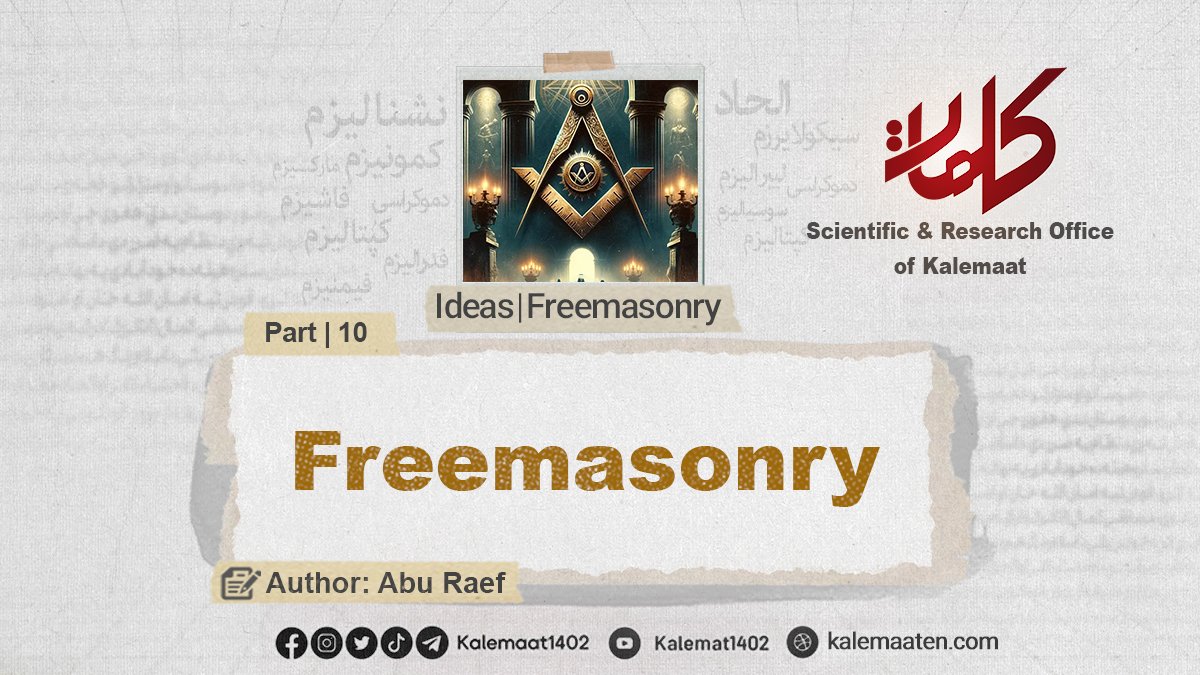
    Freemasonry

    Freemasonry (part 10)

    By 25/12/2025Updated:27/12/2025No Comments4 Mins Read
    Share Facebook Twitter Telegram WhatsApp
    Share
    Facebook Twitter Telegram Email WhatsApp
    Author: Abu Raef
    Freemasonry (part 10)
    Degrees of Freemasonry and Classes of Members
    In this section, we address an important part of the Freemasonic membership system, its leadership structure, and its key and fundamental members. These degrees, in reality, constitute the framework and foundation of the leadership and administrative system of this movement, and they identify individuals and officials according to their position and role in implementing plans and schemes.
    Main Degrees
    Freemasonry has three principal degrees:
    1. al-Ṭālib, al-‘Āmil, al-Mutamarrin; meaning apprentice, trainee, or learner, which represent the degree of beginners.
    2. al-Rafīq, al-Mu‘āwin, al-Shaghghāl, Ibn al-Mihna, and Zamīl al-Ṣin‘a; meaning companion, assistant, skilled worker, son of the profession, or fellow of the craft. These represent the intermediate degree.
    3. The third and most important stage of these degrees is the stage of al-Ustādh and al-‘Arīf, meaning: master or foreman. This is the degree of those who have completed the path and possess superior skill. [1]
    At the beginning, these degrees were real and practical, indicating a mason’s rank within the educational and industrial system of the building craft. However, when Freemasonry was transformed into a “symbolic” system, these degrees were also transformed to represent intellectual rank and the level of membership within the new structure.
    Method of Entry into the Freemasonic Movement and Advancement Between Degrees
    Entry into Freemasonry has never been easy or accessible to everyone.
    1. In the old phase
      Entry was possible only for “selected masons,” namely those known for secrecy and the
      preservation of secrets. [2]
    2. In the new phase
      Freemasonry became an organization with hidden and long-term objectives; therefore:
    • It never presents its “merchandise” to outsiders.
    • It accepts only those who possess social status, influence, or the power to change the course of events.
    According to “Shāhīn Makāriūs,” membership is restricted to those “of whom humanity is proud and by whose help civilization and development are established.” [3]
    Another condition is that the applicant must strictly adhere to Masonic customs and have full determination to proceed on its path. The meaning of these conditions is that a Freemason must be prepared for blind obedience, and that his primary loyalty must be to Masonry before religion and homeland. [4]
    In most lodges, acceptance takes place only when two members endorse the candidate; the approval of one person alone is not sufficient. [5]
    Entrance Examination of Freemasonry
    After the conditions are fulfilled, an examination is conducted which is more a form of mockery and humiliation than a true test. In it:
    • His eyes are blindfolded;
    • Part of his clothing is removed;
    • A rope is placed around his neck and he is dragged;
    • A sword is placed against his neck;
    • Then a “Masonic oath” is imposed upon him, the breaking of which is considered equivalent to “the shedding of blood.”
    During this process, the ritual proceeds with symbols, strange sounds, and unusual movements—a collection of superstitions such that any alert and rational person, upon hearing of them, realizes that something hidden and suspicious lies behind them. [6]
    Advancement Between Degrees
    If the apprentice (al-Ṭālib) carries out the commands of the “higher authorities” precisely, after some time he may request promotion to “Companion” (al-Rafīq) and then to “Master” (al-Ustādh). At this stage as well, similar examinations are held, but more intense and more bizarre, accompanied by:
    • Heavier oaths for preserving secrecy;
    • Greater amounts of superstition;
    • And repeated Jewish expressions.
    This shows that these examinations were designed by “al-Quwwa al-Khafiyya” (the society of hidden power) in order to mock and ridicule those who have been deceived by the “illusion of secrets,” while they do not know the reality of these secrets and, even upon reaching higher degrees, will never come to know them. [7]
    To be continued…

    Previous Part/ Next Part

    References:
    1. General History of Freemasonry, pp. 31, 67.
    2. The Original Facts in the General History of Freemasonry, p. 31.
    3. Masonic Ethics, p. 71.
    4. Dispelling the Darkness, or the Origin of Freemasonry, p. 211.
    5. Freemasonry Between Its Supporters and Opponents, p. 283.
    6. Hidden Secrets in the Masonic Society, pp. 19–31; also Freemasonry in the Open, p. 30.
    7. Dispelling the Darkness, or the Origin of Freemasonry, pp. 201–209.
    False Ideas Freemasonry Islam Islamic Civilization

    Related Posts

    The Divine Education Model in the Family of the Prophets (Part 148)

    04/11/2026

    The Divine Education Model in the Family of the Prophets (Part 145)

    26/10/2026

    Loyalty to One’s Teacher

    20/10/2026
    Leave A Reply Cancel Reply

    Follow us on the social media pages
    • Facebook
    • Twitter
    • Instagram
    • Telegram
    • WhatsApp
    Don’t miss

    The Martyr of Hijab and Chastity (Part 9)

    Imam al-A‘zam Abu Hanifa (RA): The Role Model (part 47)

    The Divine Education Model in the Family of the Prophets (Part 153)

    The Martyr of Hijab and Chastity (Part 8)

    About Us:

    The Academic and Research Organization of Kalemaat is an independent Islamic Da'wah organization affiliated with Ahl al-Sunnah wa al-Jama'ah. It is dedicated to promoting the authentic values of Islam, advancing the higher objectives of the Sharia, countering Western cultural influence, upholding the Word of Allah, and contributing to the intellectual and spiritual awakening of the Muslim Ummah.

    The Organization is supported by Muslim philanthropists and businessmen, and it welcomes the cooperation and support of Muslims worldwide in advancing its mission.

    Popular Publications

    The Importance of Security in Islam (Part 18)

    13/11/2024

    Secularism (Part 19)

    25/07/2024

    The Quran; A Miracle Beyond Time – A Study of Its Miraculous Nature (Part 8)

    23/07/2025
    Follow Us on Social Media
    • Facebook
    • Twitter
    • YouTube
    • Telegram
    • Instagram
    • WhatsApp
    All right reserved by (kalemaat)
    • Home
    • Analysis of the day
    • The greats of the Ummah
    • library

    Type above and press Enter to search. Press Esc to cancel.