


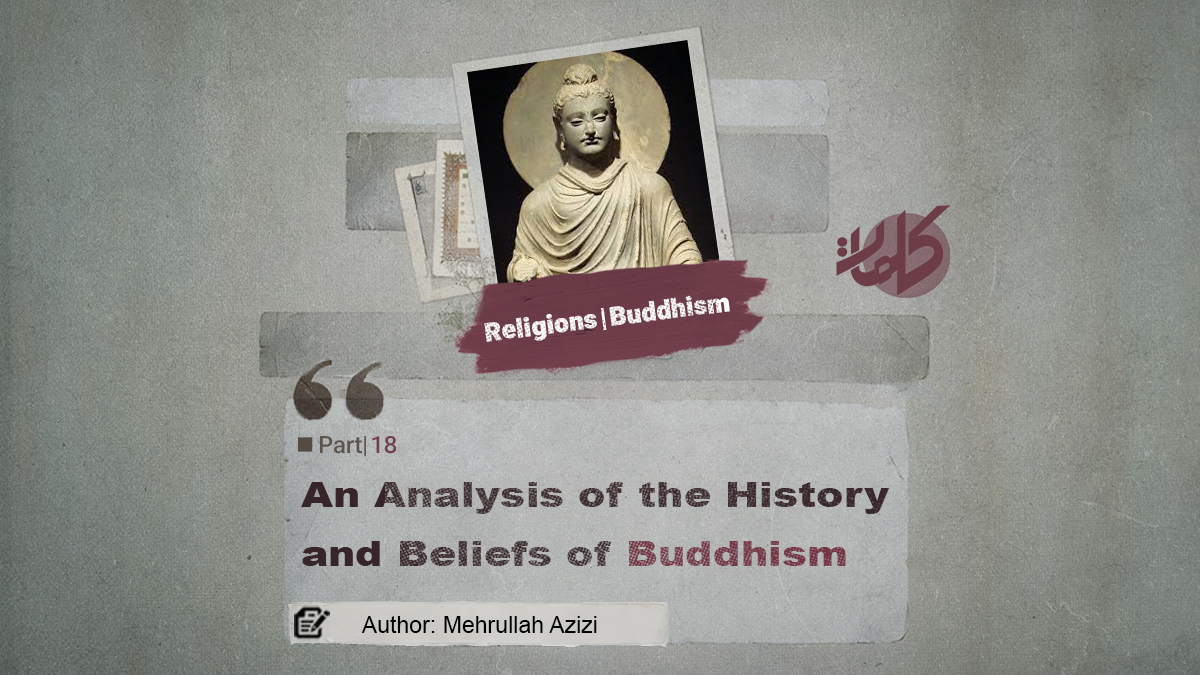
Author: Mehrullah Azizi
An Analysis of the History and Beliefs of Buddhism (part 18)
As discussed in the previous section regarding the ethical and educational teachings of Buddhism, where its most important teachings from the perspective of individual behavior and inner reform were examined, in this section we turn to another fundamental pillar of this tradition, namely, its beliefs and ideas.
Undoubtedly, understanding any school of thought is not complete merely by examining its ethics; rather, it is necessary to analyze its doctrinal foundations and its views regarding God, the Prophet, and the Hereafter, as well as humanity and existence, in a precise manner. Therefore, in what follows, an attempt will be made to explain the core beliefs of Buddhism, especially their view concerning the existence of God and the worship of Buddha, and then critically evaluate them.
Beliefs and Thoughts of Buddhism
1. Denial of the Existence of God
The existence of God and belief in Him have been among the debated and controversial issues within Buddhism. Here, we first explain this belief and then proceed to critique and evaluate it.
2. Explanation of the Belief
In the early stages of his mission, Buddha did not speak about God or metaphysical matters. However, later he expressed statements indicating a tendency toward atheism and denial of God’s existence. In one of his discourses, he mocked those who believed in God, saying that those who speak of God without having seen Him are like a lover who burns with the fire of love without knowing who the beloved is; or like someone who builds a ladder without knowing where the palace is; or like a person who wishes to cross a river but calls upon the opposite bank to come to him.
Some researchers believe that Buddha did believe in God, but he neither explicitly spoke about divinity nor clearly affirmed or denied it. According to them, Buddhism is more of a social and ethical reform movement than a religion in the conventional sense. [1]
Professor Radhakrishnan, who served as the Vice President of India in 1952, states: “Buddha did not formally declare a doctrine, nor did he establish a specific philosophical system, and he did not claim to have come from eternity with a special wisdom. Rather, he firmly believed that he had attained this wisdom through persistent and rigorous effort throughout his life, whether in one lifetime or across successive lives. He guided his followers toward a system that ensured moral growth, but he did not call them to a religion like other religions. In his view, followers should recognize the paths rather than bind themselves to rigid beliefs, for fixed beliefs hinder the search for truth. For this reason, he sometimes rejected certain truths not because they were false, but because they conflicted with the preconceived beliefs of those to whom they were presented.”
Based on this, Buddha did not engage much in speaking about God and avoided entering debates about affirming or denying Him. He refrained from discussions related to theology, metaphysics, and complex existential questions, believing that human liberation depends on oneself rather than on God and that humans are the makers of their own destiny.
Among his sayings is: “Be islands unto yourselves; be your own refuge and shelter. Do not rely on anything external, and seek refuge in none but yourselves.”
He discouraged his companions and visitors from engaging in such discussions and, when asked about highly abstract issues, directed them toward examining their actions, motives, inclinations, emotions, and inner factors. [2]
However, and Allah knows best, the more accurate conclusion appears to be that Buddha inclined toward atheism, as can be inferred from his statements. Early Buddhists also seem to have reached a consensus regarding his atheistic stance. [3]
3. Response and Critique
In Islam, belief in the Oneness of Allah (Tawhid) and in the existence of the Absolute God of the worlds is considered one of the fundamental pillars of faith. Anyone who does not believe in the One God is regarded as misguided, at loss, and distant from truth and innate human nature.
Islam teaches that human salvation and success can only be achieved through Tawhid. The Prophet Muhammad (PBUH) said: «قولوا لا إله إلا الله تفلحوا» Translation: “Say: There is no god but Allah (SWT) and you will succeed.” [4]
Since Buddha and his followers do not believe in Tawhid, they will be in loss both in this world and the Hereafter, and their ultimate fate is Hell.
Tawhid is the essential condition for entering Paradise. Whoever does not accept it in its complete sense cannot enter eternal Paradise. The Prophet (PBUH) said: «من كان آخر كلامه لا إله إلا الله دخل الجنة» Translation: “Whoever’s last words are ‘There is no god but Allah (SWT)’ will enter Paradise.” [5]
To be continued…
Previous Part | Next Part
References:
- Abu Zahrah, Ancient Religions, p. 58.
- Ahmad al-Shalabi, The Major Religions of India, p. 161, citing Guides of Humanity in the East, p. 13.
- Al-A‘zami, Chapters on the Religions of India, p. 142.
- Musnad Ahmad, vol. 25, p. 405.
-
Al-Mustadrak ‘ala al-Sahihayn (by al-Hakim), vol. 1, p. 503.
