


Author: Abu Raef
Freemasonry (part 17)
Connotations of Masonic Symbols and Numbers
Before addressing the examination of the connection between Freemasonry and Judaism and Zionism while this matter is clear and among the self-evident, we will first discuss the symbols and signs of this movement. There is no doubt that most, indeed the vast majority, of these signs and symbols have a direct connection with Judaism, Zionism, and their doctrines.
There is no dispute that movements, organizations, and hidden esoteric schools (whether religious, intellectual, or political) each possess symbols, slogans, numbers, and a special language that distinguish them from others. These indications express their particular beliefs, rituals, and ideas matters whose meanings are understood only by those affiliated with and believing in them.
It should be understood that if Israeli Zionism is a movement whose aim is to gather the Jewish people in the Promised Land, and if Jews believe that the awaited Messiah will appear at the end of times to return his people to the Promised Land and rule the world from Mount Zion so that justice and prosperity may prevail, then they have transformed this religious belief into a political program. Likewise, they have transformed religious slogans and symbols into worldly and political slogans and symbols.
On this basis, Jewish esoteric Masonic symbols, slogans, and numbers have increased in a striking manner, such that a single Masonic slogan may depending on the necessity of the existing situation carry one or several meanings and indications. At times, these slogans are produced and invented by Freemasonry itself, and at other times they are directly influenced by, borrowed from, or adopted as they are from the slogans of earlier nations, civilizations, and religions, or else they are distorted and altered to conform to their global schemes and the construction of a “New World Order.” [1]
The explanation and clarification of this matter will become evident through the following seven topics:
First Topic: Geometric and Architectural Symbols with Specific Masonic Connotations
-
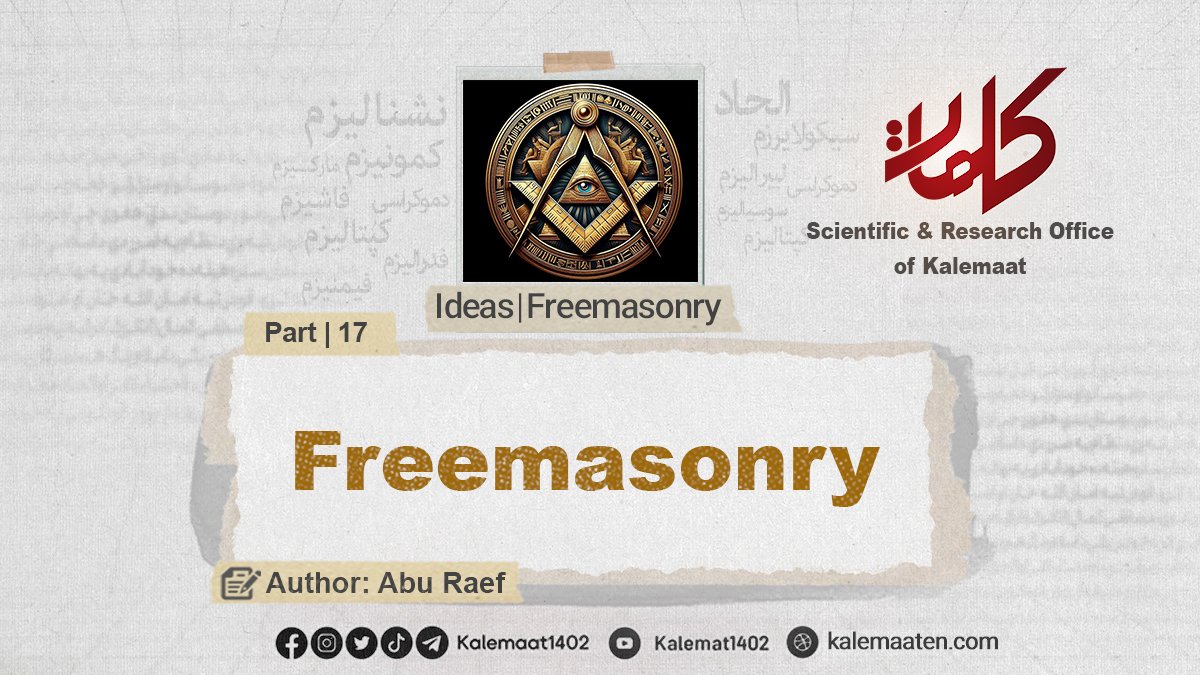
The Pyramid Symbol
The pyramid symbol holds an important place in ancient civilizations, especially in Pharaonic Egyptian civilization, because it symbolizes the House of God, the primordial elevation, the Mountain of Life, and the House of Wisdom—meanings that contain the secrets of wisdom and knowledge. Its four corners represent the four pillars of the world, or the columns that bear the dome of the sky, and they signify truth, knowledge, stability, and mystery. [2]
However, in Masonic thought, the pyramid symbol is considered one of the most important emblems of the Masonic Illuminati, and for this reason its connotations have expanded more than those of other symbols.
The pyramid is a symbol of a conspiracy aimed at the destruction of the Catholic Church (as the representative of global Christianity) and the establishment of a political–economic dictatorial system, whose administration is undertaken by a global government in the style of the United Nations.
The reason for this is the presence of this very symbol on United States dollar banknotes.
The symbol of the “eye” at the apex of the pyramid, which sends out its rays in all directions and is called “the all-seeing eye,” signifies: the intelligence and terrorism organization (the Illuminati), which was founded in 1776 CE by Adam Weishaupt; it also signifies the eye of the satanic god (Baphomet); and even the Antichrist himself, who is one-eyed and stands at the top of the pyramid as a ruler dominating the world.
It also signifies the eye of (Hiram Abiff of Tyre), the architect of the construction of Solomon’s Temple, whose name is mentioned in the First Book of Kings (7:13–22): “And King Solomon sent and brought Hiram from Tyre. He was the son of a widow woman of the tribe of Naphtali, and his father was a man of Tyre, a worker in bronze; and he was filled with wisdom, understanding, and knowledge to do all works in bronze. So he came to King Solomon and performed all his work… And he made two pillars of bronze; eighteen cubits was the height of each pillar, and a line of twelve cubits measured the circumference of each… And he set up the pillars in the porch of the temple; he set up the right pillar and called its name Jachin, and he set up the left pillar and called its name Boaz.” [3]
Certainly, what Freemasonry intends by “Hiram Abiff” is not that historical architect; rather, it refers to (Hiram Epod – 40 CE), one of the pillars of Judaism, who established the hidden Jewish power to strike Christianity and its followers. [4]
Above the eye appears the phrase Annuit Coeptis, meaning “Our plan has succeeded and been accomplished,” and directly beneath the pyramid is the phrase Novus Ordo Seclorum, meaning “The New World Order.” [5]
This sacred triangular pyramid, with its three sides, symbolizes the attributes of the eternal god:
The first side symbolizes divine existence and presence;
The second side symbolizes power and capability;
And the third side symbolizes knowledge and encompassing awareness.
And this eternal god is none other than “Lucifer”: the satanic god, the fallen angel, the god of “Kabbalah,” and the deity of the Masons, whose absolute eye encompasses everything within his sacred triangle. [6]
Undoubtedly, this radiant eye also has a reflection in Pharaonic civilization, in the myth of (Isis and Osiris), when the “Eye of the god Horus” is mentioned—who was blind in the right eye. [7]
To be continued…
Previous Part | Next Part
References:
- Al-Qatt, Khalid Ali Abbas, Connotations of Sacred Symbols and Numbers in Masonic Thought, p. 209, Journal of the Egyptian Philosophical Society, Year Twenty-Six, Issue Twenty-Six.
- Thibaut, Robert Jacques, Encyclopedia of Pharaonic Myths and Symbols, p. 335, translated by Fatimah Abdullah Mahmoud, first edition: 2004 CE, Supreme Council of Culture, Cairo, Egypt.
- Connotations of Sacred Symbols and Numbers in Masonic Thought, p. 211.
- Guy Carr, William, Pawns on the Chessboard, p. 53, Dar al-Kitab al-Arabi, n.d.
- Al-Amir, Baha’, The Jews and the Masons in Revolutions and C.
