

Close Menu
    Facebook X (Twitter) Telegram WhatsApp
    • Language
      • دری
      • پښتو
      • العربیة
    • Home
    • Analysis
    • Islam
      • Prophet of Islam (PBUH)
      • Holy Quran
      • Muslim
      • Belief
      • Faith
      • Worships
      • Fiqh
      • Jihad
      • Islamic Perspectives
      • Islamic Economics
      • Islamic Management
      • Islamic Culture
      • Sufism
      • Crimes
      • Prohibitions
      • Sayings of the Scholars
      • Muhajir Tafsir
      • Hadith
    • Religions
      • Judaism
      • Christianity
      • Buddhism
      • Hinduism
      • Zoroastrianism
      • Satanism
      • Confucianism
      • Sikhism
    • Theories
      • Atheism
      • Secularism
      • liberalism
      • Socialism
      • Communism
      • Democracy
      • Federalism
      • Fascism
      • Capitalism
      • Marxism
      • Feminism
      • Nationalism
      • Colonialism
      • Frankfurt School
      • Freemasonry
      • Humanism
    • Fitan
      • Mu’tazila
      • Murji’ah
      • Jahmiyyah
      • The Fitna of the Khawarij
      • The Fitna of the Rawafid
      • The Fitna of Orientalism
      • Ghamdism
      • The Fitna of the Qadianis
      • Qadariyyah
      • Karramiyyah
    • Ummah
      • Sahabah (Companions of the Prophet ﷺ)
        • Hazrat Abu bakr Siddiq (RA)
        • Hazrat Umar al-Faruq (RA)
        • Hazrat Uthman ibn Affan (RA)
        • Hazrat Ali (RA)
        • Hazrat Khalid ibn al-Walid (RA)
        • Hazrat Fayruz al-Daylami (RA)
        • Hazrat Abdullah ibn al-Zubayr (RA)
      • Ummahat al-Mu’minin
      • Islamic scholars
        • Allamah Sayyid Abul Hasan Ali Nadwi (RH)
        • Imam al-Aʿzam Abu Hanifa (RH)
        • Imam al-Bukhari (RH)
        • Imam al-Tirmidhi (RH)
        • Imam al-Ghazali (RH)
        • Shah Waliullah al-Dehlawi (RH)
        • Sayyid Jamal al-Din Afghani
        • Mawlana Jalal al-Din Muhammad Balkhi Rumi (RH)
      • Muslim Rulers
        • Sultan Salahuddin Ayyubi (RH)
        • Umar ibn Abd al-Aziz (RH)
        • Sultan Yusuf ibn Tashfin (RH)
      • Muslim Scientists
    • Civilizations
      • Islamic Civilization
      • Eastern and Western Civilizations
      • Traces of History
    • Diverse
      • Ramadan Message
      • Reports
      • Light and Darkness
    • library
    Facebook X (Twitter) Telegram WhatsApp Instagram Pinterest YouTube
    kalemaat Englishkalemaat English
    You are at:Home»Religions»Christianity»Points of different Between Islam and Christianity (Part Three)
    Christianity

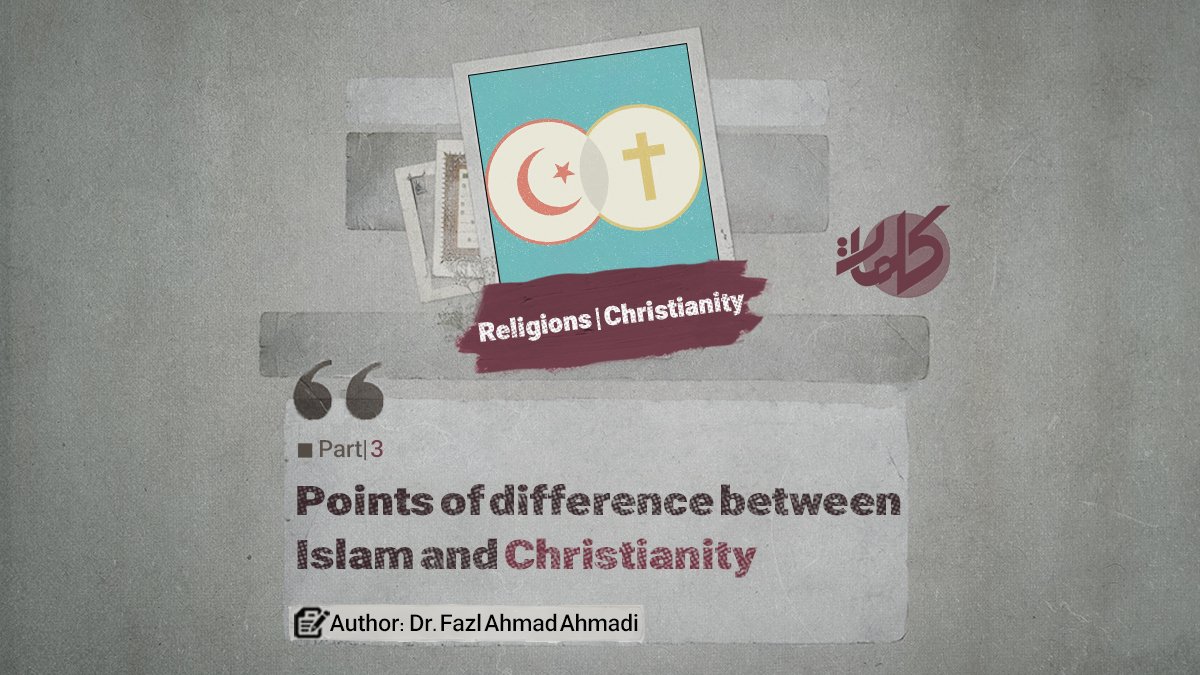
    Points of different Between Islam and Christianity (Part Three)

    By 27/01/2025Updated:27/01/2025No Comments5 Mins Read
    Share Facebook Twitter Telegram WhatsApp
    Share
    Facebook Twitter Telegram Email WhatsApp
    Author: Dr. Fazl Ahmad Ahmadi
    Points of different Between Islam and Christianity (Part Three)
    D. Monotheism and Trinity:
    Christianity, in its essence, is a monotheistic religion, and Christians believe in monotheism. However, it is worth noting that Christians accept monotheism alongside a concept of the Trinity, which, in their belief, ultimately returns to monotheism. According to the doctrine of the Trinity, Christians believe that the One God is manifested in three persons: the Father, the Son, and the Holy Spirit. In reality, Christians hold faith in three hypostases and three divine persons, and to avoid being labeled as disbelievers or accused of polytheism, they assert that these three persons or hypostases are manifestations of a single truth (al-Qaffari and al-‘Aql, 1992: 72; Saeed, n.d.: 280).
    Today, the Trinity is a significant belief for all Christians, with differences in interpretation, although it is not the original doctrine of Christianity (al-Samouk and al-Shammari, n.d.: 345). They believe: “When Christians speak of the Trinity, they are trying to express the oneness of God.” Defending such a belief, which appears irrational and incomprehensible, and explaining the return of the Trinity to monotheism, was one of the main concerns of Christian theologians in the medieval period. This is because the early Christians did not believe in the Trinity and considered Christ a prophet and messenger of God.
    The Ebionites and early Christians of the first centuries A.D. believed that Jesus Christ was merely an ordinary human being, the son of Mary, who was born by the absolute power of God without a father (Taheri & Taheri, 2009: 14). However, it seems that the issue of worshipping multiple entities was present from the early days of Christianity, as the Holy Qur’an says:
    «وَإِذْ قَالَ اللَّهُ يَا عِيسَى ابْنَ مَرْيَمَ أَأَنتَ قُلْتَ لِلنَّاسِ اتَّخِذُونِي وَأُمِّيَ إِلَهَيْنِ مِن دُونِ اللَّهِ قَالَ سُبْحَانَكَ مَا يَكُونُ لِي أَنْ أَقُولَ مَا لَيْسَ لِي بِحَقٍّ إِن كُنتُ قُلْتُهُ فَقَدْ عَلِمْتَهُ تَعْلَمُ مَا فِي نَفْسِي وَلَا أَعْلَمُ مَا فِي نَفْسِكَ إِنَّكَ أَنتَ عَلَّامُ الْغُيُوبِ»
    (Al-Ma’idah, 116)
    In Islam, the pinnacle of all beliefs is monotheism and the oneness of God. In other words, monotheism is the most fundamental doctrine and the foundation of all Muslim beliefs. The Holy Qur’an, as the most authentic religious source in Islam, without any alteration or distortion, consistently emphasizes monotheism and regards it as the core essence of Islam. The entry into Islam begins with the phrase “لا اله الا الله” (There is no deity but Allah).

    Numerous verses in the Qur’an explicitly and implicitly emphasize monotheism. These include:
    1- “Say: He is Allah, the One” (Al-Ikhlas, 1);
    2- “There is no deity but Allah” (As-Saffat, 37; and Muhammad, 19);
    3- “There is no deity except Him” (Al-Baqarah, 163);
    4- “Indeed, your God is One” (Yusuf, 110; Al-Anbiya, 8; and Fussilat, 6);
    5- “There is no deity but Allah” (Sad, 65).

    In all these verses, the existence of a singular and unique God is explicitly emphasized. At times, God provides reasoning to affirm monotheism, as in: “Had there been within them [the heavens and the earth] gods besides Allah, they both would have been ruined” (Al-Anbiya, 22).
    Thus, while explaining monotheism in all its dimensions in Islam requires separate research, the references to the above-mentioned verses suffice for this discussion.
    E-God:
    In Christianity, the most common name for God is Yahweh. In Islam, the most common name for God is Allah, similar to Eloah in the Old Testament. The vast majority of Christians in the world adhere to the doctrine of the Trinity, which states in its creed that God is three persons (Father, Son, and Spirit) in one essence. In Islam, this concept is considered a denial of monotheism and, as a result, the sin of polytheism, which is considered one of the major sins. The Quran itself refers to the Trinity in verse 73 of Al-Ma’idah, which says: “They have disbelieved who say: ‘Allah is the third of three.’ And there is no god but Allah. And if they do not desist from what they say, a painful punishment will surely befall the disbelievers.”
    And- Mutual Social Behaviours:
    In the world of facts and the position of practice that has emerged between Muslims and Christians, the good behavior and good behavior of Muslims towards Christians and the life of the followers of Christ (peace be upon him) among Islamic nations and their socio-political advancement, sometimes to the point of ministry and having the right to perform religious rituals and have monasteries and churches, is evidence of respect for Christianity as a heavenly religion abolished by Islam and the respectful life of Christians in Islamic society. Perhaps the most striking example of this behavior and behavior of Muslims towards Christians can be seen during the Crusades, during which Muslims separated the actions of the European Crusaders from the local Christians and never blamed the crimes of the invading warriors on the Christian inhabitants of the region. Local Christians in Muslim-populated areas enjoyed their full civil and religious rights and even benefited from the support of Muslims in cases of disagreement with non-native Christians. This behavior and good conduct of Muslims occurred while Muslims were deprived of civil rights in areas under the control of invaders and were even denied the right to own a mosque (Binesh, Bita: 81).
    [1] – «قُلْ هُوَ اللَّهُ أَحَدٌ».
    [2] – «لَا إِلهَ إِلَّا اللَّهُ».
    [3] – «وَإِلَهُكُمْ إِلَهٌ وَاحِدٌ».
    [4] – «أَنَّمَا إِلَهُكُمْ إِلَهٌ وَاحِدٌ».
    [5] – «وَمَا مِنْ إِلَهٍ إِلَّا اللَّهُ».
    [6] – «لَوْ كَانَ فِيهِمَا آلِهَةٌ إِلَّا اللَّهُ لَفَسَدَتَا».

    Related Posts

    An Analysis of the History and Beliefs of Buddhism (part 39)

    03/06/2026

    An Analysis of the History and Beliefs of Buddhism (part 38)

    29/05/2026

    An Analysis of the History and Beliefs of Buddhism (part 37)

    29/05/2026
    Leave A Reply Cancel Reply

    Follow us on the social media pages
    • Facebook
    • Twitter
    • Instagram
    • Telegram
    • WhatsApp
    Don’t miss

    The Status of Knowledge

    Serving One’s Parents

    Imam al-A‘zam Abu Hanifa (RA): The Role Model (part 35)

    The Worst of People

    About Us:

    The Academic and Research Organization of Kalemaat is an independent Islamic Da'wah organization affiliated with Ahl al-Sunnah wa al-Jama'ah. It is dedicated to promoting the authentic values of Islam, advancing the higher objectives of the Sharia, countering Western cultural influence, upholding the Word of Allah, and contributing to the intellectual and spiritual awakening of the Muslim Ummah.

    The Organization is supported by Muslim philanthropists and businessmen, and it welcomes the cooperation and support of Muslims worldwide in advancing its mission.

    Famous publications

    The Status of Knowledge

    15/10/2026

    Serving One’s Parents

    15/10/2026
    Follow us on social medias
    • Facebook
    • Twitter
    • YouTube
    • Telegram
    • Instagram
    • WhatsApp
    All right reserved by (kalemaat)
    • Home
    • Analysis of the day
    • The greats of the Ummah
    • library

    Type above and press Enter to search. Press Esc to cancel.