Close Menu
    Facebook X (Twitter) Telegram WhatsApp
    • Language
      • دری
      • پښتو
      • العربیة
    • Home
    • Analysis
    • Islam
      • Prophet of Islam (PBUH)
      • Holy Quran
      • Muslim
      • Belief
      • Faith
      • Worships
      • Fiqh
      • Jihad
      • Islamic Perspectives
      • Islamic Economics
      • Islamic Management
      • Islamic Culture
      • Sufism
      • Crimes
      • Prohibitions
      • Sayings of the Scholars
      • Muhajir Tafsir
      • Hadith
    • Religions
      • Judaism
      • Christianity
      • Buddhism
      • Hinduism
      • Zoroastrianism
      • Satanism
      • Confucianism
      • Sikhism
    • Theories
      • Atheism
      • Secularism
      • liberalism
      • Socialism
      • Communism
      • Democracy
      • Federalism
      • Fascism
      • Capitalism
      • Marxism
      • Feminism
      • Nationalism
      • Colonialism
      • Frankfurt School
      • Freemasonry
      • Humanism
    • Fitan
      • Mu’tazila
      • Murji’ah
      • Jahmiyyah
      • The Fitna of the Khawarij
      • The Fitna of the Rawafid
      • The Fitna of Orientalism
      • Ghamdism
      • The Fitna of the Qadianis
      • Qadariyyah
      • Karramiyyah
    • Ummah
      • Sahabah (Companions of the Prophet ﷺ)
        • Hazrat Abu bakr Siddiq (RA)
        • Hazrat Umar al-Faruq (RA)
        • Hazrat Uthman ibn Affan (RA)
        • Hazrat Ali (RA)
        • Hazrat Khalid ibn al-Walid (RA)
        • Hazrat Fayruz al-Daylami (RA)
        • Hazrat Abdullah ibn al-Zubayr (RA)
      • Ummahat al-Mu’minin
      • Islamic scholars
        • Allamah Sayyid Abul Hasan Ali Nadwi (RH)
        • Imam al-Aʿzam Abu Hanifa (RH)
        • Imam al-Bukhari (RH)
        • Imam al-Tirmidhi (RH)
        • Imam al-Ghazali (RH)
        • Shah Waliullah al-Dehlawi (RH)
        • Sayyid Jamal al-Din Afghani
        • Mawlana Jalal al-Din Muhammad Balkhi Rumi (RH)
      • Muslim Rulers
        • Sultan Salahuddin Ayyubi (RH)
        • Umar ibn Abd al-Aziz (RH)
        • Sultan Yusuf ibn Tashfin (RH)
      • Muslim Scientists
    • Civilizations
      • Islamic Civilization
      • Eastern and Western Civilizations
      • Traces of History
    • Diverse
      • Ramadan Message
      • Reports
      • Light and Darkness
    • library
    Facebook X (Twitter) Telegram WhatsApp Instagram Pinterest YouTube
    kalemaat Englishkalemaat English
    You are at:Home»Diverse»The Roots and Impacts of Hopelessness, and Strategies to Overcome It (Part Two)
    Diverse

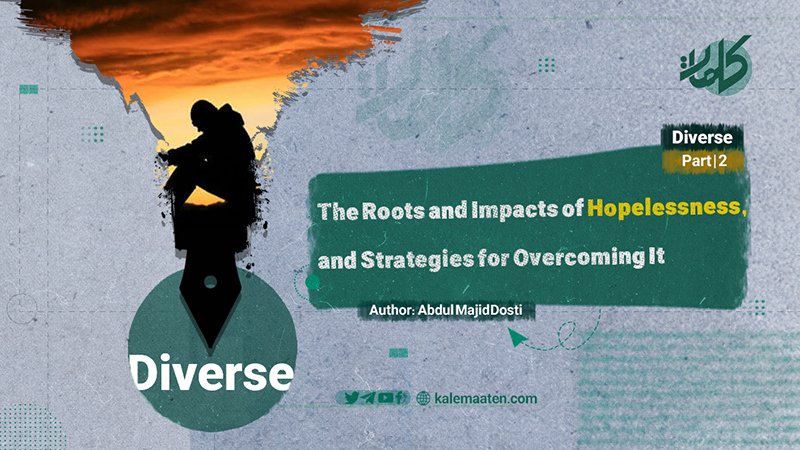
    The Roots and Impacts of Hopelessness, and Strategies to Overcome It (Part Two)

    By 17/12/2024No Comments3 Mins Read
    Share Facebook Twitter Telegram WhatsApp
    Share
    Facebook Twitter Telegram Email WhatsApp
    Author: Abdul Majid Dosti
    The Roots and Impacts of Hopelessness, and Strategies to Overcome It (Part Two)
    The world is a space for applying tools and analyzing events using intellect and insight. Few matters lie beyond reason and wisdom. While religious and ideological themes are outside this discussion, our focus remains on issues that can be understood through rational thought. Therefore, we aim to explore one of the causes of despair that arises from personal encounters or is influenced by external conditions.
    Delving deeper, we find that despair is a temporary state individuals may experience amid both minor and significant events. This feeling can lead to hopelessness and depression, affecting one’s mental and physical well-being and causing disruptions in actions and reactions. A hidden factor contributing to despair is the repressive treatment that an individual may have encountered during childhood, often within the family, which now manifests in their temperament during youth and adulthood.
    1. Family Repression
    The family, as the primary educational environment for a child, provides the essential foundation for their upbringing and future development. Childhood experiences, including the amount of affection received, leave a profound imprint on the child’s spirit. A lack of love and warmth during these formative years can create a lasting void. If a child feels like a burden to their family, growing up surrounded by cold and unkind words, they may internalize the belief that they are unnecessary weights on society. This feeling can engender a constant need for attention and affection from others. If their emotional needs remain unmet, they may suffer from emotional fractures, leading to feelings of failure and, consequently, profound despair.
    The way parents interact with their children heavily influences a person’s sense of hopefulness. Children, nurtured by their parents, are like unblossomed seeds, planted in their mother’s womb, growing into young saplings. Under their parents’ care, those seeds can flourish into maturity, intellectual strength, and a solid foundation. During the crucial phase of developing resilience and acquiring the intellectual understanding needed for independence, parents serve as mentors and guardians, guiding their children away from anything that might undermine their growth.
    Unfortunately, it is alarming when parents become the very source of negative influences in their children’s minds. When a gardener becomes a thief or a guard dresses as a robber, it represents a tragic loss, prompting mourning for lost potential.
    A child, molded by their parents, needs careful guidance to develop intellectually and emotionally. Instead, they may absorb intense and harmful stress from their closest protectors, which creates a lasting sense of weakness and failure extending into adulthood. A noble saying reminds us that children are born with pure nature, and it is the parents’ responsibility to provide guidance toward a positive direction.
    Thus, one root of despair in a person’s psyche lies in their childhood experiences, particularly the neglect or lack of attention from family. These experiences manifest later in life as hopelessness and a sense of failure. Therefore, it is crucial to confront negative, destructive factors and eliminate them at their source. The method and intensity of this confrontation vary based on the depth and persistence of each issue.
    Addressing issues stemming from family repression requires more time and effort than dealing with temporary causes of despair. However, with resilience, perseverance, and a consistent personal improvement plan filled with hope and joy, overcoming these challenges is within reach. All causes of despair can be remedied by seeking solutions, allowing for a return to mental health and renewed strength, enabling individuals to reintegrate into society with fresh vigor.
    Continues…

    Related Posts

    The Divine Education Model in the Family of the Prophets (Part 144)

    19/10/2026

    The Divine Education Model in the Family of the Prophets (Part 143)

    18/10/2026

    The Divine Education Model in the Family of the Prophets (Part 142)

    17/10/2026
    Leave A Reply Cancel Reply

    Follow us on the social media pages
    • Facebook
    • Twitter
    • Instagram
    • Telegram
    • WhatsApp
    Don’t miss

    The Reality of Repentance

    Increase in Lifespan

    Imam al-A‘zam Abu Hanifa (RA): The Role Model (part 36)

    Loyalty to One’s Teacher

    About Us:

    The Academic and Research Organization of Kalemaat is an independent Islamic Da'wah organization affiliated with Ahl al-Sunnah wa al-Jama'ah. It is dedicated to promoting the authentic values of Islam, advancing the higher objectives of the Sharia, countering Western cultural influence, upholding the Word of Allah, and contributing to the intellectual and spiritual awakening of the Muslim Ummah.

    The Organization is supported by Muslim philanthropists and businessmen, and it welcomes the cooperation and support of Muslims worldwide in advancing its mission.

    Famous publications

    The Reality of Repentance

    21/10/2026

    Increase in Lifespan

    21/10/2026
    Follow us on social medias
    • Facebook
    • Twitter
    • YouTube
    • Telegram
    • Instagram
    • WhatsApp
    All right reserved by (kalemaat)
    • Home
    • Analysis of the day
    • The greats of the Ummah
    • library

    Type above and press Enter to search. Press Esc to cancel.
