Close Menu
    Facebook X (Twitter) Telegram WhatsApp
    • Language
      • دری
      • پښتو
      • العربیة
    • Home
    • Analysis
    • Islam
      • Prophet of Islam (PBUH)
      • Holy Quran
      • Muslim
      • Belief
      • Faith
      • Worships
      • Fiqh
      • Jihad
      • Islamic Perspectives
      • Islamic Economics
      • Islamic Management
      • Islamic Culture
      • Sufism
      • Crimes
      • Prohibitions
      • Sayings of the Scholars
      • Muhajir Tafsir
      • Hadith
    • Religions
      • Judaism
      • Christianity
      • Buddhism
      • Hinduism
      • Zoroastrianism
      • Satanism
      • Confucianism
      • Sikhism
    • Theories
      • Atheism
      • Secularism
      • liberalism
      • Socialism
      • Communism
      • Democracy
      • Federalism
      • Fascism
      • Capitalism
      • Marxism
      • Feminism
      • Nationalism
      • Colonialism
      • Frankfurt School
      • Freemasonry
      • Humanism
    • Fitan
      • Mu’tazila
      • Murji’ah
      • Jahmiyyah
      • The Fitna of the Khawarij
      • The Fitna of the Rawafid
      • The Fitna of Orientalism
      • Ghamdism
      • The Fitna of the Qadianis
      • Qadariyyah
      • Karramiyyah
    • Ummah
      • Sahabah (Companions of the Prophet ﷺ)
        • Hazrat Abu bakr Siddiq (RA)
        • Hazrat Umar al-Faruq (RA)
        • Hazrat Uthman ibn Affan (RA)
        • Hazrat Ali (RA)
        • Hazrat Khalid ibn al-Walid (RA)
        • Hazrat Fayruz al-Daylami (RA)
        • Hazrat Abdullah ibn al-Zubayr (RA)
      • Ummahat al-Mu’minin
      • Islamic scholars
        • Allamah Sayyid Abul Hasan Ali Nadwi (RH)
        • Imam al-Aʿzam Abu Hanifa (RH)
        • Imam al-Bukhari (RH)
        • Imam al-Tirmidhi (RH)
        • Imam al-Ghazali (RH)
        • Shah Waliullah al-Dehlawi (RH)
        • Sayyid Jamal al-Din Afghani
        • Mawlana Jalal al-Din Muhammad Balkhi Rumi (RH)
      • Muslim Rulers
        • Sultan Salahuddin Ayyubi (RH)
        • Umar ibn Abd al-Aziz (RH)
        • Sultan Yusuf ibn Tashfin (RH)
      • Muslim Scientists
    • Civilizations
      • Islamic Civilization
      • Eastern and Western Civilizations
      • Traces of History
    • Diverse
      • Ramadan Message
      • Reports
      • Light and Darkness
    • library
    Facebook X (Twitter) Telegram WhatsApp Instagram Pinterest YouTube
    kalemaat Englishkalemaat English
    You are at:Home»Diverse»The Roots and Impacts of Hopelessness, and Strategies for Overcoming it (Part One)
    Diverse

    The Roots and Impacts of Hopelessness, and Strategies for Overcoming it (Part One)

    By 03/11/2024No Comments3 Mins Read
    Share Facebook Twitter Telegram WhatsApp
    Share
    Facebook Twitter Telegram Email WhatsApp
    Author: Abdul Majid Dosti
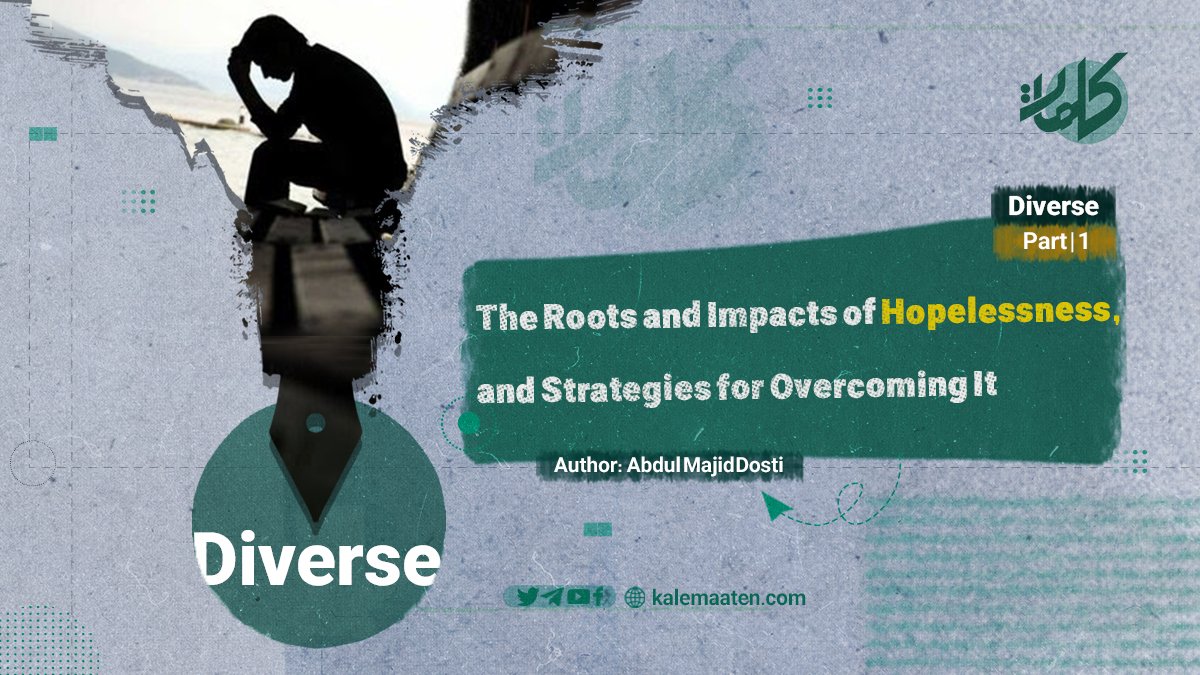
    The Roots and Impacts of Hopelessness, and Strategies for Overcoming it (Part One)
    Human beings are a collection of various moods and conditions, influenced at every stage of life by prevailing circumstances. Their temperament takes on hues of good and bad, and their nature can transform, sometimes undergoing a complete shift that makes them almost unrecognizable. It feels as if we’re encountering them for the first time, rediscovering them all over again. Therefore, humans rarely exhibit a consistent and singular disposition, often demonstrating changes in habits and behaviors. Depending on the circumstances, they may respond to those around them in a manner that is either pleasant or disagreeable.
    To illustrate this state, it is like a pot of food placed over a fire; whatever you put into the pot is what will cook and emerge. Alternatively, it is like soil: whatever you plant is what will grow. One cannot expect wheat from barley, nor corn from barley, and every reaction is the outcome of an earlier action. Likewise, a person’s mood is influenced by their surroundings; seeing, hearing, touching, or even feeling certain things and events can instantly transform their personal world, reshaping it and breaking down their inner self.
    Now, these impactful moods can be divided into positive and negative, good and bad. Corresponding to this influence, an individual’s actions are transformed, affecting not only their personal life but also their family life in both the short and long term.
    For example, if a person gets into a trivial argument with a colleague, allowing it to escalate into a confrontation with angry words, they sacrifice their peace over a meaningless matter. Later, when they come home still anxious and troubled, they may react more quickly and sharply to minor irritations, raising their voice with family members in a way that feels particularly harsh. Since this person holds a respected position in the family, no one dares to confront them or offer an explanation; instead, the family becomes silent sufferers, victims of the unresolved issues from outside.
    On the contrary, happy and joyful moods yield better outcomes, spreading cheer to both the individual and their loved ones. For instance, when a person experiences joyful moments, immersed in happiness, they avoid anything negative or inappropriate that might tarnish the purity of their joy. Just as they wish to protect their own happiness, they also go out of their way to fill the hearts of their family members with joy, showering them with moments of laughter and positivity.
    One of these varied moods and emotional challenges is despair, a negative and often harmful state. This feeling of deep hopelessness sometimes arises due to specific causes, impacting a person’s core and altering their behavior. Despair can stem from various powerful reasons, sometimes leading individuals to extreme actions like self-harm or choosing detrimental paths for their lives. It can also lead a person to inflict pain on others, manifesting their hopelessness in various forms across society.
    In this article, we will first examine the factors that lead to symptoms of despair in an individual, turning their expression into a showcase of gloom. Next, we will discuss the consequences of this despair, and finally explore strategies and methods for combating it, Allah willing.
    Continues…

    Related Posts

    The Divine Education Model in the Family of the Prophets (Part 144)

    19/10/2026

    The Divine Education Model in the Family of the Prophets (Part 143)

    18/10/2026

    The Divine Education Model in the Family of the Prophets (Part 142)

    17/10/2026
    Leave A Reply Cancel Reply

    Follow us on the social media pages
    • Facebook
    • Twitter
    • Instagram
    • Telegram
    • WhatsApp
    Don’t miss

    The Reality of Repentance

    Increase in Lifespan

    Imam al-A‘zam Abu Hanifa (RA): The Role Model (part 36)

    Loyalty to One’s Teacher

    About Us:

    The Academic and Research Organization of Kalemaat is an independent Islamic Da'wah organization affiliated with Ahl al-Sunnah wa al-Jama'ah. It is dedicated to promoting the authentic values of Islam, advancing the higher objectives of the Sharia, countering Western cultural influence, upholding the Word of Allah, and contributing to the intellectual and spiritual awakening of the Muslim Ummah.

    The Organization is supported by Muslim philanthropists and businessmen, and it welcomes the cooperation and support of Muslims worldwide in advancing its mission.

    Famous publications

    The Reality of Repentance

    21/10/2026

    Increase in Lifespan

    21/10/2026
    Follow us on social medias
    • Facebook
    • Twitter
    • YouTube
    • Telegram
    • Instagram
    • WhatsApp
    All right reserved by (kalemaat)
    • Home
    • Analysis of the day
    • The greats of the Ummah
    • library

    Type above and press Enter to search. Press Esc to cancel.
