Close Menu
    Facebook X (Twitter) Telegram WhatsApp
    • Language
      • دری
      • پښتو
      • العربیة
    • Home
    • Analysis
    • Islam
      • Prophet of Islam (PBUH)
      • Holy Quran
      • Muslim
      • Belief
      • Faith
      • Worships
      • Fiqh
      • Jihad
      • Islamic Perspectives
      • Islamic Economics
      • Islamic Management
      • Islamic Culture
      • Sufism
      • Crimes
      • Prohibitions
      • Sayings of the Scholars
      • Muhajir Tafsir
      • Hadith
    • Religions
      • Judaism
      • Christianity
      • Buddhism
      • Hinduism
      • Zoroastrianism
      • Satanism
      • Confucianism
      • Sikhism
    • Theories
      • Atheism
      • Secularism
      • liberalism
      • Socialism
      • Communism
      • Democracy
      • Federalism
      • Fascism
      • Capitalism
      • Marxism
      • Feminism
      • Nationalism
      • Colonialism
      • Frankfurt School
      • Freemasonry
      • Humanism
    • Fitan
      • Mu’tazila
      • Murji’ah
      • Jahmiyyah
      • The Fitna of the Khawarij
      • The Fitna of the Rawafid
      • The Fitna of Orientalism
      • Ghamdism
      • The Fitna of the Qadianis
      • Qadariyyah
      • Karramiyyah
    • Ummah
      • Sahabah (Companions of the Prophet ﷺ)
        • Hazrat Abu bakr Siddiq (RA)
        • Hazrat Umar al-Faruq (RA)
        • Hazrat Uthman ibn Affan (RA)
        • Hazrat Ali (RA)
        • Hazrat Khalid ibn al-Walid (RA)
        • Hazrat Fayruz al-Daylami (RA)
        • Hazrat Abdullah ibn al-Zubayr (RA)
      • Ummahat al-Mu’minin
      • Islamic scholars
        • Allamah Sayyid Abul Hasan Ali Nadwi (RH)
        • Imam al-Aʿzam Abu Hanifa (RH)
        • Imam al-Bukhari (RH)
        • Imam al-Tirmidhi (RH)
        • Imam al-Ghazali (RH)
        • Shah Waliullah al-Dehlawi (RH)
        • Sayyid Jamal al-Din Afghani
        • Mawlana Jalal al-Din Muhammad Balkhi Rumi (RH)
      • Muslim Rulers
        • Sultan Salahuddin Ayyubi (RH)
        • Umar ibn Abd al-Aziz (RH)
        • Sultan Yusuf ibn Tashfin (RH)
      • Muslim Scientists
    • Civilizations
      • Islamic Civilization
      • Eastern and Western Civilizations
      • Traces of History
    • Diverse
      • Ramadan Message
      • Reports
      • Light and Darkness
    • library
    Facebook X (Twitter) Telegram WhatsApp Instagram Pinterest YouTube
    kalemaat Englishkalemaat English
    You are at:Home»Diverse»The Roots and Impacts of Hopelessness and Strategies for Overcoming It (Part 6)
    Diverse

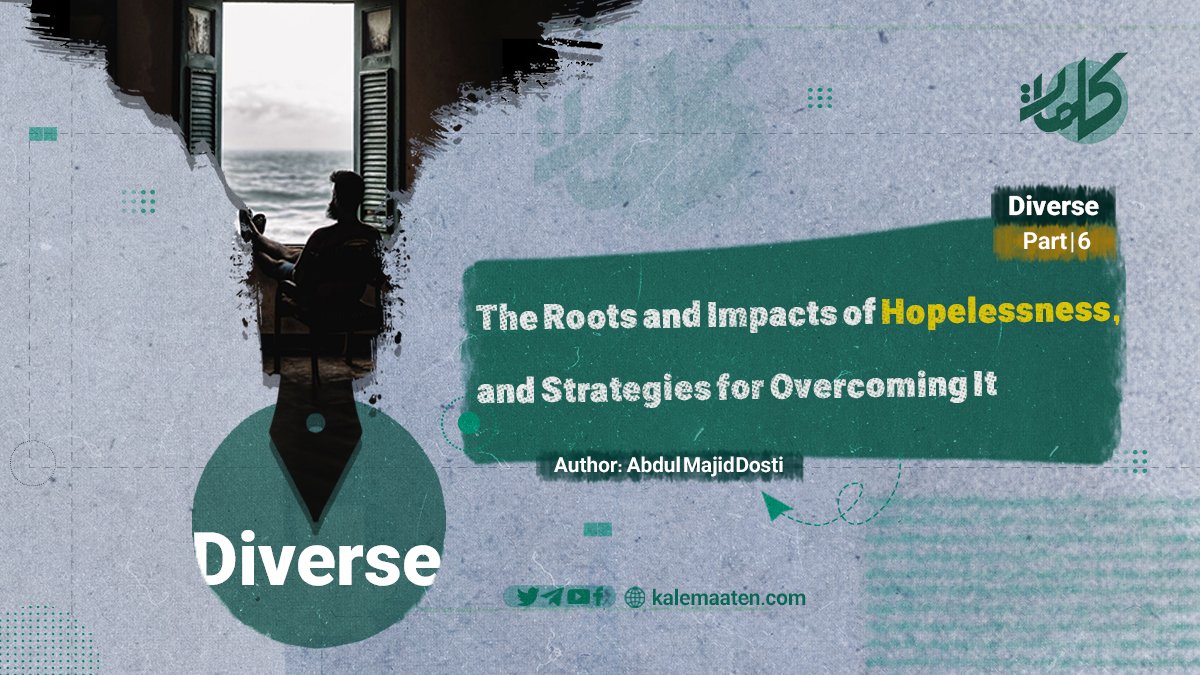
    The Roots and Impacts of Hopelessness and Strategies for Overcoming It (Part 6)

    By 22/12/2024No Comments3 Mins Read
    Share Facebook Twitter Telegram WhatsApp
    Share
    Facebook Twitter Telegram Email WhatsApp
    Author: Abdul Majid Dosti
    The Roots and Impacts of Hopelessness and Strategies for Overcoming It (Part 6)
    Undoubtedly, humans are inherently in need of companionship, a confidant, someone to share their existence with. Their soul beats with the desire to be near another, and their heart trembles in yearning for union. Deep within their mind, intellect, and senses, they long for someone who understands their words, empathizes with their feelings, and calms their spirit with mere presence. In the embrace of that beloved soul, as free as a desert gazelle, their heart settles, and they are enveloped in serenity. Love elevates a person, allowing them to soar in the boundless skies of affection and kindness.
    Love transitions a person from a state of logical reasoning and rationality to a state of passionate loving and viewing the world through a lens of tenderness and positivity. It transforms their manner of interaction, their speech, and their perspective, making everything appear more attractive and captivating. The world seems brighter, and every face becomes more beautiful.
    However, when this romantic and passionate phase ends, whether due to internal or external reasons—unilateral or mutual—such as the interference and opposition of families, and the love fails to culminate in a happy ending, it feels as though the person has been sacrificed at the altar of love, their soul shattered while still alive. One of the primary causes of despair is the heartbreak caused by unfulfilled love, which we will delve into further below:
    5. Heartbreak
    Love is like a bottle of perfume; when it shatters, all its enchanting fragrances dissipate, leaving only broken glass behind. The shards may still carry a hint of the once-beautiful scent, but handling and gathering them cuts and wounds the hands, turning the sweet pleasure of love into the bitterness of disillusionment and suffering.
    Heartbreak feels like dying before death, losing everything in every sense. It is a separation of the soul from the body, leaving one’s intellect and emotions wandering aimlessly in a desert of confusion, caught in a conflict between rational decisions and the desires of the heart and soul.
    Heartbreak is like wearing mourning clothes, even though no loved one has passed away. Yet, the pain of loss feels far greater, breaking the person’s heart into pieces. Their beloved is still alive, walking the same earth and breathing the same air, but it feels as if iron bars have been placed between the lover and the beloved—an unbreakable barrier that prevents closeness, union, or any chance of turning separation into togetherness.
    When such a situation arises, one finds themselves ensnared in despair. This despair weaves an inescapable web around the heartbroken individual, rendering them unable to move or summon the strength to escape. It is like prey caught in the coils of a serpent, as it slowly tightens its grip, crushing bones and gradually draining life.
    One of the outcomes of heartbreak is despair, which engulfs a person in a fog of restlessness, idleness, and emotional numbness. Thus, it can be said that heartbreak is one of the strongest causes of despair, often surpassing other factors, driving individuals to the brink of madness, and stripping them of their intellect, reason, and wisdom.
    Continues…

    Related Posts

    The Divine Education Model in the Family of the Prophets (Part 144)

    19/10/2026

    The Divine Education Model in the Family of the Prophets (Part 143)

    18/10/2026

    The Divine Education Model in the Family of the Prophets (Part 142)

    17/10/2026
    Leave A Reply Cancel Reply

    Follow us on the social media pages
    • Facebook
    • Twitter
    • Instagram
    • Telegram
    • WhatsApp
    Don’t miss

    Increase in Lifespan

    Imam al-A‘zam Abu Hanifa (RA): The Role Model (part 36)

    Loyalty to One’s Teacher

    The Divine Education Model in the Family of the Prophets (Part 144)

    About Us:

    The Academic and Research Organization of Kalemaat is an independent Islamic Da'wah organization affiliated with Ahl al-Sunnah wa al-Jama'ah. It is dedicated to promoting the authentic values of Islam, advancing the higher objectives of the Sharia, countering Western cultural influence, upholding the Word of Allah, and contributing to the intellectual and spiritual awakening of the Muslim Ummah.

    The Organization is supported by Muslim philanthropists and businessmen, and it welcomes the cooperation and support of Muslims worldwide in advancing its mission.

    Famous publications

    Increase in Lifespan

    21/10/2026

    Imam al-A‘zam Abu Hanifa (RA): The Role Model (part 36)

    20/10/2026
    Follow us on social medias
    • Facebook
    • Twitter
    • YouTube
    • Telegram
    • Instagram
    • WhatsApp
    All right reserved by (kalemaat)
    • Home
    • Analysis of the day
    • The greats of the Ummah
    • library

    Type above and press Enter to search. Press Esc to cancel.
