Close Menu
    Facebook X (Twitter) Telegram WhatsApp
    • Language
      • دری
      • پښتو
      • العربیة
    • Home
    • Analysis
    • Islam
      • Prophet of Islam (PBUH)
      • Holy Quran
      • Muslim
      • Belief
      • Faith
      • Worships
      • Fiqh
      • Jihad
      • Islamic Perspectives
      • Islamic Economics
      • Islamic Management
      • Islamic Culture
      • Sufism
      • Crimes
      • Prohibitions
      • Sayings of the Scholars
      • Muhajir Tafsir
      • Hadith
    • Religions
      • Judaism
      • Christianity
      • Buddhism
      • Hinduism
      • Zoroastrianism
      • Satanism
      • Confucianism
      • Sikhism
    • Theories
      • Atheism
      • Secularism
      • liberalism
      • Socialism
      • Communism
      • Democracy
      • Federalism
      • Fascism
      • Capitalism
      • Marxism
      • Feminism
      • Nationalism
      • Colonialism
      • Frankfurt School
      • Freemasonry
      • Humanism
    • Fitan
      • Mu’tazila
      • Murji’ah
      • Jahmiyyah
      • The Fitna of the Khawarij
      • The Fitna of the Rawafid
      • The Fitna of Orientalism
      • Ghamdism
      • The Fitna of the Qadianis
      • Qadariyyah
      • Karramiyyah
    • Ummah
      • Sahabah (Companions of the Prophet ﷺ)
        • Hazrat Abu bakr Siddiq (RA)
        • Hazrat Umar al-Faruq (RA)
        • Hazrat Uthman ibn Affan (RA)
        • Hazrat Ali (RA)
        • Hazrat Khalid ibn al-Walid (RA)
        • Hazrat Fayruz al-Daylami (RA)
        • Hazrat Abdullah ibn al-Zubayr (RA)
      • Ummahat al-Mu’minin
      • Islamic scholars
        • Allamah Sayyid Abul Hasan Ali Nadwi (RH)
        • Imam al-Aʿzam Abu Hanifa (RH)
        • Imam al-Bukhari (RH)
        • Imam al-Tirmidhi (RH)
        • Imam al-Ghazali (RH)
        • Shah Waliullah al-Dehlawi (RH)
        • Sayyid Jamal al-Din Afghani
        • Mawlana Jalal al-Din Muhammad Balkhi Rumi (RH)
      • Muslim Rulers
        • Sultan Salahuddin Ayyubi (RH)
        • Umar ibn Abd al-Aziz (RH)
        • Sultan Yusuf ibn Tashfin (RH)
      • Muslim Scientists
    • Civilizations
      • Islamic Civilization
      • Eastern and Western Civilizations
      • Traces of History
    • Diverse
      • Ramadan Message
      • Reports
      • Light and Darkness
    • library
    Facebook X (Twitter) Telegram WhatsApp Instagram Pinterest YouTube
    kalemaat Englishkalemaat English
    You are at:Home»Religions»Shinto religion (Part 19)
    Religions

    Shinto religion (Part 19)

    By 25/11/2025Updated:27/11/2025No Comments4 Mins Read
    Share Facebook Twitter Telegram WhatsApp
    Share
    Facebook Twitter Telegram Email WhatsApp
    Author: Abu Ayesha

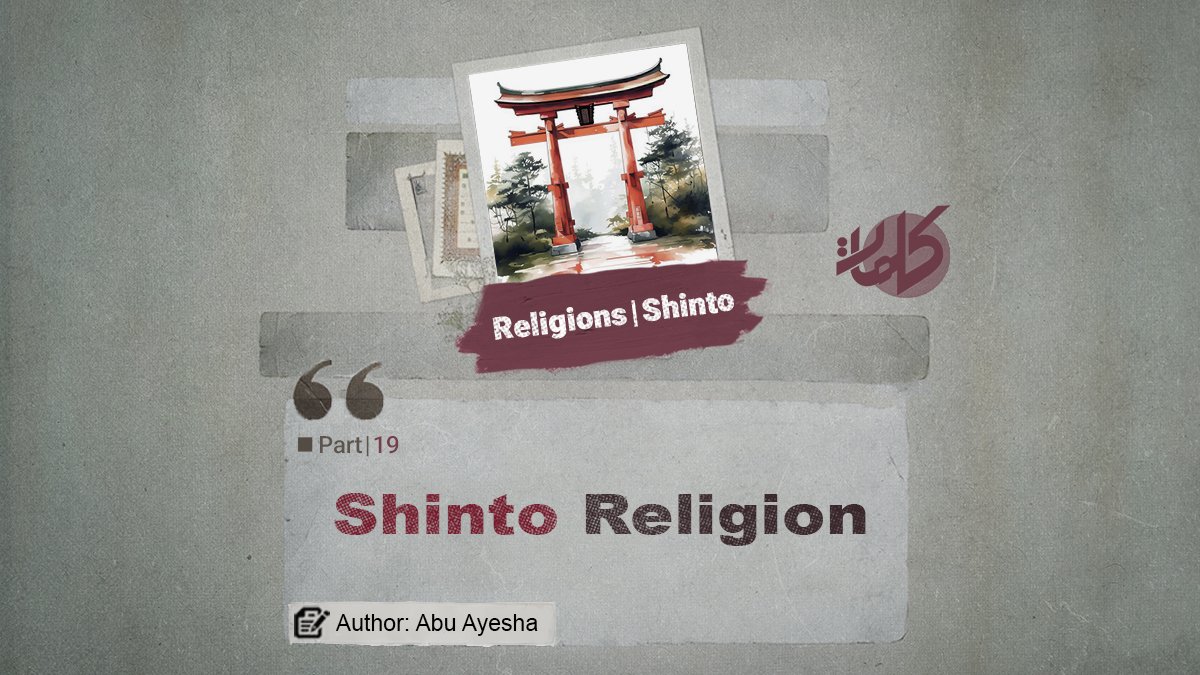
    Shinto religion (Part 19)

    Summary of the Contents
    In the previous sections, we discussed many topics regarding the Shinto religion—how Shinto came into existence; that Shinto, the religion of the Japanese people, is a tradition found only in Japan and has no applicability elsewhere. It is a tradition thousands of years old, yet instead of its followers’ increasing day by day, they are gradually disappearing and abandoning it, preferring secularism and irreligion over their native faith.
    We must not forget that for a long time, this tradition served as a tool for powerful rulers and emperors to bring the general public under their command and control. Throughout the research, we learned that Shinto, like some other religions, has no founder and no original scripture. The books that were later written in this tradition were authored by emperors and ruling elites of the time and mainly describe their own genealogies and histories. We also explored important issues such as what objects or beings are worshipped in this religion—for example, individuals or things of high status or those that people fear. These are considered kami, and we examined who they are and how many of them exist. We learned about Shinto shrines, the role they play, how people worship, which rituals they perform upon entering these shrines, and the nature of their worship. These topics were discussed in detail. In this research, an effort was made to present everything said or narrated about this tradition accurately and without alteration.
    Muslims, upon reading these findings, should realize how much honor Allah the Almighty has granted them, for they bow only before the God who created the heavens and the earth—a being whose worship brings dignity and nobility. He is the One who is able to fulfill whatever a person asks of Him and who answers the supplication of His servants. Islam is a religion of mercy, compassion, and kindness. It is neither based on myths and superstitions nor does it contain ambiguity and confusion. Rather, all its rulings and teachings originate from the Book of the Lord of all worlds and the noble sayings of the Messenger of Allah (peace and blessings be upon him), transmitted to us by truthful and trustworthy individuals—those unanimously acknowledged by fair-minded people for their honesty, integrity, steadfastness, and nobility (i.e., the noble Companions, may Allah be pleased with them all, and the great Followers, may Allah have mercy on them).
    In Islam, there is no class distinction. Worshiping Allah the Almighty is equally required of all. Kings and the poor stand side by side in the mosque. The greatest commanders and leaders act as servants and well-wishers for their people and for all Muslims. In summary, Islam is the religion that brings happiness, success, and salvation in both worlds to its followers. A Muslim who adheres to the teachings of Islam is neither humiliated in this world nor faces hardship in the Hereafter.
    This research attempted to analyze the position of Shinto through an investigative and analytical approach. By examining multiple sources, we presented a clear picture of Shinto, its origins, and the myths and superstitions narrated about it. Shinto came into being centuries before Christ and was long regarded as the most prominent and important religious tradition of the Japanese people. However, over time—and due to various influences—people gradually abandoned their faith and the beliefs they once held. Today, a Shinto practitioner sees no problem in spending part of the day performing Shinto rituals and another part practicing Buddhist rites, for religion, in their view, is nothing more than adherence to ancient customs, performing rituals, and bowing at shrine gates. With the arrival of other religions in Japan, the traditional forms of Shinto underwent transformation and decline, and people became increasingly indifferent toward it.
    The primary goal of this research was to provide accurate information about the Shinto tradition, and by Allah’s grace, this goal has been achieved. We ask Allah the Almighty to grant us a deep understanding of our noble religion, Islam, to keep us steadfast upon this eternal and flawless faith, and to honor us through it. And that is not difficult for Allah, the Mighty.

    Continues…

    Previous Part/ Next Part

    False Religions Islam Islamic Civilization Shinto Religion

    Related Posts

    Seeing Allah (SWT)

    18/10/2026

    Kindness to Parents

    18/10/2026

    Serving One’s Parents

    15/10/2026
    Leave A Reply Cancel Reply

    Follow us on the social media pages
    • Facebook
    • Twitter
    • Instagram
    • Telegram
    • WhatsApp
    Don’t miss

    The Divine Education Model in the Family of the Prophets (Part 143)

    Seeing Allah (SWT)

    Kindness to Parents

    The Divine Education Model in the Family of the Prophets (Part 142)

    About Us:

    The Academic and Research Organization of Kalemaat is an independent Islamic Da'wah organization affiliated with Ahl al-Sunnah wa al-Jama'ah. It is dedicated to promoting the authentic values of Islam, advancing the higher objectives of the Sharia, countering Western cultural influence, upholding the Word of Allah, and contributing to the intellectual and spiritual awakening of the Muslim Ummah.

    The Organization is supported by Muslim philanthropists and businessmen, and it welcomes the cooperation and support of Muslims worldwide in advancing its mission.

    Famous publications

    The Divine Education Model in the Family of the Prophets (Part 143)

    18/10/2026

    Seeing Allah (SWT)

    18/10/2026
    Follow us on social medias
    • Facebook
    • Twitter
    • YouTube
    • Telegram
    • Instagram
    • WhatsApp
    All right reserved by (kalemaat)
    • Home
    • Analysis of the day
    • The greats of the Ummah
    • library

    Type above and press Enter to search. Press Esc to cancel.