Close Menu
    Facebook X (Twitter) Telegram WhatsApp
    • Language
      • دری
      • پښتو
      • العربیة
    • Home
    • Analysis
    • Islam
      • Prophet of Islam (PBUH)
      • Holy Quran
      • Muslim
      • Belief
      • Faith
      • Worships
      • Fiqh
      • Jihad
      • Islamic Perspectives
      • Islamic Economics
      • Islamic Management
      • Islamic Culture
      • Sufism
      • Crimes
      • Prohibitions
      • Sayings of the Scholars
      • Muhajir Tafsir
      • Hadith
    • Religions
      • Judaism
      • Christianity
      • Buddhism
      • Hinduism
      • Zoroastrianism
      • Satanism
      • Confucianism
      • Sikhism
    • Theories
      • Atheism
      • Secularism
      • liberalism
      • Socialism
      • Communism
      • Democracy
      • Federalism
      • Fascism
      • Capitalism
      • Marxism
      • Feminism
      • Nationalism
      • Colonialism
      • Frankfurt School
      • Freemasonry
      • Humanism
    • Fitan
      • Mu’tazila
      • Murji’ah
      • Jahmiyyah
      • The Fitna of the Khawarij
      • The Fitna of the Rawafid
      • The Fitna of Orientalism
      • Ghamdism
      • The Fitna of the Qadianis
      • Qadariyyah
      • Karramiyyah
    • Ummah
      • Sahabah (Companions of the Prophet ﷺ)
        • Hazrat Abu bakr Siddiq (RA)
        • Hazrat Umar al-Faruq (RA)
        • Hazrat Uthman ibn Affan (RA)
        • Hazrat Ali (RA)
        • Hazrat Khalid ibn al-Walid (RA)
        • Hazrat Fayruz al-Daylami (RA)
        • Hazrat Abdullah ibn al-Zubayr (RA)
      • Ummahat al-Mu’minin
      • Islamic scholars
        • Allamah Sayyid Abul Hasan Ali Nadwi (RH)
        • Imam al-Aʿzam Abu Hanifa (RH)
        • Imam al-Bukhari (RH)
        • Imam al-Tirmidhi (RH)
        • Imam al-Ghazali (RH)
        • Shah Waliullah al-Dehlawi (RH)
        • Sayyid Jamal al-Din Afghani
        • Mawlana Jalal al-Din Muhammad Balkhi Rumi (RH)
      • Muslim Rulers
        • Sultan Salahuddin Ayyubi (RH)
        • Umar ibn Abd al-Aziz (RH)
        • Sultan Yusuf ibn Tashfin (RH)
      • Muslim Scientists
    • Civilizations
      • Islamic Civilization
      • Eastern and Western Civilizations
      • Traces of History
    • Diverse
      • Ramadan Message
      • Reports
      • Light and Darkness
    • library
    Facebook X (Twitter) Telegram WhatsApp Instagram Pinterest YouTube
    kalemaat Englishkalemaat English
    You are at:Home»Theories»Atheism»Examining Darwin’s Theory (Part Two)
    Atheism

    Examining Darwin’s Theory (Part Two)

    By 31/12/2024No Comments4 Mins Read
    Share Facebook Twitter Telegram WhatsApp
    Share
    Facebook Twitter Telegram Email WhatsApp
    Author: M. Asim Ismail Zahi
    Examining Darwin’s Theory (Part Two)
    Darwin and the Theory of Evolution
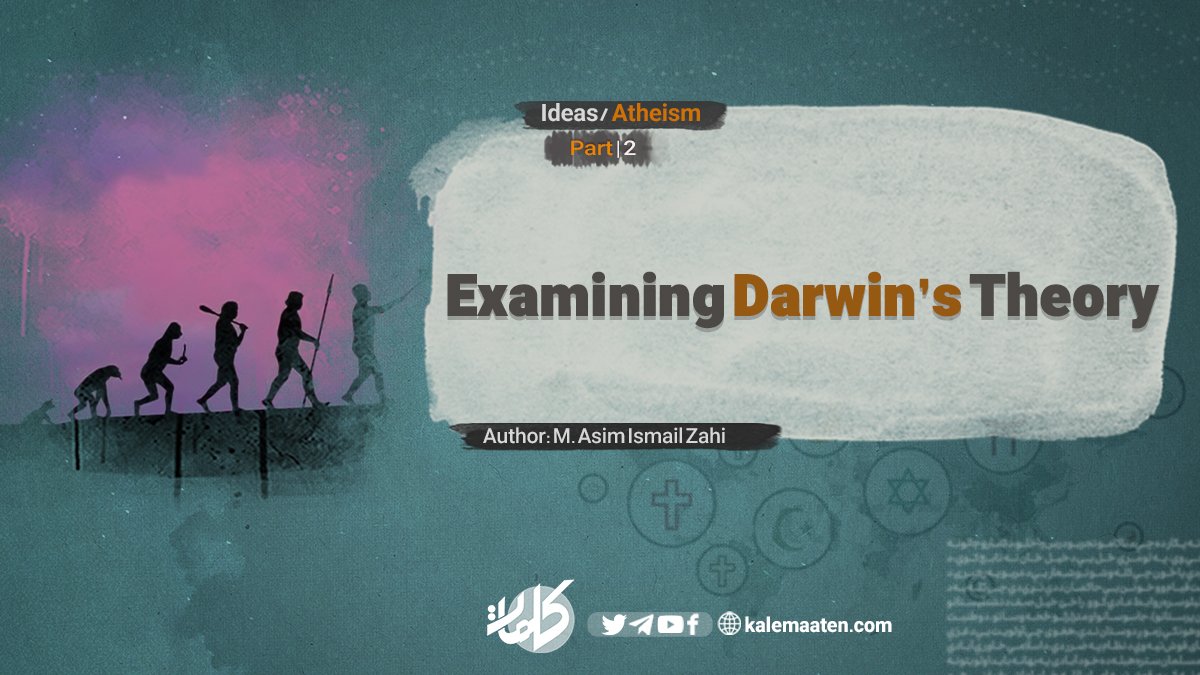
    Charles Robert Darwin (February 12, 1809 – April 19, 1882) was an English scientist and biologist best known as the founder of the theory of evolution. He authored the book On the Origin of Species. The theory of evolution, first introduced by Darwin in this work, proposes that living organisms evolved from simple forms, such as bacteria, to more complex forms, including humans. This transformation and evolution are said to have occurred by chance, with the first molecule emerging from the collision of atoms in a primordial mixture. This process eventually led to the emergence of living organisms, which gradually evolved from one species to another. The final and most advanced stage of this evolution is modern humans, who are believed to have descended from ape-like creatures and human-like apes.
    Theories of Evolution and the Fixity of Species
    Regarding the creation of humans, there are two major theories among scholars:
    1. The Theory of Fixity of Species:
    Some scholars believe that living beings were created as distinct species. According to this view, humans are an independent species, originally created from soil. This belief aligns with the teachings of the Qur’an and is supported by its verses.
    2. The Theory of Evolution:
    Other scholars lean toward the theory of evolution, asserting that different species emerged through the gradual evolution of an initial form. According to this theory, all species share a common origin, which evolved into various forms over time. Proponents of this theory argue that skeletal remains from millions of years ago suggest that living organisms have transitioned from simpler to more complex forms.
    Critique of the Theory
    The theory of evolution has not advanced beyond being a hypothesis, and the evidence presented merely supports it as a conjecture without confirming its actual occurrence. Even its proponents have not definitively established it. While many laypeople believe evolution to be a scientific and proven fact, the reality is that, after 150 years, it remains an unproven hypothesis with no solid evidence. On the contrary, many pieces of evidence challenge the validity of evolution.
    Insufficiency of Evidence
    The influence and impact of the theory of evolution cannot be underestimated; it has fundamentally altered human thought about the world and their existence. However, even after 150 years, the theory remains at the level of a hypothesis. Upon scrutinizing the evidence and arguments supporting it, it becomes apparent how insufficient and inconclusive they are.
    Examination and Critique of Darwin’s Theory
    It is essential to analyze and critique this theory from various perspectives:
    A. From the Perspective of the Qur’an
    The Qur’an, as a divine miracle and the word of Allah (s.w.t), is the ultimate source of all knowledge. This heavenly scripture serves as the constitution and guide for Muslims’ lives, offering the best worldview. Therefore, the Qur’an’s stance is our criterion, providing clear and definitive guidance. As a book of thought, science, and practice, the Qur’an opens the door to all valid and beneficial scientific research.
    Nevertheless, we first turn to the Qur’an to hear its clear and decisive message about the creation of humans.
    The Material and Earthly Aspect of Humans
    The Qur’an explicitly states that the origin of humans lies in soil. From the Qur’anic perspective, the physical aspect of human existence originates from the elements of this earth and is composed of earthly and material substances, such as:
    – Turab (soil)
    – Teen (clay)
    – “«سُلَالَةٍ مِّن طِينٍ» ” (extract of clay)
    – Teen laazib (sticky clay)
    – “«صَلْصَالٍ مَنْ حَمَإٍ مسنُونٍ»” (dark, stinking mud)
    – ” «صَلْصَالٍ كَالْفَخَارِ» ” (baked clay like pottery)
    All these terms refer to the material and earthly origin of humans, indicating that they were independently created and have not evolved from other beings. “فَإِذَا سَوَّيْتُهُ:” “Then I fashioned him in due proportion and breathed into him My Spirit, transforming him into a human form with a complete creation.” “وَلَقَدْ خَلَقْنَاكُم ثُمَّ صَوَّرْنَاكُم:” “(Adam, your first ancestor) We created you and then gave you shape.”
    Continues…

    Related Posts

    Islam and Democracy (The 47th and Final Part)

    26/09/2026

    Islam and Democracy (Part 46)

    24/09/2026

    Islam and Democracy (Part 45)

    23/09/2026
    Leave A Reply Cancel Reply

    Follow us on the social media pages
    • Facebook
    • Twitter
    • Instagram
    • Telegram
    • WhatsApp
    Don’t miss

    Imam al-A‘zam Abu Hanifa (RA): The Role Model (part 39)

    Imam al-A‘zam Abu Hanifa (RA): The Role Model (part 38)

    The Reminder of Death

    Justice Among Children

    About Us:

    The Academic and Research Organization of Kalemaat is an independent Islamic Da'wah organization affiliated with Ahl al-Sunnah wa al-Jama'ah. It is dedicated to promoting the authentic values of Islam, advancing the higher objectives of the Sharia, countering Western cultural influence, upholding the Word of Allah, and contributing to the intellectual and spiritual awakening of the Muslim Ummah.

    The Organization is supported by Muslim philanthropists and businessmen, and it welcomes the cooperation and support of Muslims worldwide in advancing its mission.

    Popular Publications

    The Importance of Security in Islam (Part 18)

    13/11/2024

    Secularism (Part 19)

    25/07/2024

    The Quran; A Miracle Beyond Time – A Study of Its Miraculous Nature (Part 8)

    23/07/2025
    Follow Us on Social Media
    • Facebook
    • Twitter
    • YouTube
    • Telegram
    • Instagram
    • WhatsApp
    All right reserved by (kalemaat)
    • Home
    • Analysis of the day
    • The greats of the Ummah
    • library

    Type above and press Enter to search. Press Esc to cancel.
