




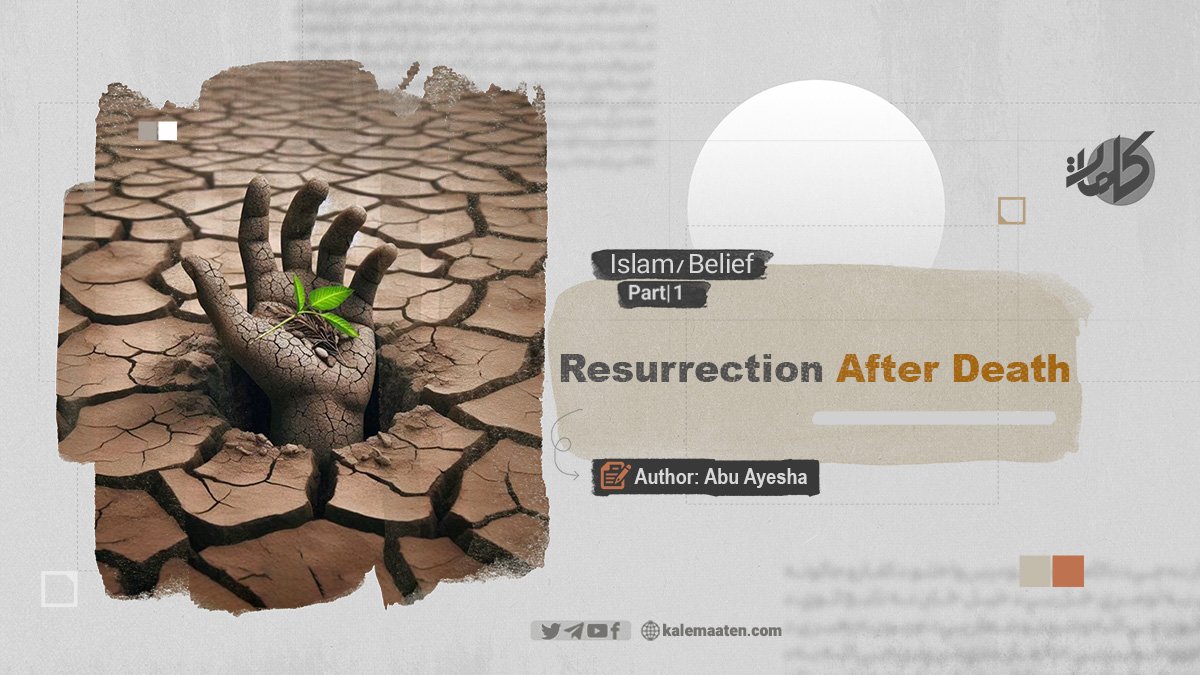
Author: Abu Ayesha
Resurrection After Death (part one)
Abstract
Resurrection after death is one of the fundamental principles of the divine religions, especially the noble religion of Islam. The Noble Qur’an emphasizes this truth in many verses and regards it as one of the essential pillars of faith; as in Surah Al-Baqarah, the righteous are described as those who “have certainty in the Hereafter.” Belief in resurrection after death is an indication of divine justice, and faith in life after death plays a foundational role in directing human behavior and regulating worldly life. Belief in the Hereafter is deeply connected to wisdom, justice, and the purposiveness of creation. In numerous verses, the Noble Qur’an presents the Hereafter as a definitive and undeniable reality, considers it a criterion of faith and piety, and refers to it as the Day of Reckoning, recompense, and the return of all human beings. This research seeks to place life after death on the scales of reason and revelation, to critique the views of those who deny resurrection, and to examine the transmitted and rational proofs of both affirmers and deniers, while providing appropriate responses to the objections raised in this regard.
Introduction
One of the most fundamental doctrinal teachings in Islam is belief in the Hereafter and resurrection after death. This belief not only signifies the end of this world and the beginning of a new realm called the Hereafter, but also represents the wisdom, justice, and absolute power of Allah the Exalted, and in a sense guarantees divine justice and the establishment of order in the universe. With resurrection after death and the return to the ultimate Ruler and final Judge over creation, all will realize that every right will be restored. The oppressors who committed oppression in this world will be held accountable there, and the oppressed whose rights were trampled under the feet of the tyrants will attain their due rights. Thus, belief in the Hereafter and resurrection after death is of great importance. The Hereafter is a concept that has been emphasized in many verses of the Noble Qur’an, and the Noble Prophet (Peace be upon him) described it as a pillar of the religion.
Ahl al-Sunnah wa al-Jama‘ah, based on the Qur’an, the Sunnah, and the consensus of the Ummah, regard the Hereafter as a certain reality, and denying it is considered a denial of one of the foundations of faith. Belief in the Hereafter gives purpose to human behavior, imbues ethics with meaning, and places life on a path of responsibility and piety. Belief in this matter causes a person to act with caution and to constantly examine and evaluate their own deeds.
Considering the importance and necessity of awareness and knowledge regarding this very fundamental subject, this research attempts to clarify the status of the Hereafter from the perspective of the Qur’an and the Sunnah, to present the arguments of both sides, and to examine and critique the views of those who deny resurrection, while elucidating the truth of belief in life after death through rational and transmitted proofs.
Keywords: Hadiths, Ahl al-Sunnah, Verses, Doubts, Resurrection, Deniers of the Resurrection.
Reminder: Before examining the word Resurrection (al-Maʿād) from the linguistic and technical perspectives, it is necessary to know that the term “revival after death” in Arabic is used in two forms: (al-Maʿād) and (al-Baʿth baʿda al-mawt) (معاد والبعث بعد الموت). Although, from the perspective of root letters, there are differences between these two terms and each requires separate linguistic research, in meaning they are identical. “Baʿth, Maʿād, and Hashr are all three words with one meaning.” [1] Therefore, below, both terms are traced to their roots, after which other discussions are presented.
Linguistic meaning of al-Maʿād: Al-Maʿād in language is from the root (ع و د), meaning rujūʿ (return), from the pattern qāla yaqūlu (ʿāda yaʿūdu) قال یقول (عاد یعود). (Al-Maʿād), with a fatḥah on the mīm, means maṣīr and marjiʿ (final destination and place of return) [2].
From the same root (ع و د) comes the phrase “al-maʿād fī al-ākhirah”, meaning the return of a human being to life after death, and his destiny with the outcome of his deeds and his state in the Hereafter. [3]
Al-Maʿād is a maṣdar mīmī derived from ʿāda, and its meaning is the return and final destination of the human being. [4] In the Qur’anic verse it is said: «إن الذي فرض علیک القرآن لرادک إلی معاد [5] » Translation: “Indeed, He who imposed the Qur’an upon you will surely return you to a place of return.”
Ibn Abbas (RA) said in the explanation of this verse: “He will return you to your place in Paradise.”
Mujahid (RA) said: “He will bring him to life on the Day of Resurrection and at the raising of the servants.” [6]
Al-Maʿād in technical terminology: Hafiz Hakami (RA) said regarding al-Maʿād: “Al-Maʿād means returning and going back to Allah, the Exalted.” [7]
Qazi Iyad (RA) said: “Al-Maʿād in the Hereafter means the return of the human being to life after death, and his destiny according to the outcome of his deeds and his condition in the Hereafter.” [8]
Abd al-Razzaq Afifi said: “The Resurrection is the reviving of the dead by Allah, the Exalted, and bringing them out of their graves on the Day of Resurrection.” [9]
Therefore, al-Maʿād in Islamic terminology, based on examining the origin and root of the word, is derived from the same linguistic meaning understood by people (that is, returning to Allah, the Exalted, and being revived after death. Death is not the end point of human life; rather, a time will come when the human being must appear before the court of divine justice and answer for every small and great deed he performed in this world.
To be continued…
Next Part
References:
- Comprehensive Book of Sciences on the Terminologies of the Arts, 1421 AH / 2000 CE, vol. 1, p. 170.
- Al-Razi, Zayn al-Din Abu Abdullah Muhammad ibn Abi Bakr, Mukhtar al-Sihah, edited by Yusuf al-Shaykh Muhammad, 1420 AH (solar), vol. 1, p. 221.
- Al-Sabti, Iyad ibn Musa, Mashariq al-Anwar ‘ala Sahih al-Athar, vol. 2, p. 105.
- Umar, Ahmad Mukhtar Abd al-Hamid, Dictionary of Contemporary Arabic Language, 1429 AH, vol. 2, p. 1573.
- Surat al-Qasas, verse 85.
- Al-Zabidi, Muhammad ibn Muhammad, Taj al-‘Arus min Jawahir al-Qamus, edited by a group of researchers, vol. 8, p. 441.
- Al-Hakami, Hafiz ibn Ahmad, Ma‘arij al-Qabul, vol. 2, p. 681.
- Al-Sabti, Iyad ibn Musa, Mashariq al-Anwar ‘ala Sahih al-Athar, vol. 2, p. 105.
- Fatawa and Letters of Abd al-Razzaq Afifi – Creed Section, p. 231.


