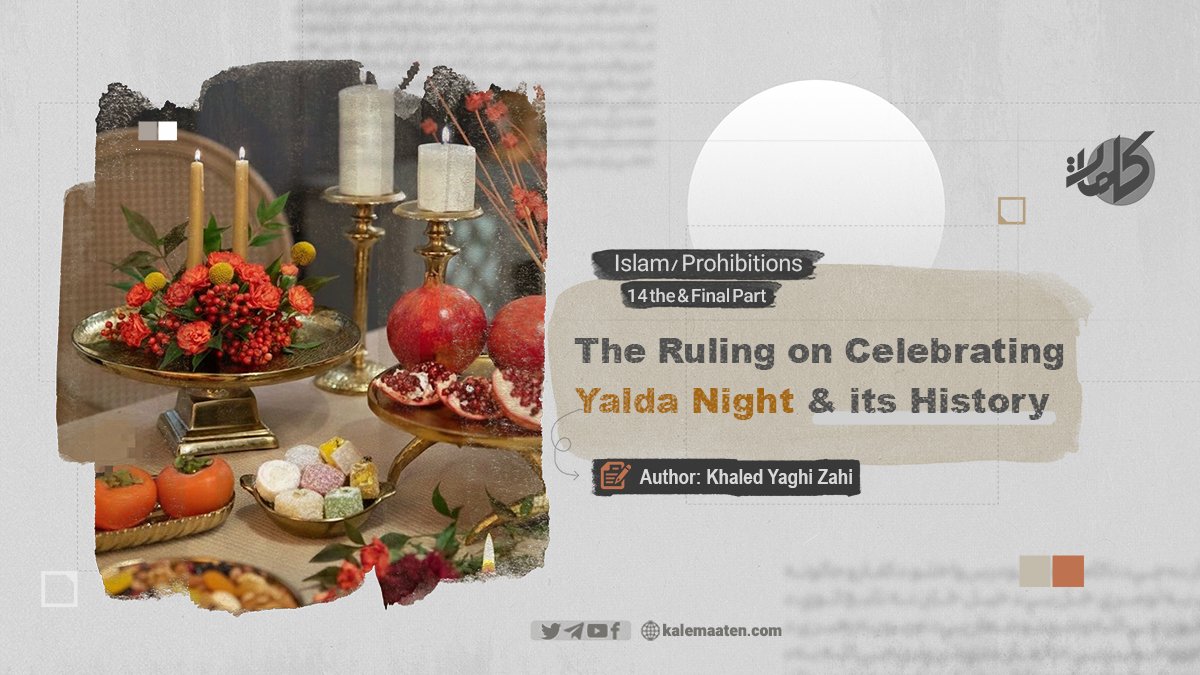
The Ruling on Celebrating Yalda Night and its History (the 14th and final part)
Response to Some Doubts
Doubt
It may be suggested in the minds of some dear people that with such an excuse and ceremonies like these, an opportunity is created for maintaining family ties and for relatives to gather together?!
Response
It should be stated that Islam encourages maintaining family ties and visiting relatives throughout the entire year, not that people remain distant from one another all year long and then gather for only one night, and that too with so many incorrect customs and heavy expenses.
Rather, it is obligatory upon every Muslim to always care about his family, relatives, and kin, and to consistently visit and meet them.
Doubt
What kind of celebration is Yalda? Neither is an animal slaughtered nor is a human being cast to the ground in a ritual, like its counterpart Nowruz; it is only kindness, joy of being together, and praising humanity. Yes, this is the legacy of our ancestors.
Response
A: Comparing Yalda Night with Eid al-Adha
On Yalda night, whatever you prepare is consumed by yourselves, whereas on the blessed Eid al-Adha, what the Muslims prepare is spent on the poor and the needy.
I believe that for people of fairness, these few words are sufficient, and I will not present further explanation in this section.
B: Response to the criticism directed at prayer
I do not know precisely what you mean by “being cast to the ground.” If you mean superstitious rituals, then we also do not accept them. But if you mean prayer (and here specifically the Eid prayer), then we say: falling to the ground before the Creator who brought us into existence—who is in no need of our worship; is for our own benefit, and prostration to Him is the utmost honor.
Reflect for a few moments on the phrase “the Creator of all existence” so that you may better understand the meaning of these statements.
Apparently, you have equated prostration to the Almighty, Merciful, and Self-Sufficient God with prostration to weak and flawed human beings who claim divinity.
C: Response to the criticism regarding the slaughter of animals
You speak of slaughtering animals as if Muslims massacre animals and laugh about it!
Well, dear friend, what is the outcome of this act? Is it not the case that humble and submissive people, with hearts full of sincerity and seeking forgiveness, perform this act, and then take clean and wholesome meat to the poor and the needy?
I have a friendly request… go and ask the needy yourselves: do you prefer that the wealthy bring you meat, or that they sit in their own homes eating nuts? In the end, I invite you to fairness.
Comparing Yalda Night with some Islamic programs
Reference to maintaining family ties and kindness in the programs of Zoroastrian tradition
That “being together” which you mention is known as maintaining family ties. Yes, visiting relatives is a very commendable matter, but why do you think such a thing does not exist in Islam?
Allah the Exalted says: “وَاتَّقُواْ اللّهَ الَّذِي تَسَاءلُونَ بِهِ وَالأَرْحَامَ إِنَّ اللّهَ كَانَ عَلَيْكُمْ رَقِيباً” Translation: “And fear Allah, by whom you ask one another, and [do not sever] the ties of kinship. Indeed, Allah is ever Watchful over you.” [1]
You have referred to kindness; this too is very praiseworthy. But look at what the blessed Islam has stated concerning it: “فَبِمَا رَحْمَةٍ مِنَ اللَّهِ لِنْتَ لَهُمْ وَلَوْ كُنْتَ فَظّاً غَلِيظَ الْقَلْبِ لَانْفَضُّوا مِنْ حَوْلِكَ” Translation: “So by mercy from Allah you were gentle with them, and if you had been harsh and hard-hearted, they would have dispersed from around you.” [2]
Now, considering that the Noble Messenger (PBUH) has been introduced as our role model: “لَقَدْ كَانَ لَكُمْ فِي رَسُولِ اللَّهِ أُسْوَةٌ حَسَنَةٌ” Translation: “Indeed, in the Messenger of Allah you have an excellent example.” [3] Have we also been commanded to kindness or not?
Therefore, in a “complete package called Islam,” everything that fair-minded people consider good and beneficial for guidance and happiness exists. It is not correct to speak in such a way as if such things exist in your program but not in ours.
You have raised the issue of the legacy of ancestors
There is nothing as “your ancestors” and “our ancestors.” People who lived thousands of years ago on this land are ancestors of us all.
In fact, it was these very ancestors who accepted the beautiful program of Islam and left it as a legacy for future generations. Thus, we too have benefited from their heritage.
I have a suggestion: with the abundant resources available to us, why do you not undertake systematic studies so that it becomes clear to you which group of our ancestors acted more correctly; the majority who accepted Islam, or the minority who remained Zoroastrian? [4]
Ahmadzahi, ʿAbd al-Salām, Shab-e Yalda in the Law of Allah, p. 67, publication date: 1396 AH, Iran.
All References
The Noble Qur’an.
Al-Dimashqi, Abu al-Fida Ismail ibn Umar ibn Kathir, Tafsir al-Qur’an al-‘Azim, second edition: 1420 AH / 1999 CE, publisher: Dar Taybah for Publishing and Distribution – Beirut.
Al-Naysaburi, Muslim ibn al-Hajjaj ibn Muslim, al-Jami‘ al-Sahih known as Sahih Muslim, publisher: Dar al-Jil – Beirut and Dar al-Afaq al-Jadidah – Beirut.
Al-Naysaburi, Muhammad ibn Ishaq ibn Khuzaymah, Sahih Ibn Khuzaymah, publisher: al-Maktab al-Islami – Beirut.
Al-Ajuri, Muhammad ibn al-Husayn, al-Shari‘ah, no. 134, publisher: Mu’assasat Qurtubah.
Al-‘Abbad, ‘Abd al-Muhsin, Sharh Sunan Abi Dawud, publisher: Dar al-Qalam – Beirut.
Al-Sijistani, Abu Dawud Sulayman ibn al-Ash‘ath, Sunan Abi Dawud, publisher: Dar al-Fikr.
Al-Nasa’i, Ahmad ibn Shu‘ayb, Sunan al-Nasa’i al-Kubra, first edition, 1411–1991, publisher: Dar al-Kutub al-‘Ilmiyyah – Beirut.
Tafsir Ibn Kathir, Hadith verification: Hani al-Hajj, al-Maktabah al-Tawfiqiyyah, Egypt, year of publication: 2013 CE.
Madarik al-Tanzil wa Haqa’iq al-Ta’wil (Tafsir al-Nasafi), edited by Shaykh Zakariya ‘Umayrat, volume 2, Wahidi Library, Peshawar.
Al-Bayhaqi, Ahmad ibn al-Husayn ibn ‘Ali, Sunan al-Bayhaqi al-Kubra, publisher: Maktabat Dar al-Baz – Makkah al-Mukarramah, 1414–1994.
Al-‘Ayni, Badr al-Din, ‘Umdat al-Qari Sharh Sahih al-Bukhari, Dar al-Kitab al-‘Arabi – Beirut.
Al-Naysaburi, Abu al-Husayn Muslim ibn al-Hajjaj ibn Muslim al-Qushayri, al-Jami‘ al-Sahih known as Sahih Muslim, publisher: Dar al-Jil – Beirut and Dar al-Afaq al-Jadidah – Beirut.
Al-Zabidi, Muhammad ibn Muhammad ibn ‘Abd al-Razzaq al-Husayni, Taj al-‘Arus min Jawahir al-Qamus, Dar Ihya’ al-Turath al-‘Arabi – Beirut.
Al-Dimashqi, Muhammad Amin ibn ‘Umar, Radd al-Muhtar ‘ala al-Durr al-Mukhtar, Dar al-Ma‘rifah – Beirut.
Al-Bukhari, Muhammad ibn Isma‘il ibn Ibrahim, Sahih al-Bukhari, first edition 1422 AH, publisher: Dar Tawq al-Najah.
Al-Nasa’i, Ahmad ibn Shu‘ayb, Sunan al-Nasa’i al-Kubra, first edition, 1411–1991, publisher: Dar al-Kutub al-‘Ilmiyyah – Beirut.
Al-Mawardi, ‘Ali ibn Muhammad Habib, Adab al-Dunya wa al-Din, publisher: Dar wa Maktabat al-Hilal – Riyadh.
Al-Tirmidhi, Muhammad ibn ‘Isa, al-Jami‘ al-Sahih Sunan al-Tirmidhi, publisher: Dar Ihya’ al-Turath al-‘Arabi – Beirut.
Al-Isfahani, Husayn ibn Muhammad, al-Mufradat fi Gharib al-Qur’an, publisher: Dar al-Ma‘rifah – Beirut, Lebanon.
Al-Qazwini, Muhammad ibn Yazid, Sunan Ibn Majah, publisher: Dar al-Fikr – Beirut.
Al-Nawawi, the jurist and hadith scholar Muhyi al-Din, al-Adhkar al-Nawawiyyah, revised new edition, Dar al-Fikr for Printing, Publishing, and Distribution.
Al-Bayhaqi, Abu Bakr Ahmad ibn al-Husayn, Shu‘ab al-Iman, first edition, 1410, publisher: Dar al-Kutub al-‘Ilmiyyah – Beirut.
Abu Rayhan al-Biruni, Muhammad ibn Ahmad, al-Athar al-Baqiyah ‘an al-Qurun al-Khaliyah, translator: Akbar Danasarisht, year of publication: 1386 AH, publisher: Amir Kabir – Tehran – Iran.
Farahvashi, Bahram, Jahan Faruri, year of publication: 1391 AH, publisher: University of Tehran Press.
Ansari, Bahman, Zoroaster and the Zoroastrians, publication date: 8 Bahman 1396 AH, Tehran.
Sha‘ban-Nejad, Afsaneh, Shab-e Yalda, year of publication: 1377 AH, publisher: Mihrab-e Qalam, Tehran.
Ahmadzahi, ‘Abd al-Salam, Shab-e Yalda in the Law of God, publication date: 1396 AH, Iran.