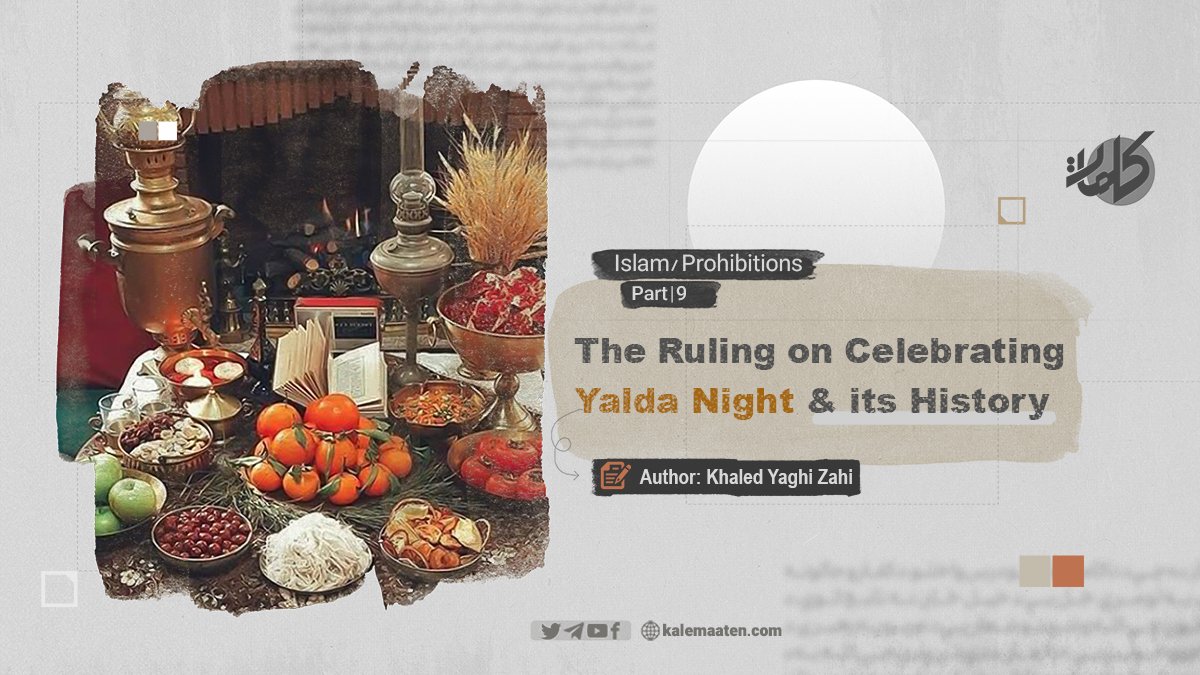
Author: Khaled Yaghi Zahi
The Ruling on Celebrating Yalda Night and Its History (part 9)
Yalda in the Scale of the Shari‘ah (continuation)
An Eid and a celebration are not for families, relatives, children, and elders to gather on a day that Allah has not designated as a festival. Eid is not merely gathering together and eating nuts and pistachios. Eid is not wearing elegant and new clothes and drinking pleasant beverages. Eid is not grouping laughter and narrating ancient stories. Subhan Allah, look at this statement of the just Imam Umar ibn ‘Abd al-‘Aziz (RA), who said: “ليس العيد لمن لبس الجديد إنما العيد لمن أمن الوعيد” Translation: Eid is not for the one who wears new clothes; rather, Eid is for the one who is safe from punishment. [1]
Yes, salvation on that Day is the true Eid, and salvation on that Day is not possible except through Islam and righteous deeds.
Umm al-Mu’minin A’ishah (RAH) said: “دَخَلَ أَبُو بَكْرٍ وَعِنْدِي جَارِيَتَانِ مِنْ جَوَارِي الْأَنْصَارِ تُغَنِّيَانِ بِمَا تَقَاوَلَتْ الْأَنْصَارُ يَوْمَ بُعَاثَ قَالَتْ وَلَيْسَتَا بِمُغَنِّيَتَيْنِ فَقَالَ أَبُو بَكْرٍ أَمَزَامِيرُ الشَّيْطَانِ فِي بَيْتِ رَسُولِ اللَّهِ صَلَّىاللَّهُعَلَيْهِوَسَلَّمَ وَذَلِكَ فِي يَوْمِ عِيدٍ فَقَالَ رَسُولُ اللَّهِ صَلَّىاللَّهُعَلَيْهِوَسَلَّمَ يَا أَبَا بَكْرٍ إِنَّ لِكُلِّ قَوْمٍ عِيدًا وَهَذَا عِيدُنَا” Translation: Abu Bakr (RA) entered upon me while there were with me two young girls from among the Ansar who were chanting verses that the Ansar had recited on the Day of Bu‘ath. She said: they were not professional singers. Abu Bakr (RA) said: Are the flutes of Satan being played in the house of the Messenger of Allah (PBUH)? And that was on a day of Eid. The Messenger of Allah (PBUH) said: O Abu Bakr, every people has its Eid, and this is our Eid. [2]
If this narration is considered, it becomes clear that Eids are among the matters specific to each religion, and it is not permissible to adopt festivals from other religions and observe them, even if they were inherited from ancestors.
Because such an act contradicts the Sunnah of the Messenger of Allah (PBUH). He abolished the national festivals of the people of Madinah and replaced them with Eid al-Adha and Eid al-Fitr, and he stated that every religion has its own Eid, meaning that it is not permissible to resemble others in their festivals.
It is narrated from Umm Salamah (RAH) that she said: “كان رسول الله صَلَّىاللَّهُعَلَيْهِوَسَلَّمَ يصوم يوم السبت والأحد أكثر ما يصوم من الأيام، ويقول: إنهما يوما عيد للمشركين فأنا أحب أن أخالفهم” Translation: The Messenger of Allah (PBUH) used to fast on Saturdays and Sundays more than on other days, and he would say: These two days are days of Eid for the polytheists, and I like to differ from them. [3]
Observe, firstly, how the Messenger of Allah (PBUH) referred to Saturday and Sunday which recur weekly as Eids, and secondly, how he stated that these two days are Eids specific to the polytheists, and that he wished to oppose them by fasting. O Muslim, observe how the Messenger of Allah (PBUH) kept himself distant from the customs of the disbelievers and encouraged his Ummah to do so. How, then, is it possible to celebrate Yalda Night, which recurs annually and is an Eid among the festivals of the Zoroastrians, and then claim to be upon the methodology of the Messenger of Allah (PBUH)? Perhaps some ignorant and pretentious people claim moderation and say they wish to maintain balance. To these poor people it must be said: are you more moderate than the Messenger of Allah (PBUH)?
It is narrated from Thabit ibn al-Dahhak (RA) that: «نَذَرَ رَجُلٌ عَلَى عَهْدِ رَسُولِ اللَّهِ صَلَّىاللَّهُعَلَيْهِوَسَلَّمَ أَنْ يَنْحَرَ إِبِلاً بِبُوَانَةَ فَأَتَى النَّبِىَّ صَلَّىاللَّهُعَلَيْهِوَسَلَّمَ فَقَالَ: إِنِّى نَذَرْتُ أَنْ أَنْحَرَ إِبِلاً بِبُوَانَةَ. فَقَالَ النَّبِىُّ صَلَّىاللَّهُعَلَيْهِوَسَلَّمَ: «هَلْ كَانَ فِيهَا وَثَنٌ مِنْ أَوْثَانِ الْجَاهِلِيَّةِ يُعْبَدُ». قَالُوا: لاَ. قَالَ: «هَلْ كَانَ فِيهَا عِيدٌ مِنْ أَعْيَادِهِمْ». قَالُوا: لاَ. قَالَ رَسُولُ اللَّهِ صَلَّىاللَّهُعَلَيْهِوَسَلَّمَ: “أَوْفِ بِنَذْرِكَ فَإِنَّهُ لاَ وَفَاءَ لِنَذْرٍ فِى مَعْصِيَةِ اللَّهِ وَلاَ فِيمَا لاَ يَمْلِكُ ابْنُ آدَمَ.”» Translation: A man came to the Messenger of Allah (PBUH) and said: O Messenger of Allah, I have vowed to sacrifice camels at Buwanah. The Messenger of Allah (PBUH) said: Was there an idol from the idols of the pre-Islamic period that was worshipped there? They said: No. He said: Was there any festival from their festivals held there? They said: No. The Messenger of Allah (PBUH) said: Fulfill your vow, for there is no fulfillment of a vow in disobedience to Allah, nor in that which the son of Adam does not possess. [4]
If that man had said that in the region of Buwanah one of the festivals of the polytheists was held, the Messenger of Allah (PBUH) would certainly have forbidden him from making a vow there and would have stopped him. That is precisely why he asked that question. So how is it possible for us to celebrate the festivals of the polytheists and the Zoroastrians; the festivals of those who worship the sun and fire?!
As for another reason: on Yalda Night, many improper beliefs, false doctrines, and ignorant ideas are revived which are incompatible with the teachings of Islam. Without any doubt or hesitation, such beliefs are unlawful, and some of them amount to disbelief. We will mention examples of these beliefs, briefly explain each of them, and state the Islamic ruling concerning them.
Allah the Exalted says: «وَيَاقَوْمِ مَا لِي أَدْعُوكُمْ إِلَى النَّجَاةِ وَتَدْعُونَنِي إِلَى النَّارِ. » Translation: “O my people! What is the matter with me that I call you to salvation, while you call me to the Fire?” [5]
O my people! I call you to follow the Islamic Eids and to establish the commands of Allah, in which lies your prosperity in this world and the Hereafter, while you call me to establish national festivals that are the legacy of polytheists from thousands of years ago and are a cause of misery in this world and the Hereafter?! What is wrong with you?!
To be continued…
References:
- Al-Harawi, Mulla Ali al-Qari. Mirqat al-Mafatih Sharh Mishkat al-Masabih. Vol. 5, p. 123. Kitab al-Salah, Bab Salat al-‘Idayn. Karachi: Qadimi Kutub Khanah.
- Al-Bukhari, Muhammad ibn Isma‘il ibn Ibrahim. Sahih al-Bukhari. Vol. 2, p. 17. Kitab al-Jumu‘ah, Bab Sunnat al-‘Idayn li-Ahl al-Islam. Hadith no. 952. First edition, 1422H. Beirut: Dar Tawq al-Najah.
- Al-Nasa’i, Ahmad ibn Shu‘ayb. Sunan al-Nasa’i al-Kubra. Vol. 2, p. 146. Kitab al-Siyam, Siyam Yawm al-Ahad. Hadith no. 2776. First edition, 1411H / 1991. Beirut: Dar al-Kutub al-‘Ilmiyyah.
- Al-Sijistani, Sulayman ibn al-Ash‘ath. Sunan Abi Dawud. Vol. 3, p. 236. Kitab al-Ayman wa al-Nudhur, Bab Ma Yu’maru Bihi min al-Wafa’ bi al-Nadhr. Hadith no. 3315. Beirut: Dar al-Fikr.
- The Qur’an, Surah Ghafir, verse 41.



