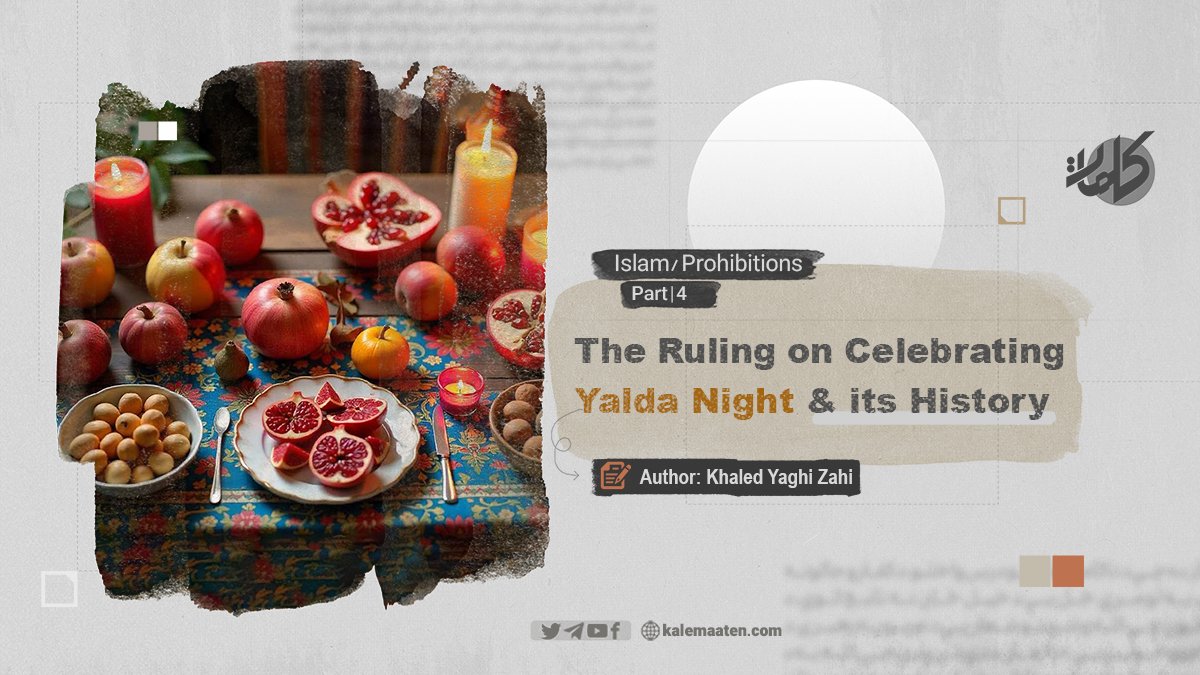
The Ruling on Celebrating Yalda Night and its History (Part Four)
The History of Yalda Night and Clarifying Its Reality (Continuation)
The followers of Babak Khorramdin, also known as the Khorramites, used to celebrate this day and regarded it as “Khorram Ruz” (the Joyous Day) and the birth of the sun, and they set it as the beginning of their new year. This ceremony, as well as the winter-beginning system of year reckoning, can still be observed among some peoples, an example of which is the local calendar of Pamir and Badakhshan (in northern Afghanistan and southern Tajikistan). Likewise, in the ancient Armenian calendar, the first month of the new year is mentioned as “Navasard,” which is connected to the Avestan word “Nosardha,” meaning “New Year.”
The ancient Iranians, considering this night as the salvation and birth of the sun, would remain awake throughout the night until the morning of the first of Dey/Jadi in order to witness the sunrise. To honor the sun, they stayed awake until dawn and celebrated in this manner: a nighttime festival marked by wakefulness until morning and watching the sunrise of the newly born sun. One of the essential elements of this celebration was the presence of elders and senior members of the family, symbolizing the old age of the sun at the end of autumn, as well as abundant foods to sustain long wakefulness, such as pomegranates, watermelons, and oleaster berries, chosen for their red color resembling the sun.
Darkness was considered a representation of Satan, and since during the longest night of the year this satanic darkness lasted longer, this night was regarded as inauspicious by the Iranians. When it arrived, they would light fires so that the darkness and satanic forces would be destroyed and driven away. People gathered together and spent the night eating, drinking, rejoicing, dancing, and conversing, and they would spread a special tablecloth on which they placed whatever fresh fruits of the season had been preserved, along with dried fruits.
The Yalda Night tablecloth was called “Meyazd” and included fresh and dried fruits, as well as nuts, or in Zoroastrian terminology, “Lork,” which were among the essential elements of this celebration and feast. It was held in honor of and attributed to the qualities of “Ahura Mazda” and “Mithra,” that is, the sun. [1]
In the rituals of ancient Iran, for every ceremonial festival and celebration, a tablecloth would be spread on which besides the instruments and utensils of worship such as the fire altar, perfume burner, incense burner, and the like; seasonal produce, various foods, and sacred offerings such as “Meyazd” were also placed.
The Iranians would sometimes spend the night of Yalda waiting for the rebirth of the sun until the rays of dawn appeared on the slopes of the Alborz Mountains. Some would engage in worship inside the Mithraea (the places of worship of the followers of the Mithraic religion), praying for the victory of Mithra and the defeat of Ahriman, and at night they would recite a supplication called “Ni Yad,” which was a prayer of gratitude for blessings.
The day following the night of Yalda (the first of Jadi/Dey) was called Khur-Ruz (the Day of the Sun) and Dey-Gan. It was observed as a day of rest and a public holiday (the Khorramites called this day Khorram Ruz or Khurreh Ruz). Khur-Ruz in ancient Iran was a day of human equality: on this day everyone, including the king, wore simple clothing so that they would appear the same, no one had the right to command another, and tasks were carried out voluntarily rather than by order. [2]
On this day, warfare and bloodshed were forbidden; even slaughtering sheep or chickens was prohibited. This matter was also known to forces hostile to the Iranians, and it was observed on the battlefronts, so bloodshed would temporarily cease.
On this day, people would refrain from work mainly because they did not wish to inadvertently commit any wrongdoing, since the Mithraic religion regarded the commission of even a small evil on the day of the sun’s birth as a very grave sin. The Iranians viewed the cypress tree as a symbol of strength against darkness and cold, and on Khur-Ruz they would stand before it and make a vow to plant another cypress by the following year. [3]
In Burhān-e Qāṭiʿ, under the entry “Yalda,” it is stated as follows: “Yalda is the first night of winter and the last night of autumn/fall, which corresponds to the first of Jadi and the last of Qaws. It is the longest night of the entire year, and on that night, or close to it, the sun enters the constellation of Capricorn. It is said that this night is extremely ominous and inauspicious, and some have said that the night of Yalda is the eleventh of Jadi.”
As previously mentioned, this night among other peoples, nations, and various religions was a day for celebration, veneration, and gathering. Yalda night in other countries, and festivals similar to the winter solstice celebration among other ancient peoples, were also common. In ancient Rome, concurrent with the spread of Christianity, the worship of Sol Invictus (the Unconquered Sun), a Roman pagan deity, was very widespread, and the Romans celebrated his birth at the time of the winter solstice. Sol Invictus also held a special role in Roman Mithraism, and even Mithras (the Greek equivalent of Mithra, the ancient Iranian deity) bore the title “the Unconquered Sun.”
Researchers believe that Western Christianity owes its main framework; which gave this religion stability and form; to pre-Christian religions of ancient Rome, including Mithraism. For example, church calendars and many remnants of pre-Christian rituals and festivals, especially Christmas, have been preserved within it. Christmas, as a combination of the Saturnalia festivals and the birth of Mithra in ancient Rome, was designated in the fourth century CE, with the official recognition of Christianity and by the decree of Constantine, as the official birthday of Christ. [4]
At the time of the expansion of mystery religions in Europe and the lands under the rule of the Roman Empire, and prior to the acceptance of Christianity, the Romans annually honored the planet Saturn (Saturn), the ancient god of agriculture, in a festival called Saturnalia on December 17. This festival lasted for seven days and encompassed the winter solstice. Since the Romans used the Julian calendar in their calculations, the day of the winter solstice occurred approximately on December 25 instead of December 21 or 22.
Franz Cumont, the Belgian archaeologist and founder of modern Mithraic studies, along with other Mithraists who shared his view, considered the concepts of Roman Mithraism to be entirely derived from Mazdean religion and from the Iranian deity Mithra (Mehr). However, from the 1970s onward this idea has been subjected to intense criticism and reassessment, and it has now become one of the most highly debated issues in the field of religious studies concerning the Roman and ancient Greek worlds.
The celebration of Mithra’s birth is not the only ritual that found its way into Christianity. There are many similarities between Christian traditions and the Mithraic cult. Even today, all Christians who celebrate the birth of Jesus Christ still keep their fireplaces and candles lit on this feast day, decorate the Christmas tree with small lights, keep vigil through the night, eat special foods, visit one another, and celebrate the occasion with friends and relatives—very much like the tradition practiced by ancient Iranians on the night of Yalda.
Christmas and Yalda are only two examples among many shared beliefs, customs, symbols, stories, and legends that connect the peoples of different nations and religions. [5]