Author: Khaled Yaghi Zahi
The Ruling on Celebrating Yalda Night and its History (Part Three)
The History of Yalda Night and Clarifying Its Reality
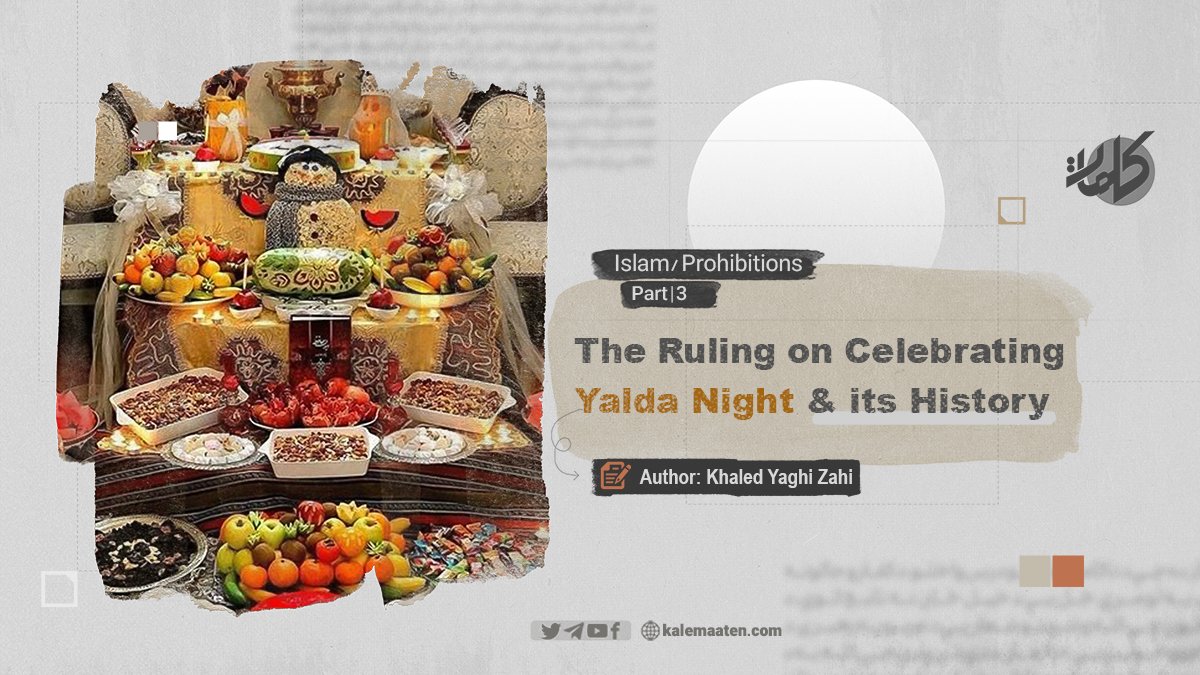
Yalda Night is one of the popular and ancient ceremonies of some peoples. This night refers to the period between sunset on the 30th of Qaws/Azar (the last day of autumn) and sunrise on the first day of the month of Jadi/Dey (the first day of winter). [1]
Many peoples celebrate Yalda Night. In the Northern Hemisphere, this night coincides with the winter solstice, and for this reason, from that time onward the length of the day increases and the length of the night decreases. The last night of autumn and the first day of winter coincide with the winter solstice, which marks a climatic transformation. Since the sun is at its closest point to the horizon, the duration of the day becomes the shortest and the duration of the night becomes the longest night of the year. In its annual movement, at the end of autumn the sun reaches the lowest point of the southeastern horizon, which causes the shortening of the day and the increase in the length of nighttime darkness. However, from the beginning of winter, or the winter solstice, the sun once again turns toward the northeast, resulting in an increase in daylight and a decrease in night. [2]
In other words, during the six months from the beginning of summer until the beginning of winter, in each twenty-four-hour cycle the sun rises slightly lower on the horizon than its previous position, until finally at the beginning of winter it reaches its lowest southern limit, at a distance of 23.5 degrees from the east or the equinoctial point. From that day onward, the path of the sun’s rising reverses and once again moves upward toward the point of the summer solstice. The beginning of the sun’s return toward the northeast and the increase in the length of the day were regarded in the thoughts and beliefs of ancient peoples as the time of the birth or rebirth of the sun, and they considered it blessed and auspicious.
Yalda and the celebrations held on this night are an ancient tradition. People of distant and past ages, whose lives were fundamentally based on agriculture and who lived throughout the year in harmony with the passing seasons and natural contrasts, through experience and the passage of time were able to organize their activities according to the movement of the sun, the change of seasons, the lengthening and shortening of day and night, and the direction, movement, and position of the stars. [3]
They observed that on certain days and in certain seasons the days became very long, and as a result they could make greater use of the sunlight and brightness. Thus arose the belief that light, brightness, and the rays of the sun were symbols of goodness and benefit and were in struggle and conflict with the darkness and gloom of the night. Ancient peoples, including the Aryan peoples of India, Iran, and Indo-European regions, realized that the shortest days occurred on the last day of autumn and the first night of winter, and immediately thereafter the days gradually became longer and the nights shorter. For this reason, they named it the night of the birth of the sun and considered it the beginning of the year. [4]
Thus, in the ancient Avestan culture, the year began with the cold season. In the Avesta, the word Sareda, Saredha سَرِدَ» یا «سَرِذَ», which conveys the meaning of “year,” itself means “cold,” and this signifies the glad tidings of the victory of Ohrmazd over Ahriman and of light over darkness. [5]
If one reflects, it becomes clear that Yalda Night has a non-Islamic origin. It even stems from the sanctification and veneration of the sun, which is one of the characteristics of sunworshippers, or those known as Mithra-worshippers or fire-worshippers. They even considered Yalda Night, or the Night of Chelleh, to be the night of the birth of the god Mithra (the sun), and by celebrating such a day they praised and glorified their god, Mithra. Even the Avestan tradition introduced it as the first official day of the year. Thus, it is said that the word “Yalda” is Syriac and means “birth”—the birth of the sun (Mithra, Mitra). The Romans called it Natalis Invictus, meaning the birthday of the unconquered Mithra. [6]
According to Zoroastrian belief, at the end of this long night, which they considered (and still consider) demonic and inauspicious, darkness is defeated, light triumphs, the sun is born, and the days begin to lengthen.
Even Abu Rayhan al-Biruni, regarding Yalda Night and its occasion and reality, provides information and says: “The name of this day is the Great Birth; by it is meant the winter solstice. It is said that on this day light passes from the limit of decrease to the limit of increase, human beings begin to grow and flourish, and the fairies move toward annihilation.” [7]
In al-Athar al-Baqiyah, al-Biruni also refers to the first day of the month of Dey as “Khor,” meaning the day on which the sun, or Mithra, was born. It is noteworthy that in al-Qanun al-Mas‘udi, in the manuscript of the British Museum in London, Yalda Night is recorded under the name “Khoreh Ruz,” although in some other sources it is called “Khorram Ruz.” The Romans called it Natalis Invictus, meaning the birthday of the unconquered Mithra. Abu Rayhan al-Biruni referred to this festival as the Great Birth and intended by it the birth of the sun. [8]
Ancient Iranians believed that the meaning of the birth of the sun was the rescue of the sun from the clutches of demons. They believed that on Yalda Night and on that day the sun (the god Mithra) was rescued and freed from the hands of the Ahrimans (the gods of evil). Therefore, to ward off the ominousness of that day, they gathered together, held special rituals and ceremonies, and consumed specific foods and fruits. They considered that night to be the night of deliverance from evil and troubles, because their god (Mithra) had been rescued during that night and day from the god of evil and the Ahrimans.
It is even interesting to know that this night coincides with the night that Christians consider to be the birth of Jesus Christ (peace be upon him), that is, Christmas. Not only Christians, but also Indian peoples celebrated it, and many religions gave a religious meaning to the Night of Chelleh. In the Mithraic religion (and later known as the Mithraic cult), the first day of winter, called “Khoreh Ruz” (Day of the Sun), was considered the birthday of Mithra and the first day of the new year. Today this function continues in the Gregorian calendar, which is a continuation of the Mithraic calendar and came into existence about four hundred years after the Christian era.
Various Christian sects, with some differences, consider the birthday of Christ to be on one of the days close to the winter solstice, and likewise celebrate the New Year and Christmas at that time, similar to the ancient Sistanian calendar.
The starting point of the ancient Sistanian calendar was the beginning of winter, and interestingly, the name of the first month of their year was also “Krist.” Associating the birth with the birth of Christ dates back to later centuries; before that, as Abu Rayhan al-Biruni reports in al-Athar al-Baqiyah, the meaning of the birth was the birth of Mithra or the sun. The naming of the first month of winter and the New Year as “Dey,” meaning the Creator/Lord, likewise originates from Mithraic beliefs.
To be continued…
References:
- Ahmadzahi, Abdul Salam. Shab-e Yalda dar Shar‘-e Khuda (Yalda Night in the Law of Allah), p. 32. Publication year: 1396 AH. Iran.
- Farahvashi, Bahram. Jahan-e Foruri, p. 214. Print year: 1391 AH. Publisher: University of Tehran Printing and Publishing Institute.
- Sha‘ban-Nejad, Afsaneh. Shab-e Yalda, p. 91. Print year: 1377 AH. Publisher: Mehrab-e Qalam, Tehran.
- Ahmadzahi, Abdul Salam. Shab-e Yalda dar Shar‘-e Khuda (Yalda Night in the Law of Allah), p. 33. Publication year: 1396 AH. Iran.
- Same source.
- Ahmadzahi, Abdul Salam. Shab-e Yalda dar Shar‘-e Khuda (Yalda Night in the Law of Allah), p. 34. Publication year: 1396 AH. Iran.
- Abu Rayhan al-Biruni, Muhammad ibn Ahmad. Al-Athar al-Baqiyah ‘an al-Qurun al-Khaliyah (Remaining Influence of Past Generations), p. 355. Translated by Akbar Danaseresht. Publication year: 1386 AH. Publisher: Amir Kabir, Tehran, Iran.
- Abu Rayhan al-Biruni, Muhammad ibn Ahmad. Al-Athar al-Baqiyah ‘an al-Qurun al-Khaliyah (Remaining Influence of Past Generations), p. 336. Translated by Akbar Danaseresht. Publication year: 1386 AH. Publisher: Amir Kabir, Tehran, Iran.



