




Author: Abu Ayesha
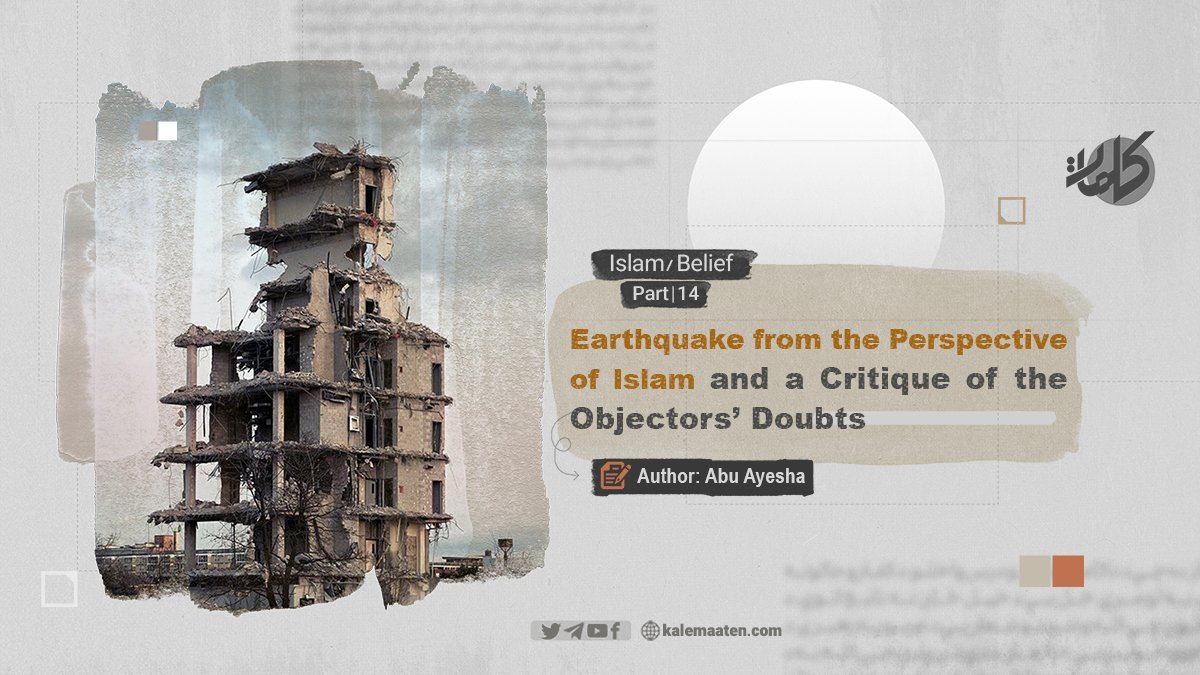
Earthquake from the Perspective of Islam and a Critique of the Objectors’ Doubts (Part 14)
Preface:
Those who, based on scientific and empirical viewpoints, attribute earthquakes to nature—without considering the divine wisdom behind them—and see no role beyond natural causes must know that in the Qur’an and Hadiths there are many examples showing that such events are not merely natural occurrences. Rather, at times, Allah sends these incidents as warnings and reminders for His servants so that they may realize there has indeed been negligence on their part. In this section of the research, due to the similarity of other incidents with earthquakes, we will discuss some events that certain critics attribute solely to nature.
A Question to Those Who Attribute Incidents to Nature!
Here, it is appropriate to ask those who attribute all events and occurrences to nature: What is your answer regarding the examples mentioned by Allah the Almighty in the Noble Qur’an, where He explicitly states that We did this in order to make them aware and attentive? Do they also attribute these incidents to nature and neglect or overlook the divine wisdom behind them? Or do they have another explanation for such questions?
Below, we mention a few examples that some people—who are unaware of the divine wisdom of Allah the Almighty—consider to be natural events or phenomena.
First Example
The first example concerns the people of a village upon whom rain fell continuously day and night. Water was abundant, and due to this abundance, unlimited blessings surrounded them. The people of that land built a large dam to preserve the rainwater and prevent it from being wasted. From this dam, water would flow gradually and steadily toward their farmlands, irrigating their gardens located on both sides of the valley—gardens whose fruits were so excellent, high-quality, and abundant that Allah the Almighty referred to them as two “Gardens,” lush and flourishing.
However, despite the countless blessings granted to them by Allah the Almighty, disobedience and sin spread among the villagers. One day, suddenly, the waters overflowed, a great flood came, the dam split open, and with its destruction, the entire town, its gardens, and fertile lands were lost. Nothing remained except rocky stones, and the villagers were either drowned or scattered and displaced from their lands.
This was the fate of that beautiful and dreamlike village—a place that resembled an image of eternal paradise and whose tragic end none could have imagined. In the blink of an eye, everything was gone.
Where did those towering trees with green leaves that cast shadow like upright cypresses vanish?
What happened to those clear streams and sparkling rivulets that flowed like strands of silver between rocks and gave life to the green gardens?
Who destroyed this village? Was it nature—or a power beyond nature?
Now, the disbelievers, the hypocrites, and those who follow them and eagerly accept their words say: “This was a natural phenomenon. The dam could not withstand the increased rainfall and the cracks that had formed in it. It collapsed, and the village was destroyed.”
They say this, but pay attention and reflect: Allah the Almighty has clearly informed us of the reality with clarity and proof.
Since rain is a creation of Allah the Almighty, and He changes it however He wills—and everything that happens in this world occurs according to His knowledge, will, and decree—know that this massive and destructive flood that struck the people of that village was not random or without purpose, as some ignorant people imagine. Rather, it was measured, decreed, and sent by Allah the Almighty, by the command of the Lord of the worlds, and it occurred because of their sins and disobedience and their disbelief in Allah the Almighty. [1]
Allah the Almighty says in His Noble Speech: “لقد کان لسبأ في مسکنهم آیة جنتان عن یمین وشمال کلوا من رزق ربکم واشکروا له بلدة طیبة ورب غفور فأعرضوا فأرسلنا علیهم سیل العرم وبدلناهم بجنتیهم جنتین ذواتي أکل خمط وأثل وشیء من سدر قلیل ذلک جزیناهم بما کفروا وهل نجازي إلا الکفور”[2] Translation: “Indeed, there was for the people of Saba a sign in their dwelling place: two gardens, one on the right and one on the left. ‘Eat of the provision of your Lord and give thanks to Him.’ A good land and a forgiving Lord. But they turned away, so We sent upon them a devastating flood, and We replaced their two gardens with two other gardens bearing bitter fruit, tamarisk trees, and a few lote trees. We gave them this recompense because they disbelieved, and We do not recompense except the ungrateful.”
Now reflect upon the statement of Allah the Almighty: “فأعرضوا”, “فأرسلنا علیهم”, and “ذلک جزیناهم بما کفروا وهل نجازي إلا الکفور” —and see what conclusion you reach. What do you see in this verse? From whom did this affliction come?
Continues…
Previous Part/ Next Part
References:
[1] Al-Uqayl, Aqeel bin Abdullah, Shubuhāt ḥawla al-zalāzil wa al-barākīn wa al-kawārith, 1431 AH, p. 20.
[2] Surah Saba, verses 15–17


