
Author: Abu Raef
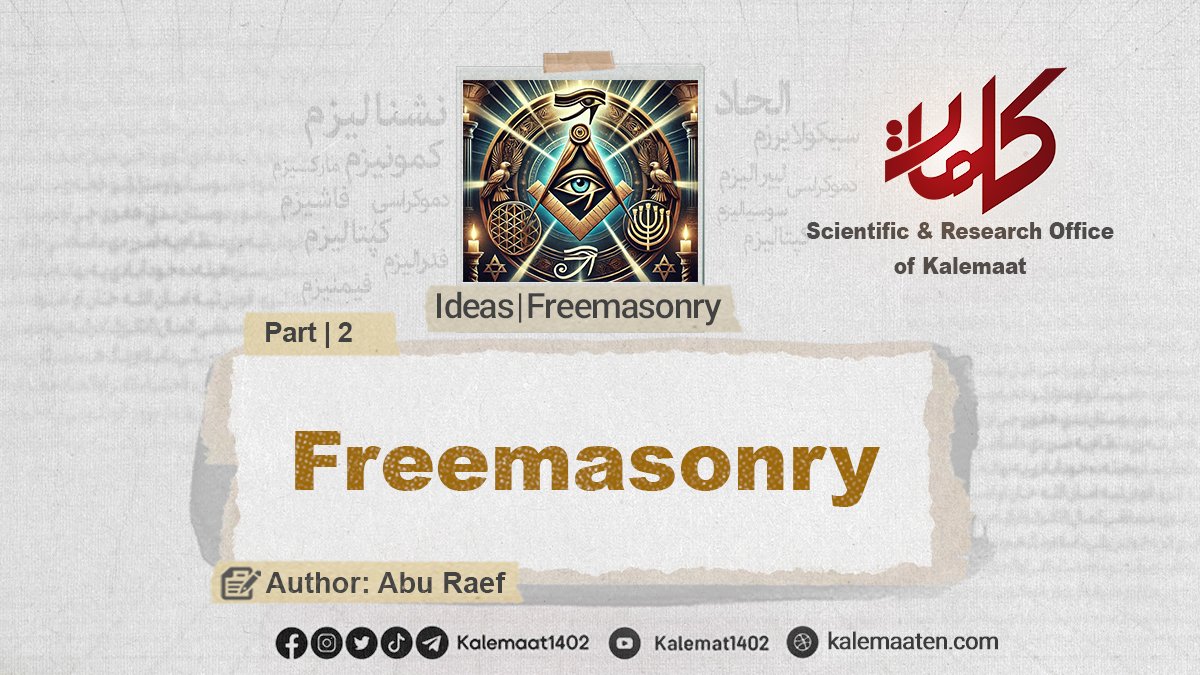
Freemasonry (Part two)
Definition of Freemasonry and an Examination of Its Nature
When research is conducted regarding the definition of this movement, one encounters various and differing explanations. The reason for this is that some scholars have examined its academic dimensions, others have studied its ideological foundations, and yet another group—being supporters and endorsers of the movement—have described it using refined and appealing language.
What is common across most definitions is that the movement is “secretive” and “mysterious,” to the extent that this characteristic has made understanding its true reality and nature difficult. Here we refer to a selection of these definitions.
Linguistic and Technical Definition of Freemasonry
Dr. Hamd Saleh al-Humaidah, a researcher of the Islamic world, writes: Linguistically, Freemasonry is a term meaning “the Free Builders,” referring to those who constructed the Haykal Sulayman (Temple of Solomon). [1]
Technically, Freemasonry is defined as: “A secretive, Jewish movement with a global essence, whose objective is the destruction of opposing religions—especially Islam and Christianity—in order to achieve Jewish aims across the world.” [2]
Some historians have defined it as follows: “Freemasonry is a tool in the hands of the Jews, through which they ensnare influential politicians and deceive unmindful nations and the masses. They are a danger to nations, hiding behind the slogans of freedom, equality, and brotherhood; whereas in reality, their goal is the reconstruction of the Haykal Sulayman (according to their belief) and the training of knowledgeable and skilled individuals who, with planning and courage, will reclaim that temple.” [3]
In al-Mawsu‘ah al-Muyassarah fi al-Adyān wa al-Madhāhib al-Mu‘āṣirah, Freemasonry is defined as: “Freemasonry is a Jewish, secretive, destructive, terrorist, and mysterious organization with a precise and well-structured hierarchy, whose aim is to guarantee Jewish domination over the world. This organization promotes irreligion, permissiveness, and corruption, hiding behind deceptive slogans such as ‘freedom,’ ‘brotherhood,’ and ‘human equality.’ Most of its members are well-known global figures who join by swearing an oath to preserve its secrets, gathering in meetings known as ‘lodges’ to plan, decide, and assign missions, with the goal of paving the way for the establishment of a global democratic republic. Their entire foundation is built upon opportunism and self-interest so that they may achieve their aspiration: the establishment of a non-religious global government.” [4]
Other Definitions Presented by Islamic Thinkers
The linguistic indication of the word mason, derived from Freemason, originates from two French words:
-
Franc meaning “honest”
-
Maçon meaning “builder”
Thus, mason means “honest builder,” and Freemasonry (al-Faramasoniyyah) signifies “the honest builders” or “the free builders.”
The term “free builder”, which existed from the 13th century CE (around 1300 A.D.), initially referred to: “Workers who were involved in constructing stone buildings.” [5]
Linguistic Meaning of Freemasonry
The term al-Māsūniyyah is linguistically composed of three parts:
-
Free – meaning “without restriction”
-
Mason – referring to a profession, especially “stone masonry”
-
-ry – the suffix of relational attribution
From the combination of these three components, the overall meaning becomes: “The Society of Free Builders” (Free Masonry). [6]
The Nature of Freemasonry
The Dutch scholar Dozy states: “Freemasonry is a massive group composed of individuals from various religions, all working toward a single goal, although only a small number among them know what that goal truly is.” [7]
That goal is none other than the reconstruction of the Haykal Sulayman upon the ruins of al-Masjid al-Aqsa. Thousands of followers of different religions, sects, nations, and regions have been following this objective like the blind. [8]
Continues…
Previous Part/ Next Part
References
[1] Haykal is a Hebrew word meaning “palace” or “large sanctuary,” referring to the Temple of Prophet Sulayman (MABH) in Jerusalem, revered by the Jews who hold peculiar beliefs regarding it.
[2] al-Humaidah, Hamd Ṣāleḥ. al-Māsūniyyah: Nash’atuhā wa Khaṭaruhā ‘ala al-‘Ālam al-Islāmī, p. 352, Journal of the Faculty of Usul al-Din and Da‘wah, Issue 39, Al-Azhar University, Cairo, Egypt.
[3] Same source, cited in al-Madhāhib al-Mu‘āṣirah wa Mawqif al-Islām Minhā by ‘Abd al-Raḥmān al-‘Umayrah.
[4] al-Juhayni, Mani‘ bin Hammad. al-Mawsu‘ah al-Muyassarah fi al-Adyān wa al-Madhāhib al-Mu‘āṣirah, Vol. 1, p. 492, 4th Edition, Dar al-Nadwah, Riyadh.
[5] al-‘Amilah, ‘Alā’ Khālid. al-Rumūz wa al-Afkār al-Māsūniyyah fi Barāmij al-Rusūm al-Mutaḥarrikah, p. 16, Middle East University, 2015.
[6] al-Shathri, Muḥammad bin Nāṣir. Dasa’is al-Māsūniyyah bayn al-Muslimīn, p. 7, 2nd Edition, 1424 AH, Dar al-Habib, Riyadh.
[7] al-Za‘bi, Muḥammad ‘Alī. al-Māsūniyyah fi al-‘Arā’, p. 22, 1st Edition, 1393 AH, n.p.
[8] Dasa’is al-Māsūniyyah bayn al-Muslimīn, p. 7.
