Close Menu
    Facebook X (Twitter) Telegram WhatsApp
    • Language
      • دری
      • پښتو
    • Home
    • Analysis
    • Islam
      • Prophet of Islam (PBUH)
      • Holy Quran
      • Muslim
      • Belief
      • Faith
      • Worships
      • Jurisprudence
      • Jihad
      • Beauty of Islam
      • Islamic Economy
      • Islamic Management
      • Islamic Culture
      • Islamic Sufism
      • Crimes
      • Prohibitions
    • Religions
      • Judaism
      • Christianity
      • Buddhism
      • Hinduism
      • Zoroastrian
      • Satanism
      • Confucius
      • Sikhism
    • Ideas
      • Atheism
      • secularism
      • liberalism
      • Socialism
      • Communism
      • Democracy
      • Federalism
      • Fascism
      • Capitalism
      • Marxism
      • Feminism
      • Nationalism
      • Colonialism
      • Frankfurt School
    • Seduction
      • Mu’tazila
      • Murjea
      • Jahmiyyah Sect
      • Khawarij’s sedition
      • Rawafez sedition
      • Istishraq’s sedition
      • Ghamediyat’s sedition
      • Qadiani’s sedition
      • Qadriyyah Sect
      • Karramiyyah Sect
    • Ummah
      • Companions
        • Hazrat Abubakr Seddiq (MGH)
        • Hazrat Umar Farooq (MGH)
        • Hazrat Usman (MGH)
        • Biography of Hazrat Ali (MGH)
        • Hazrat Khaled bin Waleed (MGH)
        • Hazrat Firooz Dilami (MGH)
        • Hazrat Abdullah Ibn Zubair (MGH)
      • Mothers of the believers
      • Islamic scholars
        • Sayed Abul Hasan Nadavi (MGHM)
        • Grand Imam Abu Hanifah (MGHM)
        • Imam Bukhari (MGHM)
        • Imam Tirmidhi (MGHM)
        • Imam al-Ghazali (MGHM)
        • Shah Waliullah Dehlavi (MGHM)
        • Seyyed Jamaluddin Afghan
        • Maulana Jalaluddin Balkhi Rumi (MGHM)
      • Muslim Governor’s
        • Sultan Salahuddin Ayyubi (MGHM)
        • Omar bin Abdul Aziz (MGHM)
        • Sultan Yusuf bin Tashfin (MGHM)
      • Islamic scientists
    • Civilizations
      • Islamic civilization
      • Eastern & Western civilizations
    • Diverse
      • Ramadan Message
    • library
    Facebook X (Twitter) Telegram WhatsApp
    کلمات انگلیسیکلمات انگلیسی
    You are at:Home»Diverse»Telephone Etiquette (Part Four)
    Diverse

    Telephone Etiquette (Part Four)

    admin2By admin213/02/2025No Comments3 Mins Read
    Share Facebook Twitter Telegram WhatsApp
    Share
    Facebook Twitter Telegram Email WhatsApp
    Author: Umm Sadiyah
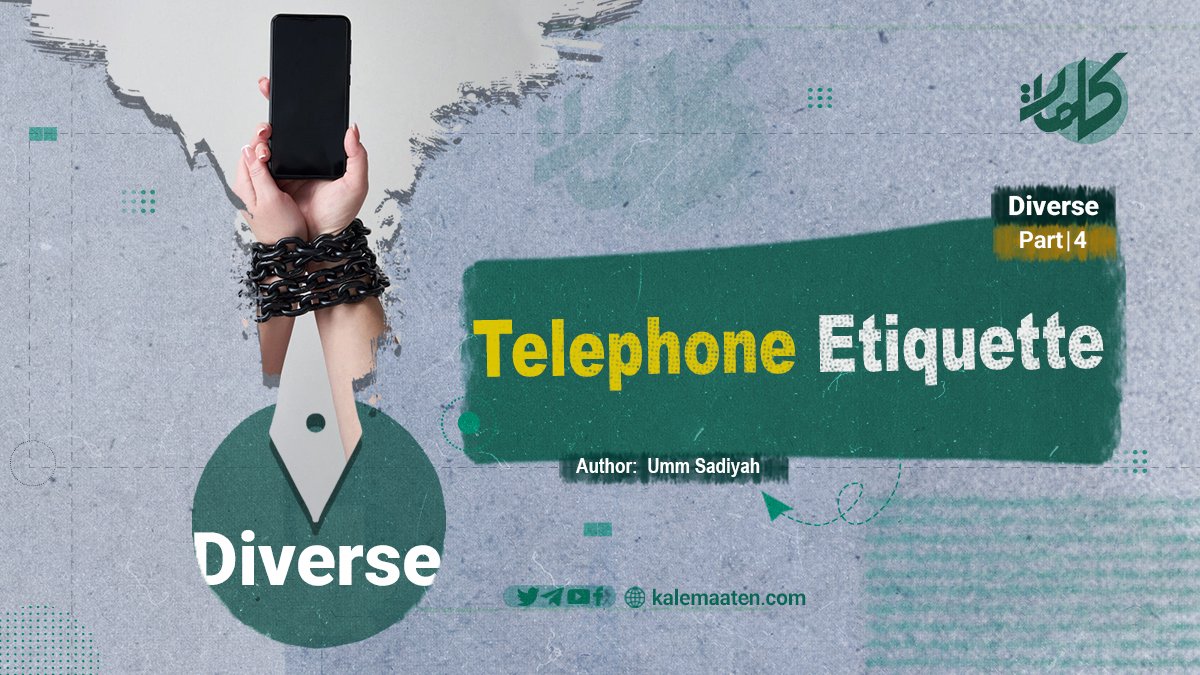
    Telephone Etiquette (Part Four)
    Part Two: Etiquette for the Respondent
    Etiquette 1: Avoiding Not Answering the Phone
    It is the responsibility of the telephone owner to ensure that the phone does not ring unnecessarily or for an extended period. Unless the owner of the line has identified the caller and has a valid reason for not answering, ignoring repeated and long calls is not aligned with the moral values of a Muslim. Someone may be in need of help in an emergency or a relative may be trying to visit. Not answering the phone is akin to someone knocking on the door and the owner of the house failing to open it, unless there is a legitimate reason for not doing so.
    Etiquette 2: A Woman Should Only Answer the Phone in Case of Emergency
    It is preferable for a man to answer the phone; however, if the man or the sons of the family are not available, the woman of the house or the daughters can answer the phone. This is a sensitive issue because a woman’s voice may inadvertently encourage unworthy individuals to say inappropriate things or exhibit inappropriate behavior. Therefore, it is recommended that women only answer the phone in the absence of men or in urgent circumstances.
    Etiquette 3: Women Should Not Answer the Phone When They Have Just Woken Up
    A woman’s soft, sleepy voice can provoke inappropriate reactions, especially in men with unhealthy thoughts. Therefore, women should refrain from answering the phone in such situations. This is also in accordance with religious teachings, as stated in the Quran: «فَلَا تَخْضَعْنَ بِالْقَوْلِ فَيَطْمَعَ الَّذِى فِي قَلْبِهِ مَرَضٌ» Translation: “Do not be soft-spoken, lest those in whose hearts is a disease covet you.”
    If a woman speaks in a clear voice without signs of sleepiness, there is no obstacle to answering the phone.
    Etiquette 4: Preventing Children from Answering the Phone
    Children should not be allowed to answer the phone, especially when they are unable to distinguish between right and wrong, or to recognize the caller and understand the conversation. This can lead to misunderstandings, missed opportunities, or even serious harm if the child inadvertently shares sensitive information or speaks with an intruder who intends to exploit them.
    Etiquette 5: Answering the Phone by Asking the Identity of the Caller
    When the phone rings, the politest way to answer is for the person on the line to first inquire about the identity of the caller, similar to someone knocking on the door. Upon picking up the phone, one may say, “Who is it?” or simply answer, “Yes.” Some well-mannered individuals start by greeting the caller; however, since the caller is akin to someone knocking on the door, it is incumbent upon the caller to initiate the greeting. Therefore, the correct method is as mentioned earlier.

    Continues…
    admin2

    Related Posts

    The Divine Education Model in the Family of the Prophets (part 67)

    27/01/2026

    The Divine Education Model in the Family of the Prophets (part 66)

    26/01/2026

    Modern Atheism in the Balance of Critique (part 2)

    12/01/2026
    Leave A Reply Cancel Reply

    Follow us on the social media pages
    • Facebook
    • Twitter
    • Instagram
    • Telegram
    • WhatsApp
    Don’t miss

    The Divine Education Model in the Family of the Prophets (part 67)

    The Quran: A Miracle Beyond Time- A Study of Its Miraculous Nature (part 76)

    Satanism (part 33) 

    The Divine Education Model in the Family of the Prophets (part 66)

    About Us:

    The Scientific and Research Office of Kalemaat is an independent office affiliated with Ahl al-Sunnah wa al-Jama‘ah. It works to promote the true values of Islam, achieve the noble goals of the sacred Sharia, resist Western cultural influence, uphold the Word of Allah, and awaken the Muslim community.

    This office is supported by Muslim philanthropists and businessmen, and it also invites all Muslims to fully cooperate and contribute to its mission.

    Famous publications

    The Divine Education Model in the Family of the Prophets (part 67)

    27/01/2026

    The Quran: A Miracle Beyond Time- A Study of Its Miraculous Nature (part 76)

    27/01/2026
    Follow us on social medias
    • Facebook
    • Twitter
    • YouTube
    • Telegram
    • Instagram
    • WhatsApp
    All right reserved by (kalemaat)
    • Home
    • Analysis of the day
    • The greats of the Ummah
    • library

    Type above and press Enter to search. Press Esc to cancel.