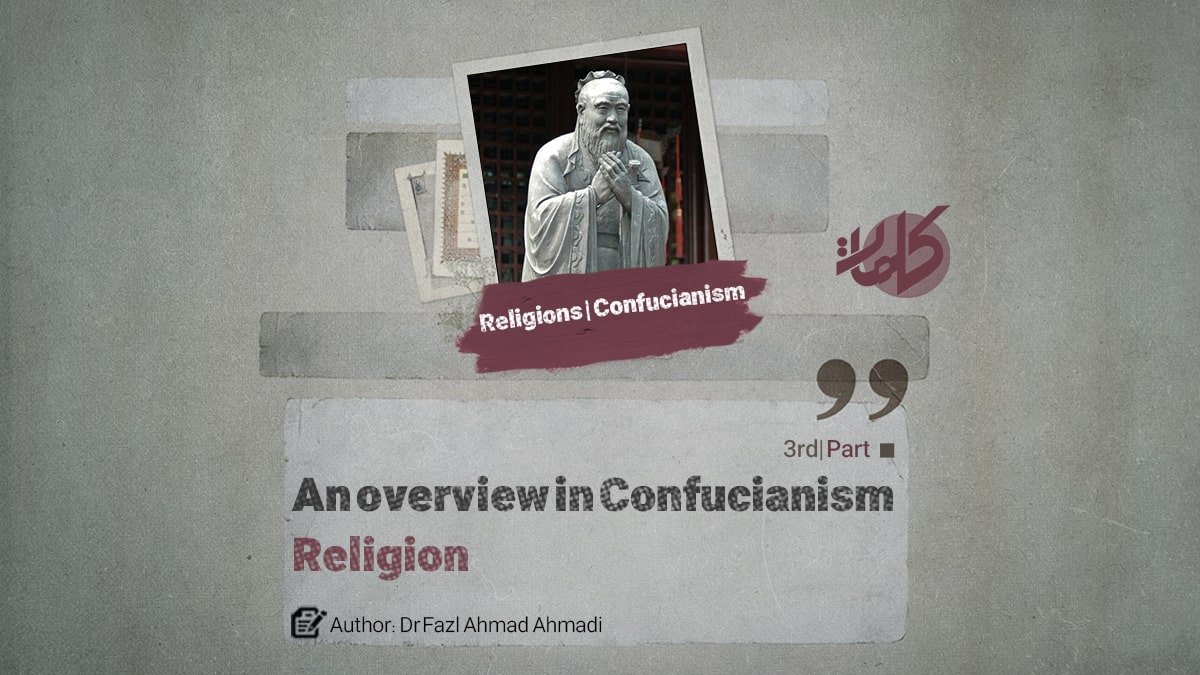
Author: Dr. Fazal Ahmad Ahmadi
An Overview of “Confucianism Religion” (Part 3)
2. From Kung Futze to Confucius
Between the years 479 and 551 BCE, a sage named “Kung Chiu”, whom his students called “Kung Futze” and later “Confucius,” meaning sage and philosopher, lived in the land of China. The Chinese people were nature-loving, and they bowed down before the moon and sun, wind, light, mountains, rivers, and every manifestation of nature. He was born in the city of “Qufu” in the state of “Lu.” Ancient Chinese fictions claim that a “spirit” informed his mother of the season of “Confucius'” birth. The child was born in a cave, and several dragons cared for him. Confucius lost his father when he was a child, and his mother took care of him and tried to educate him. When he was young, he obtained positions, including the Minister of Counselor at the court of Lu, and by studying past religions, he wrote treatises and gradually he paid attention to moral principles and gained many followers.
At the age of 22, Confucius started educating his students and people benefited from his knowledge until at the age of 34, his students reached three thousand people, at the start he arranged educational conferences, and he was teaching his students without books like Socrates, he never presented a written document during the lesson; Therefore, his lessons were written by his students. His authored treatises were never given to his students, this philosopher gained a lot of fame with the number of educated students and at the age of 52, the people of the city of “Jutek Tu” came to him and said: Dear Confucius! Since we are all aware of your grace, wisdom and knowledge, we want you to be the governor of our city, Confucius accepted the invitation of the people of this city and within one year he was able to lead all the people of that city to happiness.
A number of writers are of the opinion that if there is a person with whom Chinese civilization is related, undoubtedly, that person is Confucius; Therefore, Confucius is called the first teacher, and he is considered the most influential person and teacher in China. Also, some writers are of the opinion that the issue of religion and religiosity in China begins with Confucius and before that, religion in this sense did not exist in the land of China, although many of things that they attributed to him ,he was not the originator of those , however Confucius is an example of a perfect human being in Chinese beliefs that People and residents of his region looked up to him.
Confucius’ prominent and distinguished characteristics are as follows:
1. He never confirm without imagining.
2.He avoided works that were devoid of thinking and reflection.
3. He was not stubborn and autocratic.
4. He was the symbol of humility and simplicity, and what he had, he owed to the ancestors.
At the same time, Confucius lived a simple and modest life, living at the peak of public respect and dignity. Despite the fact that he was a nobleman and his ancestors were all nobles of the “Lo” state, he says: “I was a poor child and I had to take low-level jobs that were not worthy of princes.” When he was a child, he studied with the teacher of his village and spent most of his time in learning and studying science, poetry and historical traditions of ancient China, this study continued until the end of his life. He was also fond of music and often composed ancient Chinese tunes by playing the lute. He married one of the girls of “Lo” states at the age of 20 and had a child; But he lost the mother of his child, so he stops working for 27 months in mourning for his child’s mother.
Famous sayings of “Confucius” are still remaining, he used to say: Poetry builds human character and cultivates human religion, and music gives perfection to man.
Confucius said about goodness: Goodness is not the worship of secluded ascetics; but goodness is when a person is engaged in good deeds among people, and people are his neighbors. He also adds: it is never too late to learn knowledge; But it is better for people to start this work in their young years, he always taught people and invited people to the way of life of a wise person and taught them music, poetry and love and said: The highest love is love for their work and effort, and he also said: work should be done for self-enjoyment, not for the hope of getting a reward; Because this is the end of love for work. He adds: One should do good deeds and wish for a reward neither in this world nor in the next. Rather, one should enjoy goodness itself and be happy, and love for this kind of life is its own reward, and he used to say: Love makes everything beautiful, it establishes peace and serenity, he used to say: my children! Do not resort to war because the seal is in danger, and the heart that is united with the seal cannot commit sin.
These wise sayings of Confucius had a great impact, as he increased his followers every day and finally became a ritual.
continues…


 By
