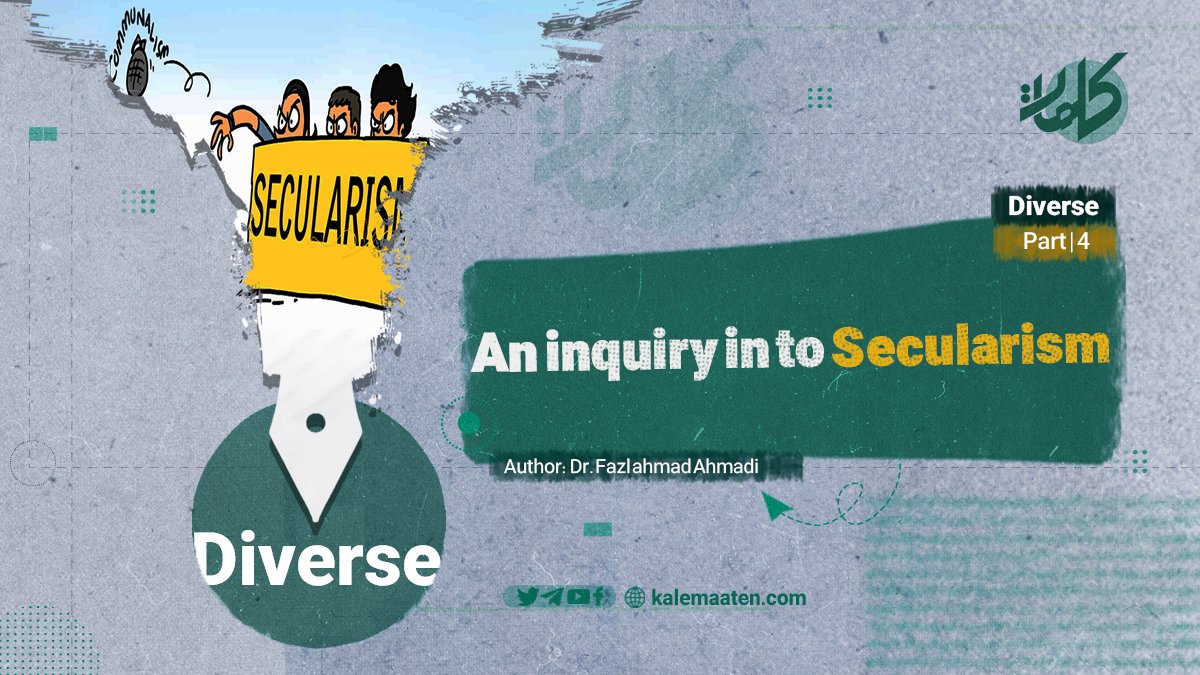
Author: Dr. Fazl Ahmad Ahmadi
An Inquiry into Secularism (Part Four)
3. The Concept and Different Definitions of Secularism
Secularism is derived from the word “secular,” which originally comes from the Latin word “seculum,” meaning “world” or “age.” It also connotes concepts such as era, period, time, and century. In Persian, it is interpreted as worldliness, belief in the legitimacy of worldly affairs, non-religiousness, separation of religion from the world, non-religionism, opposition to Sharia and religious content, traditionalism, and desacralization. In Arabic, this term is interpreted as “Elamaniyt” (which can also be spelled as “Alamaniyyah,” depending on whether it is derived from or related to science).
In other words, secularism refers to the idea that religion should not interfere in non-religious (worldly) affairs, which is typically expressed as the separation of church or any religious institution from the state.
Secularism embodies the belief that life and its related affairs should be independent of religion, and religious considerations should be set aside. Consequently, moral values and social practices should be determined with regard to worldly livelihood and social welfare, rather than by reference to religious doctrines.
In the Oxford English Dictionary, secularism is defined as “the regulation of livelihood affairs such as education, politics, ethics, and other aspects related to human beings, focusing on this world without consideration of Allah and the Hereafter.” In the culture of Arianpur, secularism is described as follows: “Secularism means opposition to Sharia and religious matters, reflecting a spirit of worldliness by favoring secular and customary principles. A secularist is a person who opposes the teachings of Sharia and religious matters, supporting secular and customary principles.” The Encyclopaedia Britannica defines secularism as “a social movement that strives to diminish belief in the Hereafter among people and to focus all their concerns on the world and material affairs.”
In general, the term secularism has been used in dictionaries and encyclopedias with various meanings such as secularism, humanism, atheism, rejection of religion, and favoring worldly and customary principles. In the history of the West, this word implies different concepts and meanings, including the separation of religion and the world, the separation of religion from politics, the non-holy and non-spiritual, rationality, scientism, modernity, contemporary thought, and prevailing ideologies.
According to researchers, despite the various equivalents created in the Persian language—such as secularizing religion and separating religion from politics—the problem of equivalence persists. Some attribute this issue solely to its Westernization, while others see it as a process that attempts to merge the concept of secularism with diverse and conflicting dimensions.
Both of these theories appear flawed. Although the origin of secularism is European, concepts such as the separation of religion from politics and the theory of separating religion from the world have also existed in Islamic societies. Therefore, it is misleading to assert that the roots of secularism lie exclusively in the West. Furthermore, the notion of non-interference of religion in politics is distinct from the theory of eliminating religion; both represent different levels of the same underlying truth known as the spirit of secularism. This concept sometimes manifests as the separation of religion and politics and at other times as a rejection of religion altogether, deeming the supernatural as irrational.
Thus, it seems that the term “secularism” is more comprehensive than other equivalents, aligning more closely with the intentions of secularists. Their rationale for focusing on worldly matters—rooted in humanism, rationalism, human understanding, and human freedom—can collectively be classified under the umbrella of “worldliness.”
Therefore, one can define secularism as follows: It means adopting a worldly attitude toward various areas of human life, including government, culture, economy, and society. In other words, secularism entails a worldly view of everything without regard to any afterlife consequences.
Shayer, a noted writer, proposes different definitions for the term secularism, which can be summarized as follows:
1. When religion in all its forms—i.e., symbols, teachings, and religious institutions—is removed from the context of society and its dignity and credibility are lost, then secularism applies.
2. When people’s attention shifts away from immaterial factors and is directed toward the necessities of worldly life and its issues, secularism emerges.
3. When religion becomes internal and personal, does not interfere in aspects of social life, and does not permeate society, secularism has been achieved.
4. When knowledge, behaviors, and institutions that were once thought to be based on divine power become phenomena created by humans and under human responsibility, secularism has been realized.
5. When existing sanctities, enveloped by non-material forces, are removed from this material world—so to speak, stripped of their sanctity—secularism is established.
6. When a society abandons its adherence to traditional values and practices and, while accepting transformation, makes all its decisions based on reason and utilitarianism, secularism takes on meaning.
However, if we want to summarize the definitions mentioned above, we can identify the following key points:
A. Removal of religion from the context of society;
B. Redirecting people’s attention to human issues;
C. Preventing religion from becoming a social matter;
D. Justifying behaviors based on human power rather than divine power;
E. Depriving occult forces of their influence in the material world and desacralizing them;
F. Basing decisions on rational and utilitarian principles.
One significant aspect of defining secularism is its moral theory. The 20-volume Oxford Dictionary considers secularism a moral theory and defines it as follows: “Secularism is the theory that morality should be based solely on factors related to human happiness in worldly life; in this regard, all religious considerations, such as belief in Allah and the world of the Hereafter, are set aside.” In other words, secularism is a philosophy about life and not an epistemological or ontological theory concerning the truths of the world.
According to the meanings of the words “secular” and “secularism,” the term “secularization” is similarly derived. This word literally means the secularization and humanization of worldly affairs. In other words, secularization is a conscious and deliberate attempt to de-religionize and humanize the system of life. Additionally, to secularize society means to remove the influence of religion and otherworldly goals and objectives from societal matters. The term is also used in the following contexts:
1. Converting ecclesiastical (religious) institutions and their properties into worldly property, along with their worldly use;
2. Transforming religious government or institutions into non-religious and non-spiritual entities;
3. Secularizing or desacralizing various subjects, such as art and studies, giving them a secular and mundane direction;
4. Grounding ethics in secular principles and limiting education to its subjects;
5. Changing religious concepts to worldly concepts through secularism.
In idiomatic usage, the meaning of “secularization” aligns with its literal meaning, referring to the process of secularization. Advocates of traditionalism consciously reject all forms of belief in supernatural affairs and establish non-religious or anti-religious principles as the foundation of personal ethics and social organization.
Continues…


 By
