Close Menu
    Facebook X (Twitter) Telegram WhatsApp
    • Language
      • دری
      • پښتو
      • العربیة
    • Home
    • Analysis
    • Islam
      • Prophet of Islam (PBUH)
      • Holy Quran
      • Muslim
      • Belief
      • Faith
      • Worships
      • Fiqh
      • Jihad
      • Islamic Perspectives
      • Islamic Economics
      • Islamic Management
      • Islamic Culture
      • Sufism
      • Crimes
      • Prohibitions
      • Sayings of the Scholars
      • Muhajir Tafsir
      • Hadith
    • Religions
      • Judaism
      • Christianity
      • Buddhism
      • Hinduism
      • Zoroastrianism
      • Satanism
      • Confucianism
      • Sikhism
    • Theories
      • Atheism
      • Secularism
      • liberalism
      • Socialism
      • Communism
      • Democracy
      • Federalism
      • Fascism
      • Capitalism
      • Marxism
      • Feminism
      • Nationalism
      • Colonialism
      • Frankfurt School
      • Freemasonry
      • Humanism
    • Fitan
      • Mu’tazila
      • Murji’ah
      • Jahmiyyah
      • The Fitna of the Khawarij
      • The Fitna of the Rawafid
      • The Fitna of Orientalism
      • Ghamdism
      • The Fitna of the Qadianis
      • Qadariyyah
      • Karramiyyah
    • Ummah
      • Sahabah (Companions of the Prophet ﷺ)
        • Hazrat Abu bakr Siddiq (RA)
        • Hazrat Umar al-Faruq (RA)
        • Hazrat Uthman ibn Affan (RA)
        • Hazrat Ali (RA)
        • Hazrat Khalid ibn al-Walid (RA)
        • Hazrat Fayruz al-Daylami (RA)
        • Hazrat Abdullah ibn al-Zubayr (RA)
      • Ummahat al-Mu’minin
      • Islamic scholars
        • Allamah Sayyid Abul Hasan Ali Nadwi (RH)
        • Imam al-Aʿzam Abu Hanifa (RH)
        • Imam al-Bukhari (RH)
        • Imam al-Tirmidhi (RH)
        • Imam al-Ghazali (RH)
        • Shah Waliullah al-Dehlawi (RH)
        • Sayyid Jamal al-Din Afghani
        • Mawlana Jalal al-Din Muhammad Balkhi Rumi (RH)
      • Muslim Rulers
        • Sultan Salahuddin Ayyubi (RH)
        • Umar ibn Abd al-Aziz (RH)
        • Sultan Yusuf ibn Tashfin (RH)
      • Muslim Scientists
    • Civilizations
      • Islamic Civilization
      • Eastern and Western Civilizations
      • Traces of History
    • Diverse
      • Ramadan Message
      • Reports
      • Light and Darkness
    • library
    Facebook X (Twitter) Telegram WhatsApp Instagram Pinterest YouTube
    kalemaat Englishkalemaat English
    You are at:Home»Islam»Holy Quran»The Qur’an: A Miracle Beyond Time- A Study of Its Miraculous Nature (Part Five)
    Holy Quran

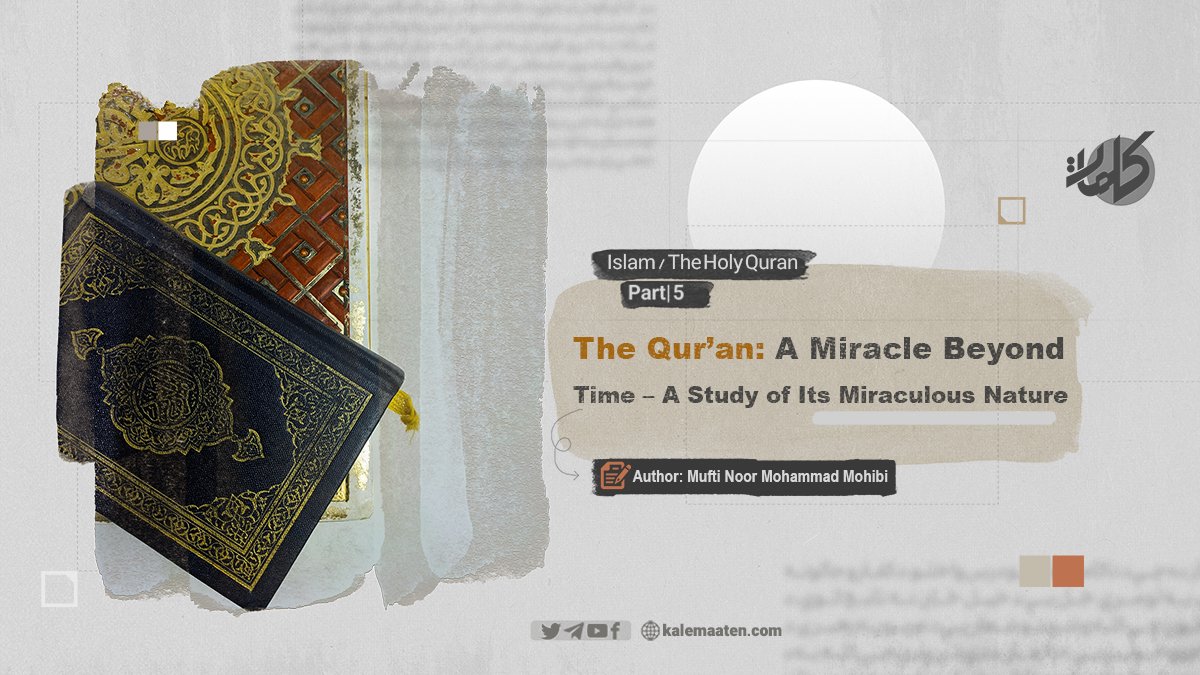
    The Qur’an: A Miracle Beyond Time- A Study of Its Miraculous Nature (Part Five)

    By 02/07/2025Updated:31/12/2025No Comments3 Mins Read
    Share Facebook Twitter Telegram WhatsApp
    Share
    Facebook Twitter Telegram Email WhatsApp
    Author: Mufti Noor Mohammad Mohibi
    The Qur’an: A Miracle Beyond Time- A Study of Its Miraculous Nature (Part Five)
    Types of Quranic Miracles
    The Holy Quran is not only a divine book for the guidance of mankind; it is also considered one of the greatest miracles in the history of humanity. Since its revelation until today, thinkers, theologians, writers and scientists of various sciences have always focused on numerous aspects of its miracles, and one of the amazing characteristics of the Quran is the multiplicity and variety of its miracles; in such a way that a type of its miracle is highlighted in every era, more types of miracles have been identified in the Quran in recent periods.
    In this section, only a list of forty examples of the most famous of them is presented as follows, and each will be explained in future chapters. Allah willing:
    1. Expressional miracle (rhetoric, eloquence and unique style);
    2. Verbal miracle (special combination of words and rhythmic order);
    3. Syntactic miracle (new and unique structures of the Arabic language);
    4. Literary miracle (metaphors, similes, allegories);
    5. Scientific miracle (agreement with the natural and vital sciences of the day);
    6. Numerical miracle (mathematical order in words, verses, and concepts);
    7. Historical miracle (accuracy in describing the history of prophets and past peoples);
    8. Unseen miracle (prediction of future events that have come true);
    9. Legislative miracle (comprehensive and balanced laws in the individual and social spheres);
    10. Psychological miracle (affecting the human soul and mind);
    11. Educational miracle (correcting morality and refining the soul);
    12. Philosophical miracle (answering basic questions of ontology);
    13. Theological miracle (precise explanation of divine attributes and actions);
    14. Mystical miracle (manifestation of monotheistic and intuitive teachings);
    15. Spiritual miracle (guiding the heart, bringing peace and insight);
    16. Structural miracle (coherence between Surah and verses);
    17. Visual miracle (drawing vivid scenes with words);
    18. Auditory miracle (the effect of voice, tone, and natural melody of verses);
    19. Linguistic miracle (dynamics in the meaning and multidimensional function of words);
    20. Challenging miracle (calling for literary confrontation and defeating opponents);
    21. Moral miracle (presenting the best moral principles);
    22. Social miracle (vital and basic rules for the administration of society);
    23. Economic miracle (financial provisions centered on justice and development);
    24. Political miracle (guidance on the principles of just governance);
    25. Medical miracle (references to the realities of life and health);
    26. Environmental miracle (calling for maintaining balance in nature);
    27. Psychological miracle (recognizing the dimensions of the human psyche);
    28. Paranormal miracle (referring to the unseen world, the soul, and the Barzakh (purgatory);
    29. Nominal miracle (special order in the divine names and their use);
    30. Temporal miracle (the flexibility of the Quran for all times);
    31. Cultural miracle (reform of customs, manners, and civilizational developments);
    32. Civilizational miracle (founding a new civilization based on monotheism);
    33. Miracle in the Moqatahat letters (mysteries and secrets in the initial letters of each surah);
    34. Miracle in the purposeful repetition of verses (for emphasis and education);
    35. Miracle in addresses (a type of address to believers, unbelievers, hypocrites, and the People of the Book);
    36. Miracle in the order of revelation and compilation (two separate orders with a specific purpose);
    37. Miracle in the miracles of the prophets (narration with the purpose of having a specific effect);
    38. Miracles in the celestial signs (celestial movements, the position of the moon and the sun);
    39. Miracles in geological signs (mountains, layers of the earth, earthquakes);
    40. Miracles in biological signs (plants, animals, mating, fertility, growth).
    Continues…

    Previous Part/ Next Part

    Democracy Good Manner Islamic Civilization Islamic Philosophy Prophetic Sunnah Spiritual and Psychological Benefits of Fasting The Role of Muslims in the Formation and Development of Sciences Worships

    Related Posts

    The Status of Knowledge

    15/10/2026

    Serving One’s Parents

    15/10/2026

    The Worst of People

    14/10/2026
    Leave A Reply Cancel Reply

    Follow us on the social media pages
    • Facebook
    • Twitter
    • Instagram
    • Telegram
    • WhatsApp
    Don’t miss

    The Status of Knowledge

    Serving One’s Parents

    Imam al-A‘zam Abu Hanifa (RA): The Role Model (part 35)

    The Worst of People

    About Us:

    The Academic and Research Organization of Kalemaat is an independent Islamic Da'wah organization affiliated with Ahl al-Sunnah wa al-Jama'ah. It is dedicated to promoting the authentic values of Islam, advancing the higher objectives of the Sharia, countering Western cultural influence, upholding the Word of Allah, and contributing to the intellectual and spiritual awakening of the Muslim Ummah.

    The Organization is supported by Muslim philanthropists and businessmen, and it welcomes the cooperation and support of Muslims worldwide in advancing its mission.

    Famous publications

    The Status of Knowledge

    15/10/2026

    Serving One’s Parents

    15/10/2026
    Follow us on social medias
    • Facebook
    • Twitter
    • YouTube
    • Telegram
    • Instagram
    • WhatsApp
    All right reserved by (kalemaat)
    • Home
    • Analysis of the day
    • The greats of the Ummah
    • library

    Type above and press Enter to search. Press Esc to cancel.
