




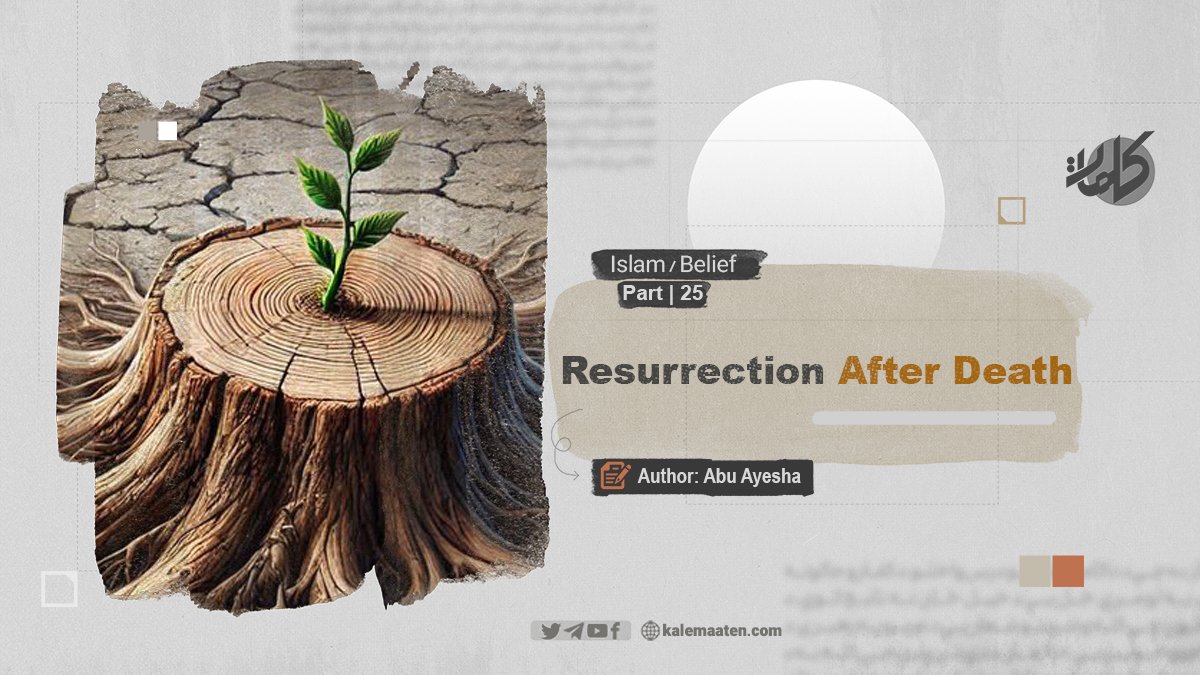
Author: Abu Ayesha
Resurrection after Death (part 25)
Third Doubt: Considering Resurrection Impossible (Istib‘ad)
Although this issue was briefly discussed in previous sections—especially in the chapter on the causes of denying resurrection after death—it is mentioned again here because many works present it as one of the principal objections raised by the deniers of resurrection. The essence of this doubt is that some contemporary deniers have adopted the same position as the polytheists of early Islam, who rejected the concept of life after death and refused to accept it.
This objection arises because such individuals follow the path of their forefathers and imitate their views. Abandoning their inherited beliefs is difficult for them. They argue that they have never witnessed the dead returning to life after burial and emerging from their graves to inform people about the next world. Furthermore, they observe that after death a body is consumed by worms and eventually turns into dust and decayed bones. Thus, they ask, how can such a person possibly be brought back to life?
The Noble Qur’an records their argument: (وَقَالَ الَّذِينَ كَفَرُوا أَإِذَا كُنَّا تُرَابًا وَآبَاؤُنَا أَئِنَّا لَمُخْرَجُونَ لَقَدْ وُعِدْنَا هَذَا نَحْنُ وَآبَاؤُنَا مِنْ قَبْلُ إِنْ هَذَا إِلَّا أَسَاطِيرُ الْأَوَّلِينَ) Translation: “Those who disbelieve say: ‘When we and our fathers have become dust, shall we really be brought forth? We and our fathers were promised this before. This is nothing but the legends of the former peoples.’” [1]
Response to the Doubt
In response, it should be said that Allah the Almighty has mentioned resurrection in numerous verses of the Qur’an and has declared it to be a certain reality and an inevitable promise that must come to pass. He explicitly answers the deniers: (وَأَقْسَمُوا بِاللَّهِ جَهْدَ أَيْمَانِهِمْ لَا يَبْعَثُ اللَّهُ مَنْ يَمُوتُ ۚبَلَى وَعْدًا عَلَيْهِ حَقًّا وَلَكِنَّ أَكْثَرَ النَّاسِ لَا يَعْلَمُونَ) Translation: “They swear their strongest oaths by Allah that Allah will not resurrect those who die. On the contrary, it is a true promise binding upon Him, though most people do not know.” [2]
Likewise, Allah says concerning the assumption of the disbelievers: (زَعَمَ الَّذِينَ كَفَرُوا أَنْ لَنْ يُبْعَثُوا ۚ قُلْ بَلَى وَرَبِّي لَتُبْعَثُنَّ ثُمَّ لَتُنَبَّؤُنَّ بِمَا عَمِلْتُمْ ۚ وَذَلِكَ عَلَى اللَّهِ يَسِيرٌ) Translation: “Those who disbelieve claim that they will never be resurrected. Say, ‘Yes, indeed!’ By my Lord, you will surely be resurrected; then you will be informed of all that you did. And that is easy for Allah.’” [3]
Today, we address those who raise similar objections and follow the path of their predecessors by asking the following: Do you believe that the One who created human beings from nothing is incapable of recreating them? Reflect carefully and use your reason. The One who brought creation into existence the first time is surely capable of bringing it back again.
Fourth Doubt: Anxiety and Fear Caused by Belief in the Hereafter
Another objection, often raised by proponents of materialism, concerns the psychological effects of belief in resurrection. They claim that thinking about life after death creates anxiety, fear, and inner distress.
One philosopher expressed this view as follows. Bertrand Russell argued the following: “Fear of Hell has always been, and still is to some extent, a source of deep anxiety and sorrow. It has deprived people of much of the comfort and consolation that belief in the immortality of the soul might otherwise provide. The desire to save others from Hell has sometimes taken the form of oppression and coercion, because if a heretic leads people astray and causes them to incur damnation, then no degree of punishment seems unjust so long as it is intended to prevent that dreadful fate.”
Response to the Doubt
In reply, it should be stated that belief in the Hereafter does not produce anxiety and terror; rather, the reality is quite the opposite. Faith in the Last Day contributes to the happiness and well-being of both the individual and society.
Moreover, belief in the Hereafter liberates a person from many fears and opens the door to countless hopes and aspirations. It gives meaning to sacrifices, patience, and righteous deeds by assuring believers that eternal rewards await them, even if they are not fully realized in this world.
The human conscience naturally longs for justice. For true justice to be fulfilled, there must be a day when truth is separated from falsehood and every person receives what he or she deserves. Thus, belief in the Hereafter is not only a moral necessity but also a behavioral necessity that guides individuals toward responsibility, integrity, and hope. [4]
To be continued…
Previous Part | Next Part
References:
- The Noble Qur’an, Surah An-Naml (27), verses 67–68.
- The Noble Qur’an, Surah An-Nahl (16), verse 38.
- The Noble Qur’an, Surah At-Taghābun (64), verse 7.
- Al-Muqaddam, Jihan Nūr al-Dīn Muḥ Al-Maʿād Bayna al-Muthbitīn wa al-Munkirīn: Dirāsah Taḥlīliyyah Naqdiyyah (Resurrection between the Affirmers and the Deniers: An Analytical and Critical Study), published in the Journal of the Faculty of Islamic and Arabic Studies, Vol. 37, No. 2, 2019, p. 65.


