




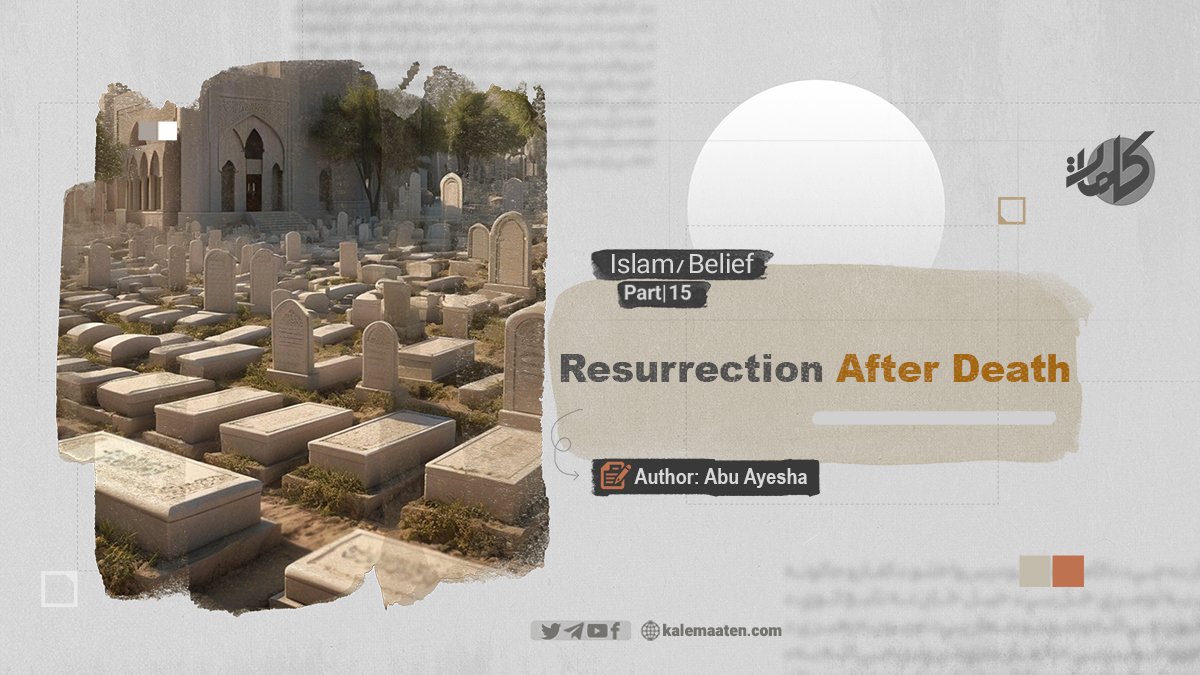
Author: Abu Ayesha
Resurrection after Death (part 15)
Factors Behind the Denial of Resurrection After Death (Continued)
-
The emergence of materialists among different nations and the spread of atheists and disbelievers in human societies; those who imagine that they know everything and possess full awareness, while in reality they are devoid of any true knowledge and act as axes aimed at destroying Islam. This is because such individuals, despite scientific progress and the emergence of signs that indicate the necessity of resurrection after death, work among people to erase the signs of truth. With the expansion of knowledge, day by day we witness signs and proofs that affirm resurrection after death. [1] Allah the Exalted says beautifully in this regard:
سَنُرِيهِمْ آيَاتِنَا فِي الْآفَاقِ وَفِي أَنْفُسِهِمْ حَتَّى يَتَبَيَّنَ لَهُمْ أَنَّهُ الْحَقُّ Translation: “We will soon show them Our signs in the horizons and within themselves until it becomes clear to them that it is the truth.” [2]
-
Attributing the influence of nature over the universe. Throughout different eras and ages, many naturalists have emerged who attribute events to nature or believe that everything in the universe occurs due to the effect of nature. According to them, every event or transformation that takes place in this world is caused by nature. This group believes that this system is not temporary and will not come to an end at a fixed time. If this system is such, then there is neither resurrection after death, nor gathering and dispersal, nor any reckoning for deeds performed. [3]
-
Being immersed in heedlessness and negligence is among the most important factors behind denying resurrection after death, to the extent that people become occupied with very trivial and insignificant matters and give them great importance. They place these matters among their main priorities and fundamental aspirations in life and give them precedence over all else, so that they remain constantly within their sight, thoughts, and the axis of their lives—despite the fact that the outward life is extremely limited, brief, and transient, even though it may seem vast and encompassing all of one’s efforts. Undoubtedly, heedlessness of the Hereafter completely disrupts a person’s entire system of thought, preventing them from having a correct understanding of it. [4] [Why they were created, what they should do, and how their end will be.]
-
The political factor is among the causes that compel people to deny resurrection after death. What is meant by this factor is love for leadership and authority, preserving one’s status, dominating others, and humiliating those who have no strength or power—so that leadership remains permanently in the hands of the strong and powerful and their position in society remains secure. This is because they know that believing—absolutely—and especially believing in resurrection after death, would make them equal to slaves and ordinary people, and they would no longer be able to present themselves as deities to others. [5]
-
Stubbornness and frivolity: a matter that drives a person to exceed their limits and demand things that are beyond human capacity, or have no relation to reality, or to request comparisons that appear impossible or corrupt—such as objecting to eating food, drinking water, or wearing clothes. This behavior stems either from ignorance of realities, weak understanding and perception, negligence of consequences, or being deceived by the fleeting enjoyment of this worldly life. [6] Allah the Exalted says:
وَقَالُوا مَا لِهَذَا الرَّسُولِ يَأْكُلُ الطَّعَامَ وَيَمْشِي فِي الْأَسْوَاقِ Translation: “And they said: What is wrong with this Messenger that he eats food and walks in the markets?” [7]
-
Disbelief and polytheism are among the greatest factors behind denying resurrection after death. Here we must understand the difference between a believer and a disbeliever. A believer is one who believes in Allah, the Day of Resurrection, and life after death, whereas a disbeliever does not believe in the resurrection of creation after death. [8]
As a result, those who do not believe in Allah and the Last Day do not accept resurrection after death and do not believe in it.
-
Inclination toward desires and immersion in pleasures whose abandonment is difficult for a person also lead to denying resurrection after death. This is because those who are deeply immersed in desires and pleasures know that believing in resurrection after death would act as a barrier against all the immoral acts they have become accustomed to and which have firmly settled in their hearts. [9]
Those who deny resurrection after death are people who are satisfied with worldly life and indulge in its desires and pleasures, and they do not wish to lose such opportunities in any way. Usury, adultery, alcohol, drugs, immodesty, music, immorality, sins, and everything that Allah the Exalted has forbidden have become part of their lives and pleasures. These individuals fear that if they believe in the Hereafter, resurrection after death, and accountability, they would be prohibited from all these pleasures and sinful acts. [10] [Therefore, they prefer not to lose what currently entertains them for a short time and deny something they neither see nor believe in.]
The causes and factors that have driven deniers of resurrection after death to adopt such views go beyond what has been mentioned above. Here, an effort has been made to present some of the most important factors that have compelled deniers of resurrection and those who believe that there is no Hereafter to take such a stance.
At times, material issues and economic factors also lead to such behavior; because those who engage in unlawful activities (such as trading in alcohol or usury, etc.) would, by entering Islam and believing in the Day of Judgment and resurrection after death, be forced to abandon such practices. By giving up these trades and dealings, they would suffer loss and financial damage. Therefore, they prefer to remain in their position so that their trade and profit are not lost. [11]
Continues…
Previous Part
References:
[1]. Ramadan, Manzur ibn Muhammad ibn Muhammad, The Method of the Noble Qur’an in Affirming the Belief in Resurrection After Death, n.d., pp. 12–13.
[2]. Surah Fussilat, verse 53.
[3]. Ramadan, Manzur ibn Muhammad ibn Muhammad, The Method of the Noble Qur’an in Affirming the Belief in Resurrection After Death, n.d., pp. 13–14.
[4]. Ibid., p. 16.
[5]. ‘Awaji, Dr. Ghalib ibn ‘Ali, The Hereafter: From Resurrection to Entry into Paradise or Hellfire, 1421 AH / 2000 CE, vol. 1, pp. 135–136.
[6]. Ramadan, Manzur ibn Muhammad ibn Muhammad, The Method of the Noble Qur’an in Affirming the Belief in Resurrection After Death, n.d., p. 17.
[7]. Surah Al-Furqan, verse 7.
[8]. Al-Sufi, Mahir Ahmad, Encyclopedia of Resurrection and Gathering, foreword by a group of scholars, 1431 AH / 2010 CE, p. 90.
[9]. ‘Awaji, Dr. Ghalib ibn ‘Ali, The Hereafter: From Resurrection to Entry into Paradise or Hellfire, 1421 AH / 2000 CE, vol. 1, p. 135.
[10]. Al-Sufi, Mahir Ahmad, Encyclopedia of Resurrection and Gathering, 1431 AH / 2010 CE, p. 90.
[11]. Summarized from: ‘Awaji, Dr. Ghalib ibn ‘Ali, The Hereafter: From Resurrection to Entry into Paradise or Hellfire, 1421 AH / 2000 CE, vol. 1, p. 135.


