
Author: Abu Raef
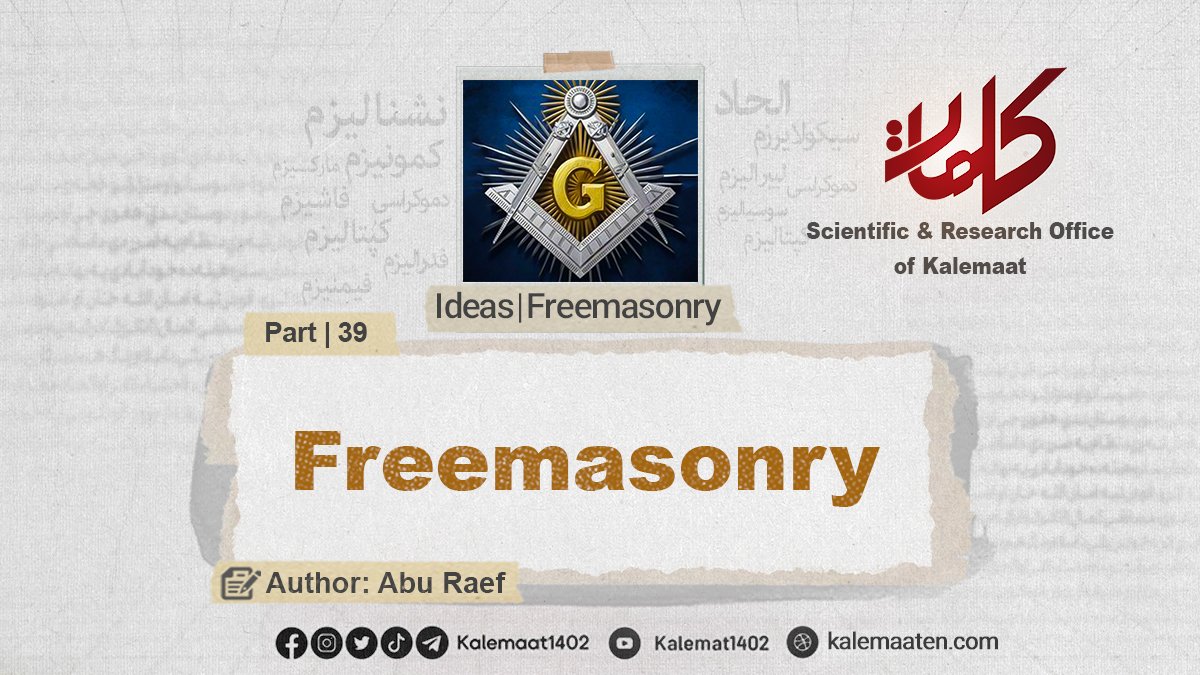
Freemasonry (part 39)
The Relationship Between Freemasonry and Judaism
The most important issue we seek to examine and evaluate—and for which the previous discussions served as an introduction—is the relationship and connection between Freemasonry and Judaism. When we study the major and foundational sources in this regard, it becomes clear that this relationship is very strong and deeply intertwined. In fact, in both supportive and opposing sources, this movement has been described as a Jewish and Zionist movement. Even its supporters and advocates consider it one of the significant products and achievements of Judaism and include it among the important activities of this religion.
In this section, we present statements, evidence, and indications that demonstrate that this movement is among the most significant activities associated with Judaism.
As mentioned earlier, perhaps the only point on which Freemasons in both the East and the West agree—or at least do not deny—is the close and firm relationship between Freemasonry and Judaism, and consequently with Jews. One possible reason for this is the widespread influence of Jews, which rests upon two major pillars: vast wealth and extensive media influence. A third pillar can also be added: “alliances with major powers.” This last factor is even more prominent and profound than the others and has, in reality, contributed to much of the influence and dominance attributed to Judaism across the world—from alliances with Western powers to cooperation with fascists, Nazis, and major colonial forces.[1]
The reason behind such alliances with global powers, as well as efforts to gain influence over movements and institutions, is claimed to be that Jews have always “worshipped power.” In contrast, in Islam, God is the Lord of all worlds; in Christianity, He is described as the God of love and peace; whereas in Judaism, He is presented as the “Lord of Hosts.” The Torah is described as portraying scenes of bloodshed with intensity and even commanding the slaughter of enemies, killing of animals, burning of crops and gardens, and filling of water sources. Examples of such emphases and instructions—allegedly altered through textual distortion and biased interpretation—will be mentioned in later discussions.
Another factor attributed to Jewish influence among societies and nations is their wealth. In reality, their wealth and media are said to influence the minds of individuals and governments—not only the poor and weak or minor rulers, but even powerful figures who are attracted to such wealth. However, this wealth is claimed to be given only under certain conditions. Likewise, powerful governments and political organizations are said to be fascinated by Jewish media, which—apparently—has the ability to portray a prophet as a devil and a corrupt person as a saint.[2]
Dr. Nu‘man ‘Abd al-Razzaq al-Samarra’i, an Islamic thinker and writer, writes regarding Jewish influence within Freemasonry and their deep connection:
It has been said (and the responsibility of this statement lies with the narrator) that the Arab foreign ministers who negotiated the first Rhodes armistice with the Zionists were all Freemasons, or at least most of them were. If this is true (and I hope it is not), then our situation would be as described by the poet al-Rusafi:
I shall sleep so I do not see my homeland being bought and sold. And for whom it is sold, and who sells it? England, for England.
What concerns us here is the relationship between Freemasonry and Judaism, especially in a time when we are witnessing defeats and collapses, facing challenges perhaps even greater than those of the Tatars and Crusaders. In those times, we were free to use any means without interference from major powers or biased international organizations. But today, we face not only enemies but countless interveners, and alongside those who oppose us, others stand against us as well. Thus, our situation has reached extreme hardship and constraint.” [3]
Statements Indicating a Deep Connection Between Freemasonry and Judaism
By examining credible sources on the relationship between Judaism and Freemasonry, as well as the statements of individuals who have described this movement, it becomes clear that Freemasonry is portrayed as a wing of Judaism and, in essence, its observing eye in the world. Jewish and Masonic thinkers have acknowledged this and even considered it a point of pride. Some of these statements are as follows:
The Chief Rabbi Isaac Daiz stated: “Freemasonry is a Jewish institution; everything in it, from beginning to end, is Jewish: its history, its obligations, its ranks, its rituals, its symbols and passwords, and its conditions—except for one minor degree and a few words in the oath.”[4]
This statement was not made by an Islamic scholar nor published in a hostile outlet, but rather by a Chief Rabbi in a publication dated 30/4/1965 in the journal Israeli English Magazine.[5]
Ahmad Alloush, the head of one of the largest lodges in Alexandria, who was elevated to the highest degrees of Freemasonry, stated:
“I never reached the goal they promised, which was to shine like the sun. However, I discovered a truth I had previously been unaware of that Freemasonry and Zionism are essentially one, each complementing the other. Their relationship is that of servant and master: Freemasonry serves, and Zionism is served.” [6]
Hanna Abu Rashid, a Grand Master and author of the Masonic Encyclopedia, explicitly stated: “The relationship between Freemasonry and the Torah is a strong one.” [7]
He further added: The Torah is an important historical document, and many of the secrets of Freemasonry cannot be understood without linking them to the Torah, for their explanation lies therein. [8]
Shahin Makarius, another Grand Master, نقلs the Masonic oath, in which one swears—placing a hand upon the Holy Torah—to believe in it as the first and final divine book, to sacrifice life and blood for the establishment of the great state of Moses, to take revenge upon the enemies of Zion, and to destroy other beliefs.[10]
One may then ask: which part of this oath is non-Jewish? While all its elements appear Jewish—from the Holy Torah to Mount Sinai, the state of Moses, and vengeance against the enemies of Zion.
Abdel-Halim Elias Khoury, himself a Freemason, also affirms that Freemasonry, at its core, contains Israeli thought. In its history, symbols, and secrets, Jewish myths are present. He states that Freemasonry—consciously or unconsciously—seeks to instill a Jewish spirit in its followers, and that its ultimate goal is the construction of Solomon’s Temple.[11]
Continues…
Previous Part | Next Part
References:
[1]. For more on this topic and the role of Jews in alliances with major global powers, see: Al-Yahud wa al-Tahāluf ma‘a al-Aqwiyā’ (Jews and Alliances with the Powerful), by Dr. Nu‘man ‘Abd al-Razzaq al-Samarra’i, Umm al-Ummah Book Center, 1st edition, 1412 AH.
[2]. Al-Samarra’i, Nu‘man ‘Abd al-Razzaq, Freemasonry, Judaism, and the Torah, p. 31, Dar al-Hikmah, College of Education, King Saud University, n.d.
[3]. Ibid., p. 32.
[4]. Hamadah, Hussein Omar, Freemasonry and Freemasons in the Arab World, p. 59, Dar al-Watha’iq, Damascus, Syria, 1438 AH.
[5]. Ibid.
[6]. Freemasonry, Judaism, and the Torah, p. 32.
[7]. Masonic Encyclopedia, p. 24.
[8]. Ibid., p. 25.
[9]. Al-Asrar al-Khafiyyah (The Hidden Secrets), p. 99.
[10]. Al-Saqqa, Muhammad Safwat & Sa‘di, Abu Habib, Freemasonry, p. 130, Publications of the Muslim World League, Mecca, 2nd edition, 1402 AH.
[11]. Freemasonry, Judaism, and the Torah, p. 34.
