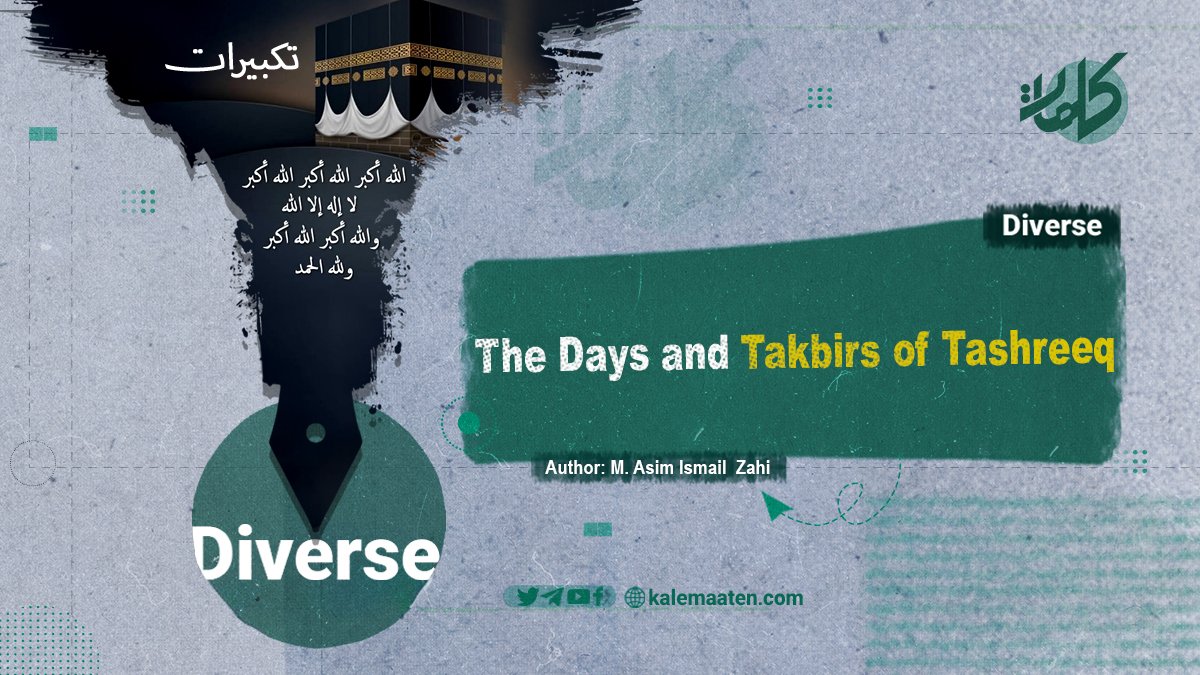
Author: M. Asim Ismail Zahi
The Days and Takbirs of Tashreeq
Abstract:
The recitation of the Takbir of Tashreeq and its manner has been passed down from Prophet Abraham, the Friend of Allah (peace and blessings be upon him and upon our Prophet). This tradition dates back to the time when Angel Jibrael (PBUH) approached Prophet Abraham (PBUH) with a sacrificial animal, while Prophet Abraham was preparing to sacrifice his son, Prophet Ismail (PBUH). Angel Jibrael feared that Prophet Abraham might carry out the sacrifice before he could reach him. Therefore, while approaching, he loudly proclaimed: «الله اکبر، الله اکبر» When Prophet Abraham, the Friend of Allah (PBUH), heard the call of Takbir from Angel Jibrael, he responded by saying: «لا اله الا الله و الله اکبر» When Prophet Ismail (PBUH) saw Angel Jibrael and the gift he had brought (the ram), and witnessed the actual sacrificial offering with his own eyes, he said: «الله اکبر و لله الحمد» Thus, this collection of invocations has been passed down to the Ummah of Muhammad from Prophet Abraham, the Friend of Allah (peace and blessings be upon him and upon our Prophet).
Introduction:
The Takbirat of Tashreeq are among the most important features of the day preceding and the days following the Eid al- Adha.
The days of Eid al-Adha commemorate the victory of the Friend of Allah (Abraham, PBUH) over Satan—how he triumphed in the divine trial of sacrificing his son. On one hand, he subdued all paternal emotions, and on the other, he overcame every whispering and deception of Satan in obedience to the command of Allah. He foiled Satan’s cunning plots and, by placing the knife on the tender throat of his only beloved son—more dear to him than his own life—demonstrated the truth of his servitude and the peak of his submission before the One and Only Lord.
Indeed, this was a victory of faith over disbelief, of monotheism over polytheism, and of light over darkness.
It is therefore only fitting that these days be considered the greatest, most honorable, and most spiritually stirring days in the history of all divine religions that followed Prophet Abraham (PBUH).
Undoubtedly, the Takbirat of Tashreeq during these days are meant to revive this memory, honor this victory, and renew the covenant with the Lord to continue following the path of Abraham (PBUH).
Etymology:
“Ayyam” (days) is the plural of “Yawm” (day), and “Tashreeq,” which is in the form of tafkīl, has several meanings: drying meat under the sun, making the face radiant and luminous, and turning towards the east (the direction of sunrise).
These days are named Ayyam al-Tashreeq (the Days of Tashreeq) because the Arabs used to cut the meat of their sacrificial animals into pieces and dry them in the sun. Alternatively, it may be because the pilgrims perform the sacrifice after the sun has risen. Or it could be due to the fact that, during these days, the spirit and soul of a person become illuminated by the light of worship and spiritual devotion.
Establishment of Takbirat in the Noble Qur’an:
The Days of Tashreeq (Ayyam al-Tashreeq) are not explicitly mentioned by name in the Noble Qur’an. However, other expressions are used that refer to these very days. One such verse is: “وَاذْكُرُوا اللَّهَ فِي أَيَّامٍ مَعْدُودَاتٍ” Translation: “And remember Allah during the appointed days.” (Surah Al-Baqarah, 2:203)
This phrase— “Ayyam Maʿdudat” (appointed days)—is interpreted by the majority of scholars to refer to the Days of Tashreeq.
Ibn Umar (may Allah be pleased with him) stated that the “appointed days” (Ayyām Maʿdudat) refer specifically to the Days of Tashreeq. The majority of scholars hold the same opinion.
Likewise, Imam al-Nasafi (MABH), in his commentary on this verse, says: “What is meant by the ‘days’ are the Days of Tashreeq (from the 9th to the 13th of Dhul-Ḥijjah), and what is meant by ‘remembering Allah’ during them is reciting the Takbirat of Tashreeq after the prayers and at the time of throwing the pebbles (Ramy al-Jamarat).”
Of course, reciting the Takbir after prayers applies to all Muslims in general, while saying it during the Ramy al-Jamarat is specific to the pilgrims of the House of Allah.
The Formula of the Takbirat of Tashreeq:
The phrase reported in many narrations is as follows: اللَّهُ أَكْبَرُ، اللَّهُ أَكْبَرُ، لَا إِلٰهَ إِلَّا اللَّهُ، وَاللَّهُ أَكْبَرُ، اللَّهُ أَكْبَرُ، وَلِلَّهِ الْحَمْدُ Translation: Allah is the Greatest, Allah is the Greatest. There is no god but Allah. And Allah is the Greatest, Allah is the Greatest, and to Allah belongs all praise.
Ruling on the Takbirat of Tashreeq:
According to the Hanafi school of thought, reciting these invocations after 23 obligatory prayers is wajib (compulsory) for every individual who performs a prescribed (farḍ) prayer—regardless of whether the prayer is offered in congregation or individually, by a man or a woman, by a resident or a traveller.
However, according to Imam al-Shafiʿi and Imam Ahmad ibn Hanbal (may Allah have mercy on them), reciting the Takbirat of Tashreeq after the five daily prayers is Sunnah (recommended, not obligatory). According to Imam Malik (MABH), it is mandub (commendable and desirable).
These Takbirat, being among the symbols (shaʿāʾir) of Islam, should be proclaimed loudly so that they may influence the hearts and transform the atmosphere.
Timing and Place for Reciting the Takbirat:
The Takbirat begin on the morning of the Day of ʿArafah (9th Dhul-Ḥijjah) and continue until the afternoon (ʿAṣr) of the fourth day of Eid (13th Dhul-Ḥijjah), to be recited after every obligatory (farḍ) prayer—whether in congregation or individually.
Ruling on the Takbirat in Other Days of the Ten and the Eid Days:
While the obligation to recite the Takbirat applies specifically to the Days of Tashreeq, Undoubtedly, reciting them frequently during the nights and days of this blessed ten-day period and the Eid—whether at home, in the mosque, in the market, or anywhere else—is highly desirable and recommended.
These days are essentially opportunities to renew our covenant with Allah, (SWT). Since most people are absorbed in worldly occupations—and such distractions often lead to heedlessness and spiritual confusion—the Merciful and All-Powerful Lord, through various opportunities, repeatedly draws us toward His nearness: sometimes through the night of salvation (Laylat al-Barāʾah), at other times through the fasts of Tāsūʿāʾ and ʿĀshūrāʾ, sometimes through the month of Ramadan, and now through the Days of Tashreeq.
Honoring these days strengthens our connection with Allah, the Exalted—and this connection is the foundation of all true happiness and success.
We are about to enter immensely valuable days—let us appreciate this priceless opportunity. Who knows how long we will live? Therefore, let us pay more attention to good deeds, repentance, and seeking forgiveness. Charity and giving in the path of Allah should be carried out with dedication.
May Allah grant all of us the ability to act upon these teachings. Ameen.


 By
