Close Menu
    Facebook X (Twitter) Telegram WhatsApp
    • Language
      • دری
      • پښتو
      • العربیة
    • Home
    • Analysis
    • Islam
      • Prophet of Islam (PBUH)
      • Holy Quran
      • Muslim
      • Belief
      • Faith
      • Worships
      • Fiqh
      • Jihad
      • Islamic Perspectives
      • Islamic Economics
      • Islamic Management
      • Islamic Culture
      • Sufism
      • Crimes
      • Prohibitions
      • Sayings of the Scholars
      • Muhajir Tafsir
      • Hadith
    • Religions
      • Judaism
      • Christianity
      • Buddhism
      • Hinduism
      • Zoroastrianism
      • Satanism
      • Confucianism
      • Sikhism
    • Theories
      • Atheism
      • Secularism
      • liberalism
      • Socialism
      • Communism
      • Democracy
      • Federalism
      • Fascism
      • Capitalism
      • Marxism
      • Feminism
      • Nationalism
      • Colonialism
      • Frankfurt School
      • Freemasonry
      • Humanism
    • Fitan
      • Mu’tazila
      • Murji’ah
      • Jahmiyyah
      • The Fitna of the Khawarij
      • The Fitna of the Rawafid
      • The Fitna of Orientalism
      • Ghamdism
      • The Fitna of the Qadianis
      • Qadariyyah
      • Karramiyyah
    • Ummah
      • Sahabah (Companions of the Prophet ﷺ)
        • Hazrat Abu bakr Siddiq (RA)
        • Hazrat Umar al-Faruq (RA)
        • Hazrat Uthman ibn Affan (RA)
        • Hazrat Ali (RA)
        • Hazrat Khalid ibn al-Walid (RA)
        • Hazrat Fayruz al-Daylami (RA)
        • Hazrat Abdullah ibn al-Zubayr (RA)
      • Ummahat al-Mu’minin
      • Islamic scholars
        • Allamah Sayyid Abul Hasan Ali Nadwi (RH)
        • Imam al-Aʿzam Abu Hanifa (RH)
        • Imam al-Bukhari (RH)
        • Imam al-Tirmidhi (RH)
        • Imam al-Ghazali (RH)
        • Shah Waliullah al-Dehlawi (RH)
        • Sayyid Jamal al-Din Afghani
        • Mawlana Jalal al-Din Muhammad Balkhi Rumi (RH)
      • Muslim Rulers
        • Sultan Salahuddin Ayyubi (RH)
        • Umar ibn Abd al-Aziz (RH)
        • Sultan Yusuf ibn Tashfin (RH)
      • Muslim Scientists
    • Civilizations
      • Islamic Civilization
      • Eastern and Western Civilizations
      • Traces of History
    • Diverse
      • Ramadan Message
      • Reports
      • Light and Darkness
    • library
    Facebook X (Twitter) Telegram WhatsApp Instagram Pinterest YouTube
    kalemaat Englishkalemaat English
    You are at:Home»Diverse»Telephone Etiquette (Part Two)
    Diverse

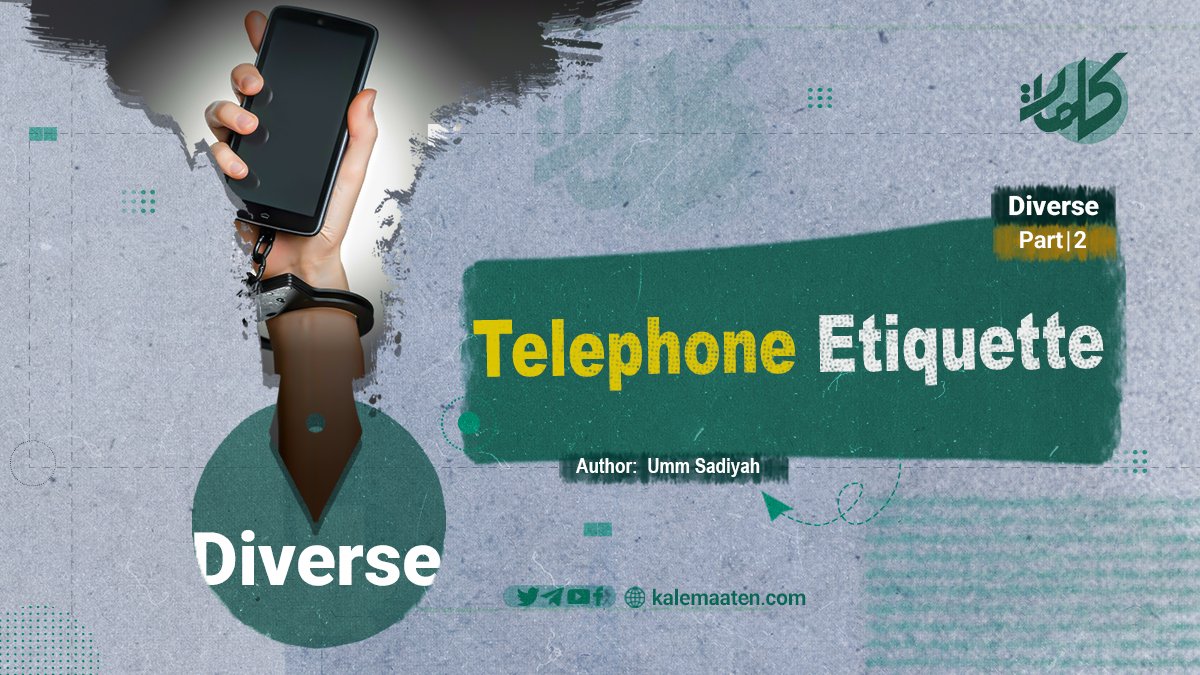
    Telephone Etiquette (Part Two)

    By 11/02/2025Updated:12/02/2025No Comments3 Mins Read
    Share Facebook Twitter Telegram WhatsApp
    Share
    Facebook Twitter Telegram Email WhatsApp

    Author: Umm Saadiyyah
    Telephone Etiquette (Part Two)
     Etiquette 3: not calling more than three times:
    This is on the part of the caller. The ringing of the telephone is like ringing the doorbell or knocking on the door. If the tradition is that one should not knock on the door more than three times, then the principle is that we should not let the telephone ring more than three times, because the people in the house are annoyed by the continuous ringing of the telephone while they do not want to answer, and the caller calls without interruption. Also, the repeated ringing of the telephone may cause harm to one of the people sleeping in the house, a sick person who needs rest, a baby or an elderly person, while it is not permissible to harm a Muslim. So it is correct not to call someone more than three times in a row, unless there is a necessity, such as when a person has to call back and forth to save his family or friend, or when he knows that the volume of the phone of the person he is calling is very low, or when he is aware that they will answer after several rings.
     Etiquette 4: the caller should start with a greeting:
    The caller is like someone knocking on the door; therefore, it is necessary for him to start with a greeting. Some people, when they hear the phone ringing (at home or in a library), pick up the phone and start with (Peace be upon you, the mercy of Allah and His blessings), which is against the principle; it is necessary for the caller to greet first according to the Sunnah; just like when someone knocks on the door, he should greet, not the homeowner.
    Etiquette 5: politeness is introducing the caller:
    The caller is like a visitor or a door knocker. As the Sunnah states that the door knocker should introduce himself. Similarly, the caller should introduce himself and say: Peace be upon you, the mercy of Allah and His blessings, I am so-and-so, the son of so-and-so. Or he should say: So-and-so is with you. Introduce himself so that the caller can get to know him.
    Etiquette 6: shortening the unnecessarily conversations:
    This is more common among women. As soon as a woman picks up the phone, she continues talking nonsense and talks about eating, drinking, clothes, prices, makeup, etc., which takes one to two hours. While all of this is unnecessary and should not be done, and in fact, this is a heavy burden on the caller who has to pay a very high bill, which is a waste of money and extravagance that Allah does not like. Allah the Almighty says: «إِنَّ الْمُبَذِّرِينَ كَانُوا إِخْوَانَ الشَّيَاطِينِ وَكَانَ الشَّيْطَانُ لِرَبِّهِ كَفُورًا» Translation: “Indeed, the spendthrifts are brothers of the devils, and Satan is an ungrateful to his Lord [1].”
    This is evidence that such a woman does not fear Allah and does not protect her husband’s wealth, which is not a characteristic of a Muslim and a righteous woman.

    Continues…

    Related Posts

    The Divine Education Model in the Family of the Prophets (Part 144)

    19/10/2026

    The Divine Education Model in the Family of the Prophets (Part 143)

    18/10/2026

    The Divine Education Model in the Family of the Prophets (Part 142)

    17/10/2026
    Leave A Reply Cancel Reply

    Follow us on the social media pages
    • Facebook
    • Twitter
    • Instagram
    • Telegram
    • WhatsApp
    Don’t miss

    Imam al-A‘zam Abu Hanifa (RA): The Role Model (part 36)

    Loyalty to One’s Teacher

    The Divine Education Model in the Family of the Prophets (Part 144)

    Who Is a Sufi?

    About Us:

    The Academic and Research Organization of Kalemaat is an independent Islamic Da'wah organization affiliated with Ahl al-Sunnah wa al-Jama'ah. It is dedicated to promoting the authentic values of Islam, advancing the higher objectives of the Sharia, countering Western cultural influence, upholding the Word of Allah, and contributing to the intellectual and spiritual awakening of the Muslim Ummah.

    The Organization is supported by Muslim philanthropists and businessmen, and it welcomes the cooperation and support of Muslims worldwide in advancing its mission.

    Famous publications

    Imam al-A‘zam Abu Hanifa (RA): The Role Model (part 36)

    20/10/2026

    Loyalty to One’s Teacher

    20/10/2026
    Follow us on social medias
    • Facebook
    • Twitter
    • YouTube
    • Telegram
    • Instagram
    • WhatsApp
    All right reserved by (kalemaat)
    • Home
    • Analysis of the day
    • The greats of the Ummah
    • library

    Type above and press Enter to search. Press Esc to cancel.