Close Menu
    Facebook X (Twitter) Telegram WhatsApp
    • Language
      • دری
      • پښتو
      • العربیة
    • Home
    • Analysis
    • Islam
      • Prophet of Islam (PBUH)
      • Holy Quran
      • Muslim
      • Belief
      • Faith
      • Worships
      • Fiqh
      • Jihad
      • Islamic Perspectives
      • Islamic Economics
      • Islamic Management
      • Islamic Culture
      • Sufism
      • Crimes
      • Prohibitions
      • Sayings of the Scholars
      • Muhajir Tafsir
      • Hadith
    • Religions
      • Judaism
      • Christianity
      • Buddhism
      • Hinduism
      • Zoroastrianism
      • Satanism
      • Confucianism
      • Sikhism
    • Theories
      • Atheism
      • Secularism
      • liberalism
      • Socialism
      • Communism
      • Democracy
      • Federalism
      • Fascism
      • Capitalism
      • Marxism
      • Feminism
      • Nationalism
      • Colonialism
      • Frankfurt School
      • Freemasonry
      • Humanism
    • Fitan
      • Mu’tazila
      • Murji’ah
      • Jahmiyyah
      • The Fitna of the Khawarij
      • The Fitna of the Rawafid
      • The Fitna of Orientalism
      • Ghamdism
      • The Fitna of the Qadianis
      • Qadariyyah
      • Karramiyyah
    • Ummah
      • Sahabah (Companions of the Prophet ﷺ)
        • Hazrat Abu bakr Siddiq (RA)
        • Hazrat Umar al-Faruq (RA)
        • Hazrat Uthman ibn Affan (RA)
        • Hazrat Ali (RA)
        • Hazrat Khalid ibn al-Walid (RA)
        • Hazrat Fayruz al-Daylami (RA)
        • Hazrat Abdullah ibn al-Zubayr (RA)
      • Ummahat al-Mu’minin
      • Islamic scholars
        • Allamah Sayyid Abul Hasan Ali Nadwi (RH)
        • Imam al-Aʿzam Abu Hanifa (RH)
        • Imam al-Bukhari (RH)
        • Imam al-Tirmidhi (RH)
        • Imam al-Ghazali (RH)
        • Shah Waliullah al-Dehlawi (RH)
        • Sayyid Jamal al-Din Afghani
        • Mawlana Jalal al-Din Muhammad Balkhi Rumi (RH)
      • Muslim Rulers
        • Sultan Salahuddin Ayyubi (RH)
        • Umar ibn Abd al-Aziz (RH)
        • Sultan Yusuf ibn Tashfin (RH)
      • Muslim Scientists
    • Civilizations
      • Islamic Civilization
      • Eastern and Western Civilizations
      • Traces of History
    • Diverse
      • Ramadan Message
      • Reports
      • Light and Darkness
    • library
    Facebook X (Twitter) Telegram WhatsApp Instagram Pinterest YouTube
    kalemaat Englishkalemaat English
    You are at:Home»Diverse»Telephone Etiquette (part One)
    Diverse

    Telephone Etiquette (part One)

    By 10/02/2025Updated:10/02/2025No Comments4 Mins Read
    Share Facebook Twitter Telegram WhatsApp
    Share
    Facebook Twitter Telegram Email WhatsApp
    Author: Umm Sadiyah
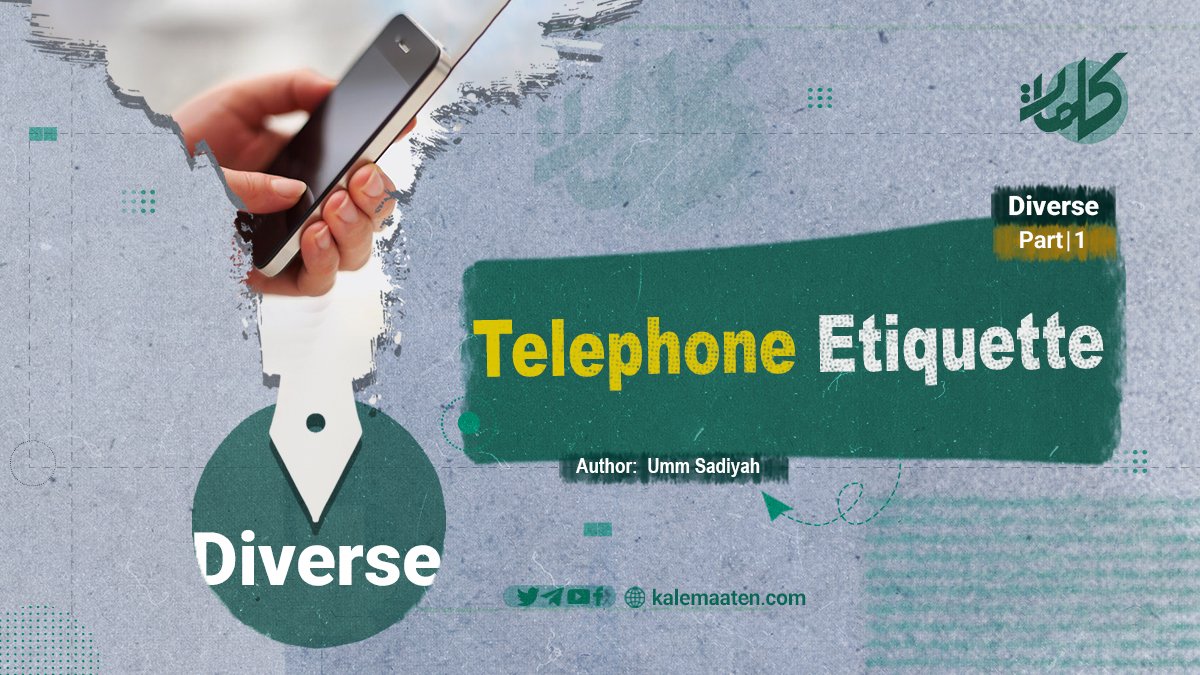
    Telephone Etiquette (part One)
    Abstract:
    The mobile phone is one of the prominent phenomena of the contemporary world, and its contribution to the cultural and social transformation of human society in the past hundred years has been to such an extent that the current era has been called the age of communications. Among the media in countries, the mobile phone is of particular importance due to its special nature, including its comprehensive coverage and ease of access and use. Lack of attention to the optimal and correct use of mobile phones has caused serious social and cultural problems and harms among people, which can definitely have negative consequences for society in the future.
    Therefore, an issue that is much more important than any new technology is the knowledge and culture of using it. If someone does not have the knowledge of using the most expensive device, that device is of no use to him. Imagine giving an expensive medical device to an illiterate person; the ultimate use he makes of it, is to level household items with it and put it under the closet and furniture. Therefore, the knowledge of using devices is of primary importance.
    Introduction:
    Since the mobile phone is a blessing from Allah Almighty for man, it has provided him with many conveniences, time and money and has brought distances closer. In a very few years, it has become possible for man to pick up the phone and talk to a friend or relative who lives in another country and get information from his relatives. He can pray for them by asking about their well-being, offer condolences on the death of a person and congratulate them on a happy occasion, do good to them by asking about the well-being of his parents and do many beneficial things through the mobile phone. Even buying and selling transactions and other matters can be done through it.
    Its benefits are many; for this reason, the mobile phone is a blessing from Allah Almighty that we must be grateful for. Gratitude for this blessing cannot be achieved except by interacting with it according to Islamic etiquette. This great and transcendent religion covers all aspects of a Muslim’s life without exception. Whoever adheres to these etiquettes has in fact fulfilled gratitude for the blessings of Allah Almighty, and whoever abandons them and does not act upon them as he deserves to be grateful for them, has shown disbelief and ungratefulness towards the blessings of Allah Almighty. Here, we will mention some etiquettes related to the telephone by the help of Allah Almighty, some of which are for the caller and some for the person answering the call, and some are etiquettes that are common to both.
    Part One, Etiquette for the Caller
    Etiquette 1: Good Intention:
    It is necessary for the caller to have good intentions when making a call. For example, when calling one’s parents, one should have the intention of rewarding them for their goodness, when calling one’s relatives, one should have the intention of maintaining ties of kinship, and when calling one’s friend, one should have the intention of loving him for the sake of Allah Almighty, because he pays for the call and dedicates time for this.
    Etiquette 2: Not making calls at inappropriate times:
    In fact, making a call on the phone is a kind of meeting with friends, although the two are different. Therefore, it is better not to call anyone unnecessarily in the middle of the night, early in the morning, and during the break before breakfast, because these are times when it is not recommended to meet unnecessarily. For this reason, if the phone rings in the morning or in the middle of the night, it annoys people, and they feel uncomfortable because their rest and sleep are disturbed. At these times, a person may respond while angry or with a hint of sadness in their voice, or a person may respond with a hint of sleep in their voice, all of which are undesirable. Therefore, it is better to call people at appropriate times, unless it is known that they will not be bothered by telephone communication at these times.

    Continues…

    Related Posts

    The Divine Education Model in the Family of the Prophets (Part 144)

    19/10/2026

    The Divine Education Model in the Family of the Prophets (Part 143)

    18/10/2026

    The Divine Education Model in the Family of the Prophets (Part 142)

    17/10/2026
    Leave A Reply Cancel Reply

    Follow us on the social media pages
    • Facebook
    • Twitter
    • Instagram
    • Telegram
    • WhatsApp
    Don’t miss

    Imam al-A‘zam Abu Hanifa (RA): The Role Model (part 36)

    Loyalty to One’s Teacher

    The Divine Education Model in the Family of the Prophets (Part 144)

    Who Is a Sufi?

    About Us:

    The Academic and Research Organization of Kalemaat is an independent Islamic Da'wah organization affiliated with Ahl al-Sunnah wa al-Jama'ah. It is dedicated to promoting the authentic values of Islam, advancing the higher objectives of the Sharia, countering Western cultural influence, upholding the Word of Allah, and contributing to the intellectual and spiritual awakening of the Muslim Ummah.

    The Organization is supported by Muslim philanthropists and businessmen, and it welcomes the cooperation and support of Muslims worldwide in advancing its mission.

    Famous publications

    Imam al-A‘zam Abu Hanifa (RA): The Role Model (part 36)

    20/10/2026

    Loyalty to One’s Teacher

    20/10/2026
    Follow us on social medias
    • Facebook
    • Twitter
    • YouTube
    • Telegram
    • Instagram
    • WhatsApp
    All right reserved by (kalemaat)
    • Home
    • Analysis of the day
    • The greats of the Ummah
    • library

    Type above and press Enter to search. Press Esc to cancel.