Close Menu
    Facebook X (Twitter) Telegram WhatsApp
    • Language
      • دری
      • پښتو
      • العربیة
    • Home
    • Analysis
    • Islam
      • Prophet of Islam (PBUH)
      • Holy Quran
      • Muslim
      • Belief
      • Faith
      • Worships
      • Fiqh
      • Jihad
      • Islamic Perspectives
      • Islamic Economics
      • Islamic Management
      • Islamic Culture
      • Sufism
      • Crimes
      • Prohibitions
      • Sayings of the Scholars
      • Muhajir Tafsir
      • Hadith
    • Religions
      • Judaism
      • Christianity
      • Buddhism
      • Hinduism
      • Zoroastrianism
      • Satanism
      • Confucianism
      • Sikhism
    • Theories
      • Atheism
      • Secularism
      • liberalism
      • Socialism
      • Communism
      • Democracy
      • Federalism
      • Fascism
      • Capitalism
      • Marxism
      • Feminism
      • Nationalism
      • Colonialism
      • Frankfurt School
      • Freemasonry
      • Humanism
    • Fitan
      • Mu’tazila
      • Murji’ah
      • Jahmiyyah
      • The Fitna of the Khawarij
      • The Fitna of the Rawafid
      • The Fitna of Orientalism
      • Ghamdism
      • The Fitna of the Qadianis
      • Qadariyyah
      • Karramiyyah
    • Ummah
      • Sahabah (Companions of the Prophet ﷺ)
        • Hazrat Abu bakr Siddiq (RA)
        • Hazrat Umar al-Faruq (RA)
        • Hazrat Uthman ibn Affan (RA)
        • Hazrat Ali (RA)
        • Hazrat Khalid ibn al-Walid (RA)
        • Hazrat Fayruz al-Daylami (RA)
        • Hazrat Abdullah ibn al-Zubayr (RA)
      • Ummahat al-Mu’minin
      • Islamic scholars
        • Allamah Sayyid Abul Hasan Ali Nadwi (RH)
        • Imam al-Aʿzam Abu Hanifa (RH)
        • Imam al-Bukhari (RH)
        • Imam al-Tirmidhi (RH)
        • Imam al-Ghazali (RH)
        • Shah Waliullah al-Dehlawi (RH)
        • Sayyid Jamal al-Din Afghani
        • Mawlana Jalal al-Din Muhammad Balkhi Rumi (RH)
      • Muslim Rulers
        • Sultan Salahuddin Ayyubi (RH)
        • Umar ibn Abd al-Aziz (RH)
        • Sultan Yusuf ibn Tashfin (RH)
      • Muslim Scientists
    • Civilizations
      • Islamic Civilization
      • Eastern and Western Civilizations
      • Traces of History
    • Diverse
      • Ramadan Message
      • Reports
      • Light and Darkness
    • library
    Facebook X (Twitter) Telegram WhatsApp Instagram Pinterest YouTube
    kalemaat Englishkalemaat English
    You are at:Home»Refinement and Civilization»Islamic Civilization»The Role of Muslims in the Formation and Development of Sciences (Part 6)
    Islamic Civilization

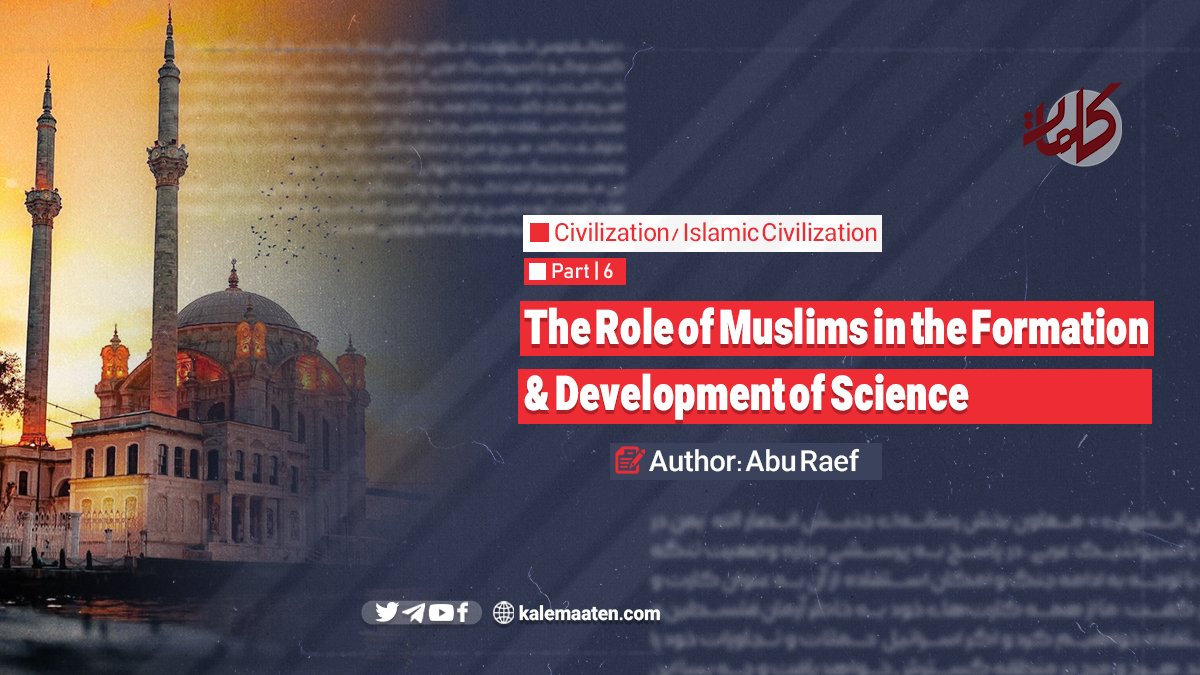
    The Role of Muslims in the Formation and Development of Sciences (Part 6)

    By 15/12/2024No Comments4 Mins Read
    Share Facebook Twitter Telegram WhatsApp
    Share
    Facebook Twitter Telegram Email WhatsApp
    Author: Abu Raef
    The Role of Muslims in the Formation and Development of Sciences (Part 6)
    The Role of Muslims in Medical Sciences
    Paying attention to the sciences that have been the basic and main needs of Muslims has always been a top priority for them, and they have made indescribable efforts to study and acquire them, considering the religious teachings and commands of the Holy Prophet of Islam (peace and blessings of Allah be upon him). One of these sciences is medicine, along with all its branches. This discipline, which is one of the most important fields for the survival of the human race and the well-being of nations, was given special attention during the era of the Holy Prophet of Islam and subsequently during the times of the Islamic caliphs and Muslim leaders. Medicine acquired a privileged place among the sciences essential to Muslims.
    The Commands of the Holy Prophet of Islam (PBUH) Regarding Medicine
    The Holy Prophet of Islam (peace and blessings of Allah be upon him) addressed medical issues and the treatment of diseases in various hadiths. When he migrated to Medina, sick and ailing individuals would come to him seeking healing. He would pray for their recovery and say: “O servants of Allah! Treat yourselves, for Allah has not sent any disease except that He has also sent its cure.”
    In another hadith, the Prophet (peace and blessings of Allah be upon him) stated: “Healing is in three things: cupping, drinking honey, and cauterization with fire, but I forbid my nation from cauterization with fire.”
    It is narrated that he recommended the preparation of “Talbinah” (a soup-like dish) and regarded it as beneficial for the sick and those who are depressed or saddened. He said: “Talbinah strengthens the heart of the sick and alleviates sadness and grief.”
    In a different hadith, it is mentioned: “Mushrooms are a food from the food of manna (the food that was provided to the Children of Israel), and their water is beneficial for healing the eyes.” Regarding treating fever, it has been said: “Fever is from the tongue of Hell, so extinguish it with water.”
    To value medicine and avoid superstitions associated with it, Islam forbids practices such as putting amulets on animals, branding them, tattooing, fortune-telling, astrology, and other common superstitions. Accordingly, the Prophet (peace and blessings of Allah be upon him) differentiated between a sorcerer and a physician, stating: “Whoever goes to a sorcerer or a fortune-teller and believes in what they say has disbelieved in what was revealed to Muhammad.” This distinction underscores the difference between the physician’s role and the practices of superstitious individuals like sorcerers and fortune-tellers.
    Islam articulates a significant scientific truth: there is no disease without a cure. The absence of knowledge regarding certain diseases is attributed to human inaction and a lack of effort to expand our understanding; therefore, we must strive to find cures.
    Islam also emphasizes personal hygiene as a means of protecting health and considers it a complement to faith. The Prophet (peace and blessings of Allah be upon him) stated: “Cleanliness is part of faith.” Consequently, Islam has raised the issue of purity and impurity, identifying various phenomena and substances as impure and forbidden, including pus, bile, vomit, saliva of dogs and other predatory animals, pork, and anything that emanates a foul odor.
    Islam has set stringent conditions for purifying impure objects, such as washing them multiple times, boiling them in water, burning them with fire, and allowing them to dry. Furthermore, it is mandatory to clean each part of the body to prevent impurity from affecting other parts; for example, the Prophet of Allah (peace and blessings of Allah be upon him) ordered the cutting of nails to prevent dirt and impurity from accumulating beneath them.

    Continues …

    Related Posts

    The Role of Muslims in the Formation and Development of the Science (the 86th and final part)

    10/12/2025

    The Role of Muslims in the Formation and Development of Science (part 85)

    06/12/2025

    The Role of Muslims in the Formation and Development of Sciences (Part 84)

    01/12/2025
    Leave A Reply Cancel Reply

    Follow us on the social media pages
    • Facebook
    • Twitter
    • Instagram
    • Telegram
    • WhatsApp
    Don’t miss

    The Divine Education Model in the Family of the Prophets (Part 145)

    Imam al-A‘zam Abu Hanifa (RA): The Role Model (part 39)

    Imam al-A‘zam Abu Hanifa (RA): The Role Model (part 38)

    The Reminder of Death

    About Us:

    The Academic and Research Organization of Kalemaat is an independent Islamic Da'wah organization affiliated with Ahl al-Sunnah wa al-Jama'ah. It is dedicated to promoting the authentic values of Islam, advancing the higher objectives of the Sharia, countering Western cultural influence, upholding the Word of Allah, and contributing to the intellectual and spiritual awakening of the Muslim Ummah.

    The Organization is supported by Muslim philanthropists and businessmen, and it welcomes the cooperation and support of Muslims worldwide in advancing its mission.

    Popular Publications

    The Importance of Security in Islam (Part 18)

    13/11/2024

    Secularism (Part 19)

    25/07/2024

    The Quran; A Miracle Beyond Time – A Study of Its Miraculous Nature (Part 8)

    23/07/2025
    Follow Us on Social Media
    • Facebook
    • Twitter
    • YouTube
    • Telegram
    • Instagram
    • WhatsApp
    All right reserved by (kalemaat)
    • Home
    • Analysis of the day
    • The greats of the Ummah
    • library

    Type above and press Enter to search. Press Esc to cancel.